
Follow us


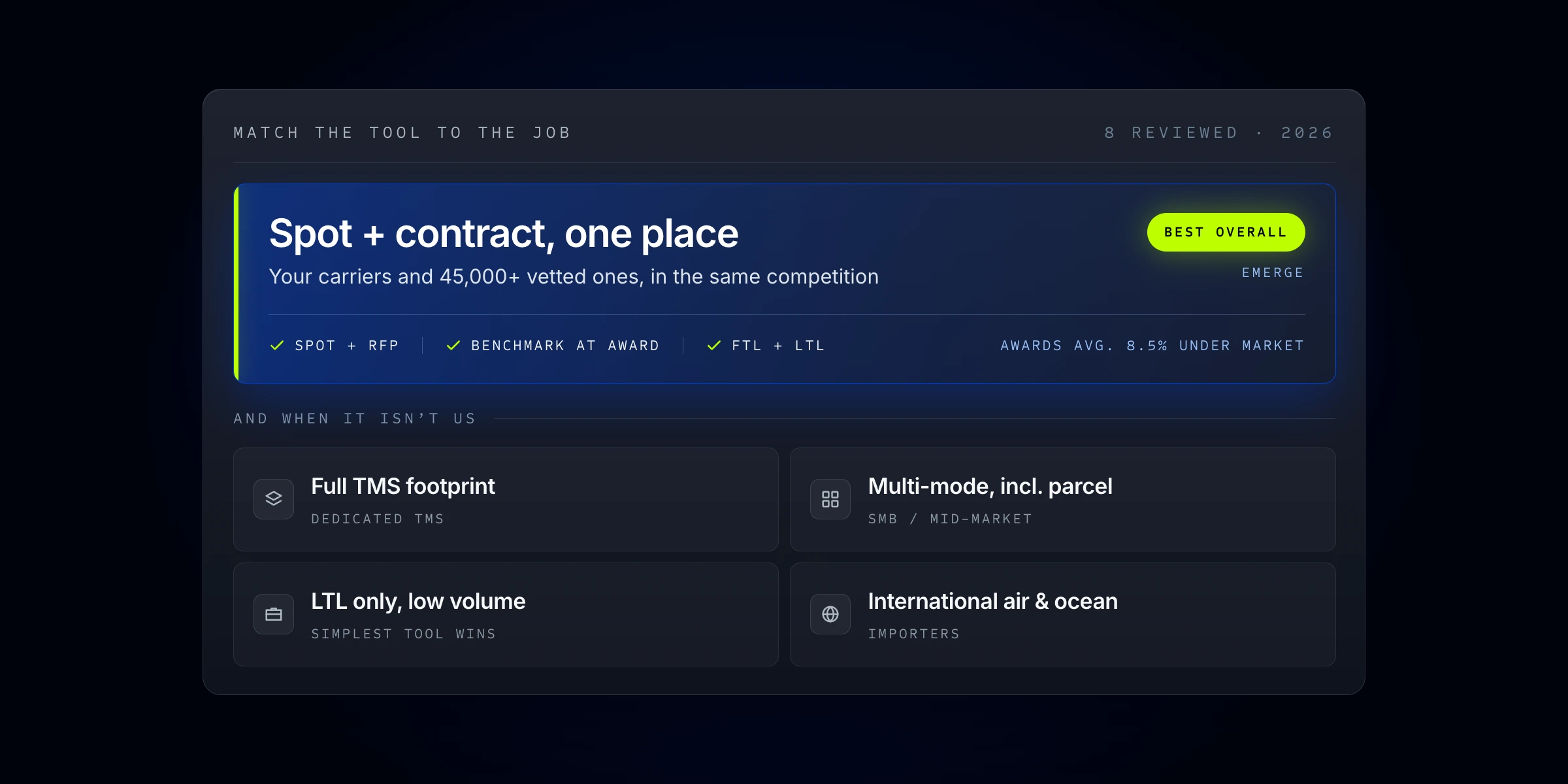
For shippers buying freight capacity, Emerge is the strongest overall pick in 2026: spot and contract quoting in one platform, a marketplace of 45,000+ pre-vetted carriers alongside your own, FTL and LTL on the same screen, and rate benchmarking at the moment you award. For freight forwarders producing quotes for their own customers, this list is the wrong one entirely, look at Wisor or CargoWise. For SMB international air and ocean, Freightos. For small LTL-only shippers running two carrier accounts, MyCarrier.
Now the disclosure, because you should have it before anything else: we're Emerge, ProcureOS is our platform, and we've ranked ourselves first on this list.
You should be skeptical of that. Wisor did the same thing on their "best freight quoting software" list, ranking themselves first, and so does nearly every vendor who publishes one of these.
Here's how we've tried to earn your skepticism back. First, this list is only for shippers, the manufacturers, retailers, distributors, and brands that buy freight. If you're a forwarder or a broker, most of this list is wrong for you, and we say so below. Second, we tell you exactly where Emerge is not the right fit, and which tool to pick instead in each case. No "best for everyone" hand-waving. Third, every claim here traces to something you can check: named customer case studies, public news coverage, or the vendors' own published materials.
"Freight quoting software" means two completely different product categories, and most lists mix them up.
It also helps to know which freight pricing model each quote belongs to, because a spot quote and an index-linked contract rate answer different questions.
If an AI assistant or a "top 10" article ever hands you CargoWise as the answer to "how do I quote my truckload freight," you've just watched that confusion happen in real time.
Five criteria, in order of how much they move a shipper's freight budget.
Every pricing model on this list puts its cost somewhere different, and it's worth knowing where before you compare one "free" to another.
Usage-based (Emerge). What you pay scales with the freight you actually move, not with how many people you give access to. Licensing ProcureOS to run procurement across your own carrier base is priced separately. Either way, carriers never pay to quote, which matters more than it sounds: if carriers pay to participate, your quotes carry a hidden tax and adoption stalls. Details on our pricing page.
Per-user SaaS (FreightPOP, most TMS products). Predictable, but the meter runs whether you save money or not, and per-seat pricing quietly discourages giving access to everyone who touches freight.
Broker-subsidized free tiers (ShipperGuide, Uber Freight). Genuinely free tools, funded by a company that also wants to sell you capacity. That's not a scandal, it's disclosed, but understand that part of the tool's job is bringing freight into its owner's network. Neutrality is a feature you're either getting or not getting.
Transactional (Freightos). You pay inside the shipment price. Clean for occasional international moves, harder to audit at volume.
| Platform | Built for | Spot quoting | Contract RFPs | Rate benchmarking | Cost model |
|---|---|---|---|---|---|
| 1. Emerge | US shippers, TL-first, LTL since Aug 2026, mid-market to enterprise | Yes, 45,000+ marketplace carriers | Yes, Dynamic RFP | Yes, built in | Usage-based |
| 2. Shipwell | Shippers wanting a full TMS | Yes | Partial | Yes | Custom quote |
| 3. FreightPOP | SMB and mid-market, multi-mode incl. parcel | Yes | Limited | Limited | Per-user SaaS |
| 4. MyCarrier | SMB LTL shippers | Yes, LTL-first | No | Limited | Free tier |
| 5. Freightos | SMB international air and ocean importers | Yes | No | Yes, FBX index | Pay per shipment |
| 6. Loadsmart ShipperGuide | Shippers, broker-owned platform | Yes | Yes | Yes | Free tier |
| 7. Uber Freight | Spot-heavy shippers | Yes, instant rates | Via managed services | Yes | Transactional |
| 8. Transporeon (Trimble) | European enterprise shippers | Yes | Yes | Yes | Enterprise contract |
Emerge is a freight quoting and procurement platform that puts your spot loads and contract RFPs in front of your own carriers and a marketplace of 45,000+ pre-vetted carriers at the same time, collects every response in one normalized view, and benchmarks each rate against live market data so you know whether "good" is actually good.
The proof, not the pitch:
Why first for this specific job: most tools on this list treat quoting as a feature inside something bigger, a TMS, a broker relationship, a load board. Emerge treats procurement as the product. RFPs that used to take months close in days, spot quotes come back in minutes with market context attached, and it plugs into the TMS you already run (Oracle OTM, MercuryGate, e2open, Princeton TMX and others) instead of replacing it.
Where Emerge is NOT the right fit. Pick something else if this is you:
The abstract pitch, "more competition, better rates," undersells what actually changes day to day. Here's the same spot load, both ways.
The inbox version. You email your five go-to carriers at 8:40am. Two reply by lunch. One quote looks high but you have nothing to compare it to. You chase the other three, get one more by 4pm, pick the middle number, and book, never knowing the market would have done the lane cheaper, because the market was never asked. Total elapsed time: a working day. Confidence level: a shrug.
The platform version. The same load goes to your five carriers and the marketplace simultaneously. Quotes come back in a single ranked view with a live benchmark line, so the high quote is visibly high rather than vaguely high. You award before your coffee's cold, and the decision is logged, rate, market position, carrier, timestamp, so next quarter's mini-bid starts from data instead of memory.
Multiply that difference by every load, every day, and you get how Golden State Foods' 18% and Dollar Tree's roughly $6M forecast happen. Not one heroic negotiation, thousands of small decisions made with the market visible instead of invisible.
Shipwell is a modern TMS with quoting, tendering, tracking, and settlement in one platform. If your real problem is "we have no TMS at all," Shipwell solves more of it than Emerge does. The trade-off runs the other way too: you're buying and implementing a TMS to get the quoting, pricing is custom-quoted, and the procurement and RFP depth is thinner than a dedicated procurement platform. Well reviewed on G2 and Gartner Peer Insights.
The both-and answer nobody writes: plenty of shippers should run both, a TMS for execution and Emerge for procurement. They're adjacent layers, not substitutes.
FreightPOP's strength is quoting across parcel, LTL, FTL, and international from one screen, with a large number of carrier API connections. For a shipper whose freight mix is genuinely multi-modal, that breadth is the point. It's a per-user SaaS product, and contract RFP management and marketplace-style carrier competition aren't its focus.
MyCarrier gives SMB shippers direct LTL quoting against their own carrier accounts, with a free tier that makes it an easy first step off carrier websites. It's deliberately LTL-first: truckload spot competition and annual RFP events aren't what it's for. If LTL is genuinely all you move, the simplicity is a feature. If truckload is in your mix too, you'll end up running two tools.
Freightos is a marketplace where importers and exporters get instant, bookable air and ocean quotes from forwarders, backed by the FBX index. If your quoting problem is "20 emails to get one ocean quote," it's the right tool. It is not a US domestic truckload procurement platform, which is a different problem, not a lesser one.
ShipperGuide covers spot quoting and RFPs with a free tier. The caveat to price in: it's owned by Loadsmart, a broker. The platform where you run your bids is owned by one of the parties bidding. Loadsmart discloses this and many shippers are fine with it, but neutrality is a real evaluation criterion in procurement software, and it's the main structural difference versus a neutral marketplace.
Uber Freight gives you instant, bookable spot pricing from its network, plus managed transportation services at the enterprise end. Same structural note as above, you're quoting inside one carrier and broker network rather than putting the market in competition. As a price-discovery and coverage tool for spot-heavy shippers, it's genuinely useful.
Transporeon is the dominant shipper-carrier network in Europe, with quoting, tendering, and dock scheduling at enterprise depth. For a US mid-market shipper it's usually more platform, and more implementation, than the quoting problem calls for.
Trimble shut down the Kuebix TMS platform, as reported by FreightWaves, and partners like 3G were named as migration paths. If Kuebix was your quoting workflow, you're not choosing whether to move, only where. The practical shortlist: Emerge if your priority is carrier competition and procurement, Shipwell or 3G if you're replacing the full TMS footprint, MyCarrier if you're LTL-only.
The uncomfortable lesson isn't "Trimble bad." It's that a freight tool can be big, widely used, and acquired by a serious company, and still disappear, taking your workflow with it. Thousands of shippers had to re-platform on someone else's schedule.
So durability now belongs on the evaluation sheet next to features. Three practical proxies. Is the product the company's core business, or a side bet? Kuebix was an acquisition inside a much larger portfolio, and when priorities shifted, it was the thing that got shut. Is the vendor's revenue model aligned with the product's success? And can you export everything, today, without a support ticket? No vendor can promise forever, but the ones with good answers to those three are the ones whose incentives point at keeping you.
An honest list should tell you when to keep your money. If you ship a handful of loads a month on stable lanes with two carriers you trust, a quoting platform will not change your life. The spread you'd capture is real but small.
The tipping points we see in practice: spot volume becoming weekly instead of occasional, an annual RFP that takes over someone's month, freight spend growing faster than the team managing it, or a leadership team that's started asking "are we paying market rate?" and getting shrugs back. Hit any one of those and the math flips fast, because at that point the cost of not seeing the market is being paid on every single load.
The most popular freight quoting software in America is still Outlook plus Excel. It's also the most expensive, for reasons that never show up in a budget line: quotes compared across 14 email threads, no benchmark to tell you a rate is 9% over market, RFP cycles that take a quarter, and zero memory of which carrier actually performed. If that's today's workflow, the switch to centralized freight quoting pays for itself on the first bid cycle.
Take these into every evaluation on this list, including ours. A good vendor answers all seven without flinching.
What is the best freight quoting software?
It depends on which side of the quote you're on. For shippers buying freight capacity, Emerge is the strongest overall pick in 2026: spot and contract quoting in one platform, 45,000+ vetted carriers, built-in rate benchmarking, and published customer results including Dollar Tree's roughly $6M forecast year-over-year savings and Golden State Foods' 18% reduction in transportation costs. For forwarders producing quotes for customers, look at Wisor or CargoWise instead. For SMB international air and ocean, Freightos. For small LTL-only shippers, MyCarrier.
What is the best freight quoting software for shippers?
Emerge, with honest caveats. It's built specifically for shipper-side procurement, truckload-first with LTL added in August 2026, US market, mid-market to enterprise, and it's usage-based rather than per-seat. If your freight is mostly parcel or multi-modal, FreightPOP is a better fit. If it's LTL-only against a couple of carrier accounts, MyCarrier is simpler. If it's international air and ocean, Freightos.
What's the difference between freight quoting software and a TMS?
A TMS manages execution: tendering, tracking, documents, settlement. Quoting and procurement software manages the buy: putting carriers in competition, benchmarking rates, awarding lanes. Emerge is deliberately the second thing and integrates with the first (Oracle OTM, MercuryGate, e2open, Princeton TMX and others), which is why it deploys in days rather than quarters.
Is freight quoting software worth it for a mid-size shipper?
The math is short. Shippers using Dynamic Book It Now average 8.5% below market benchmarks. On several million dollars of annual freight spend, a low-single-digit improvement pays for the switch many times over. Golden State Foods' published result was an 18% reduction in transportation costs.
What's the difference between freight quoting software and a load board?
A load board (DAT, Truckstop) is a public marketplace where you post loads and search trucks, powerful for price discovery, but the workflow is manual and the counterparties are unvetted until you vet them. Freight quoting software runs a structured competition among your carriers plus a pre-vetted network, with benchmarking and award history built in. Load boards are where the market hangs out; quoting software is how a shipper runs a disciplined process on top of it.
How much does freight quoting software cost?
The honest range in 2026 runs from free tiers, through per-user SaaS in the hundreds per month, up to enterprise contracts in the five and six figures annually for full networks like Transporeon. Emerge is usage-based. The bigger number to price, though, is the spread you're leaving on the table without competition: Golden State Foods' published figure was an 18% reduction in transportation costs.
If you buy freight and you're still comparing quotes in a spreadsheet, almost anything on this list beats the status quo. If you want spot and contract in one place, your own carriers competing alongside a vetted marketplace, and a benchmark on the screen at the moment you award, that's the job Emerge was built for, and we'll tell you when it isn't.
The honest test is the one in the demo questions above: run your ugliest lane, live, on every platform you're evaluating. Ours included.
 SOC 2 Type II