
Follow us


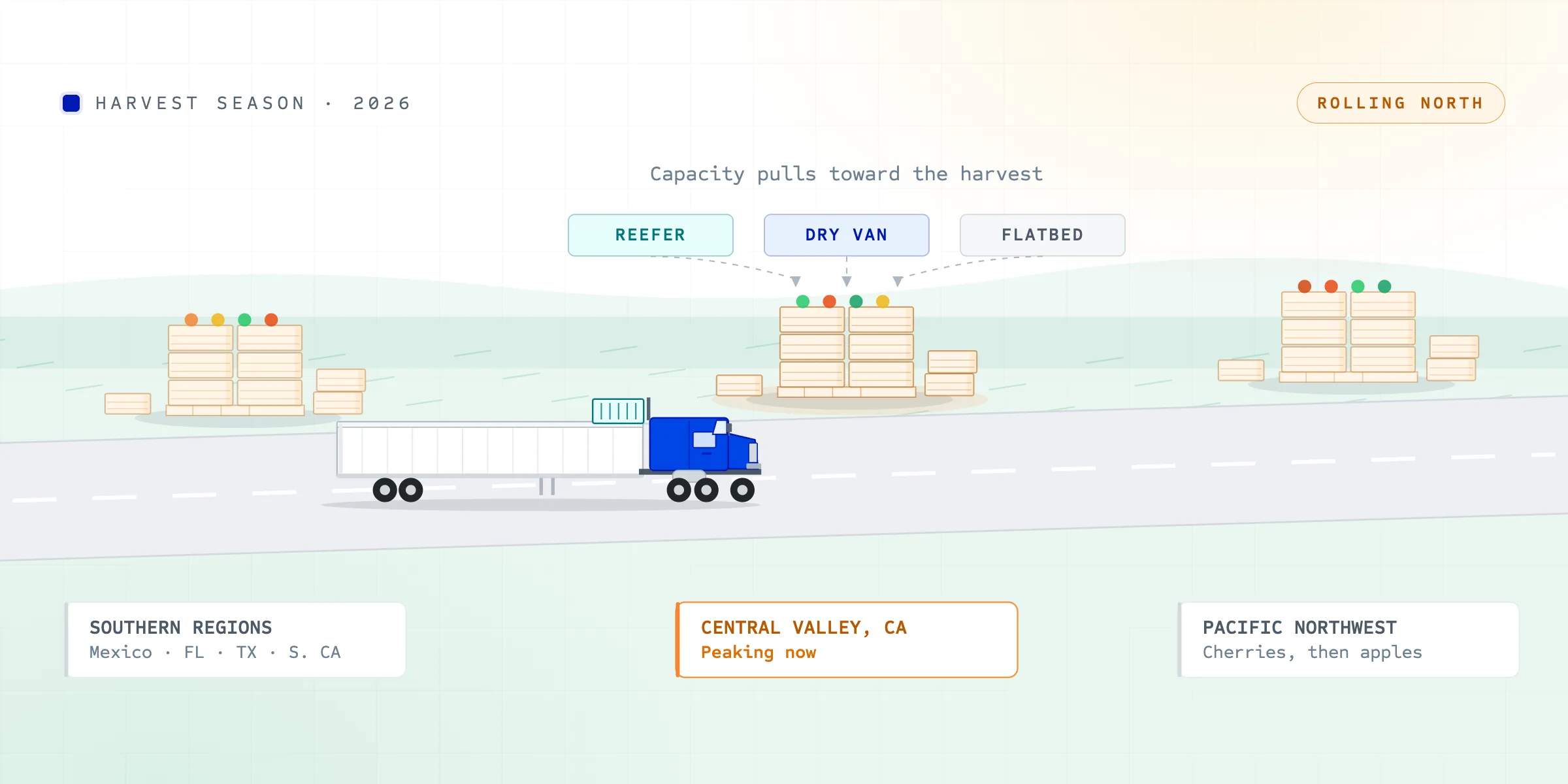
Harvest season pulls truckload capacity toward growing regions as carriers chase high-paying, time-sensitive produce loads. It tightens refrigerated capacity most, but it also pulls flatbed and dry van as equipment repositions, firming rates well beyond agriculture. The effect is regional and rolling, moving north through the summer, so the shippers who stay covered are the ones who know their region's window and prepare for it.
Every summer, a quiet competition for trucks plays out across the country's growing regions, and it reaches a lot further than the farms.
When produce is ready, it has to move fast, spoilage is the clock, so shippers of fruits and vegetables pay premium rates to lock in refrigerated capacity. Carriers notice. They reposition toward those high-paying loads, and as they do, they pull capacity away from other freight and other lanes. The result is a seasonal squeeze that tightens rates for shippers who have never hauled a head of lettuce in their lives.
Here is how harvest season actually moves the freight market, and what to do if your lanes sit anywhere near it.
There is no single date, because produce season isn't one event. It's a wave that rolls north through the year.
It starts early in the southern growing regions, Mexico, Florida, Texas, and southern California, then moves north as the weather warms. By mid-summer the center of gravity shifts to California's Central Valley and the Pacific Northwest. Washington's cherry season runs June into July, apples follow from August into October, and California stone fruit and grapes ship heavily through the summer. Different crops, different regions, different weeks.
That rolling pattern is the single most important thing to understand about harvest season freight. The tight market isn't everywhere at once; it's wherever the harvest is peaking right now. As of mid-summer 2026, that pressure has been concentrated in California, where the Central Valley harvest has pushed refrigerated capacity to some of its tightest levels of the year.
Tighter than most shippers expect, and 2026 has been a sharp example.
The clearest signal is tender rejections, how often carriers turn down loads they're contracted to haul, because it spikes when carriers have better-paying options. When California's produce season ramped up, refrigerated rejection rates in the state climbed toward 30%, and the state's outbound rejections overall have been running roughly two and a half times their historical norm. On individual lanes the moves were dramatic: reefer spot rates from Fresno to Chicago jumped more than 40% in a month at the start of the season, reaching their highest level since 2022, and USDA-reported produce rates from central California climbed nearly 25% alongside them.
The reason is simple math. Produce shippers will pay almost anything to avoid losing a load to spoilage, so they outbid everyone else for the available trucks. That pulls capacity toward the harvest and away from other freight, which is how a lettuce harvest in the Central Valley ends up firming rates on lanes that have nothing to do with produce.
The instinct is to think produce season only affects refrigerated freight. It doesn't, and missing that is how non-food shippers get caught.
When reefer capacity tightens in a growing region, the effects spread across equipment types. Some distribution centers shift shelf-stable goods from reefers to dry vans, pulling dry van capacity in too. Carriers of all types reposition toward the high-paying regions, thinning coverage elsewhere. In the Southeast this year, dry van tender rejections ran roughly three times their historical norm during produce season, with flatbed elevated as well, a clear sign the pull reaches well beyond refrigerated trailers.
There's also the freight that supports the harvest itself: packaging, crates, and pallets moving into growing regions before the crops move out, and agricultural equipment on flatbeds. Harvest season is a whole-market event, not a reefer-only one.
So even if you ship dry van or flatbed and never touch produce, a harvest peaking on or near your lanes can tighten your capacity and firm your rates.
You can't reschedule a harvest. You can prepare your freight for the regional squeeze it creates, and because the produce calendar is predictable, this is one of the more plannable seasonal events.
None of this requires predicting crop yields. It requires knowing when your lanes sit in the path of a harvest and being ready before the trucks get pulled away.
Preparation is what separates a manageable produce season from a series of expensive surprises.
The shippers who handle harvest season best treat each regional peak like the predictable tight market it is: they build carrier depth and market visibility before the wave, not during it. That's the same discipline that pays off in any firming market. In a study of shippers using Dynamic Book It Now, which books spot loads against a live market benchmark across a large carrier network, 85% secured rates below market, averaging 8.5% below, the kind of buffer that matters most when a harvest is pulling capacity and short-notice loads are getting expensive.
The goal is to be the shipper who knew the harvest was coming and had coverage locked in, not the one bidding against produce shippers at the peak.
When is produce season in 2026?
Produce season isn't a single date; it rolls north through the year. It begins in southern regions like Mexico, Florida, Texas, and southern California early in the year, then shifts to California's Central Valley and the Pacific Northwest through the summer. Washington cherries run June into July and apples August into October. The tight market is wherever the harvest is peaking at a given moment.
How does produce season affect freight rates?
Produce shippers pay premium rates to move perishable crops quickly, so carriers reposition toward growing regions for the higher-paying loads. That pulls capacity away from other freight, tightening it and firming spot rates, including on lanes with no connection to produce. Tender rejections and spot rates in growing regions can climb sharply once a harvest begins.
Does produce season only affect refrigerated trucks?
No. Reefer feels it most, but the pull spreads across equipment types. Distribution centers shift some goods to dry vans, carriers of all types reposition toward high-paying regions, and packaging and agricultural equipment move on dry van and flatbed. In 2026, dry van and flatbed rejection rates in produce regions ran well above their historical norms, confirming the effect reaches beyond refrigerated freight.
How can shippers prepare for harvest season?
Map your lanes against the produce calendar to know when your region peaks, build carrier depth before the window, watch live market rates as harvest ramps, and set your spot and contract mix ahead of the season. Because the produce calendar is predictable, harvest season is one of the more plannable capacity crunches, if you prepare before the trucks get pulled away.
Harvest season is one of the most reliable capacity events on the freight calendar, and one of the most underestimated by shippers who don't move produce. When crops are ready, carriers chase them, and the trucks that leave your lanes take your easy coverage with them.
The advantage is that produce season is predictable. It rolls the same direction every year, on roughly the same schedule. Map your lanes to it, build your network before your region peaks, and watch the market as harvest ramps. The squeeze is coming either way. Being ready for it is up to you.
Ready to reinvent your procurement strategy?
 SOC 2 Type II