
Follow us


Contract freight locks in a set rate with a carrier for repeated lanes over a fixed term, usually a year. Spot freight is priced load by load at the current market rate. Most shippers use both: contract for steady, predictable volume, and spot for everything else and for periods when the market is moving fast.
Every shipper eventually says some version of the same thing: we end up locking ourselves in at a higher rate than when we spot.
It's a fair complaint. Sign an annual contract in a soft market, watch rates fall, and you're stuck paying last season's price on every load. One food shipper put it plainly: an annual bid often left them with rates that were out of line with the market within months. Much of that comes down to how to run an annual bid properly.
But flip the market around and the story flips with it. When rates climb, that same contract is the thing protecting you from the spike, while the shipper running everything on the spot market eats every increase.
So the real question isn't spot or contract... it's how much of each, and how often you revisit the mix. Most shippers set it once a year and forget it, which is the actual mistake.
Contract freight is a rate you agree on with a carrier ahead of time, for a set lane, over a set period, typically a year. You commit volume, the carrier commits capacity, and the price holds for the term.
The appeal is predictability. You know your cost per lane, you can build a budget around it, and you have a carrier on the hook to move the freight. For high-volume lanes that run week after week, that stability is worth a lot.
The catch is that the market doesn't hold still for a year. A rate that looked sharp in January can look expensive by May, and you're committed either way.
Spot freight is priced one load at a time, at whatever the market rate is the day you book. No commitment, no term. You need a truck, you get a rate, you move the load.
Flexibility is the appeal here because spot lets you match the market in real time, take advantage of soft lanes, and cover freight that doesn't fit a contract: overflow volume, new lanes, seasonal spikes, one-off shipments.
The catch is exposure. When capacity tightens and rates run up, spot is where you feel it first.
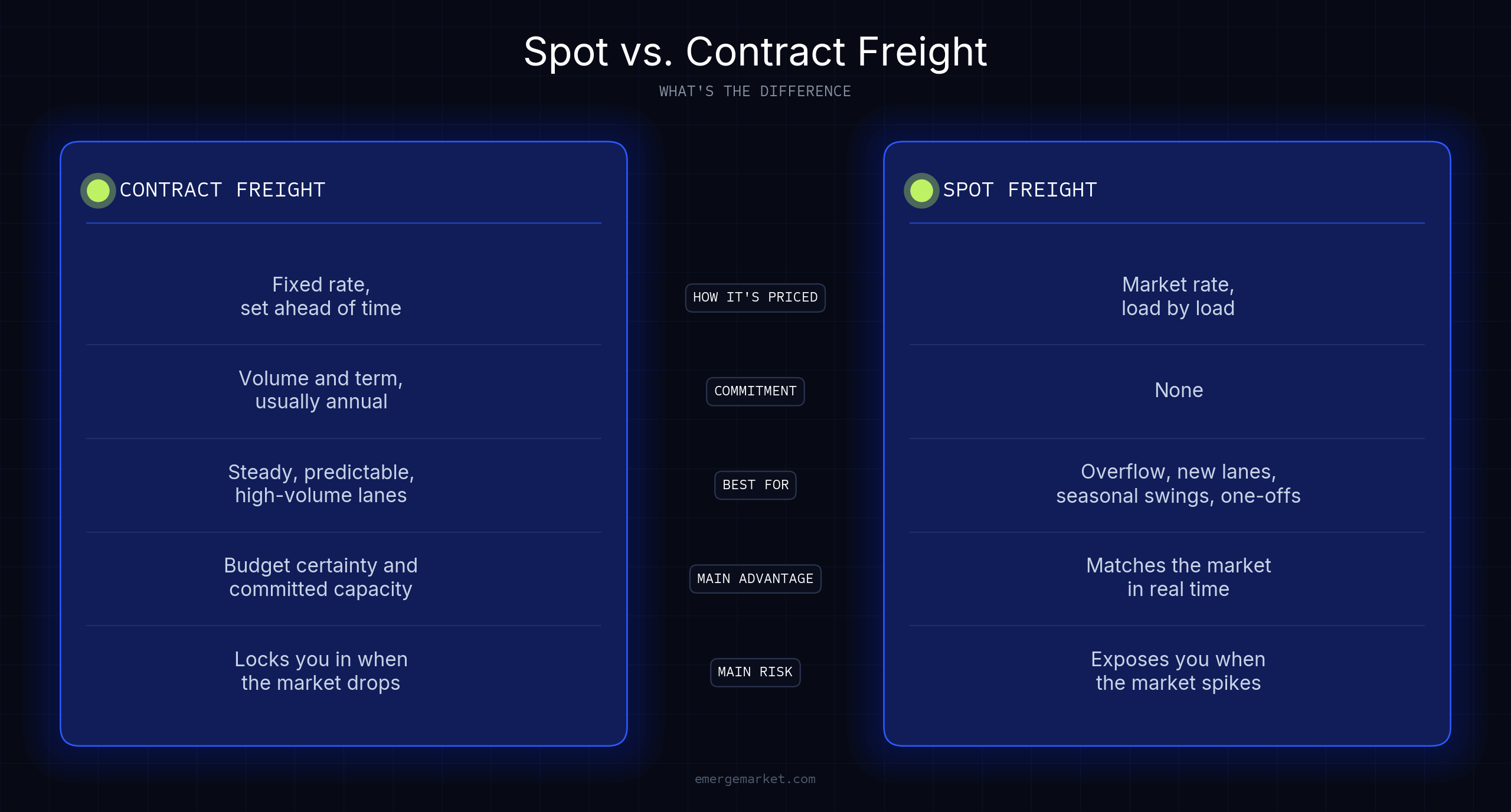
The pattern underneath the table: contract trades flexibility for certainty, and spot trades certainty for flexibility. Neither is the smart choice on its own. The smart choice is using each where its strength fits.
Use contract for the freight you can count on. If a lane runs consistently, week in and week out, and you can forecast the volume, a contract rate gives you a stable cost and a carrier committed to covering it.
Contract also earns its keep when the market is rising. Locking a rate before a climb protects your budget from the spike, which is exactly the position more shippers are in heading into the back half of 2026. Capacity is tightening and rates are firming, and that environment rewards shippers who secured rates early.
The way to keep contract freight from turning into the lock-in trap is cadence. Annual-only bids are what leave you stranded on stale rates. Running mini-bids, more frequent and smaller than an annual RFP, keeps your contracted rates closer to the real market. ND Paper moved from annual to quarterly bidding for exactly this reason. Pepsi Bottling Ventures compressed bid events that once took months down to hours, which made bidding often enough to stay current actually feasible.
Use spot for everything that doesn't belong under contract. Overflow when volume spikes past your committed capacity. New lanes you don't have history on yet. Seasonal freight. One-off shipments. Lanes too thin to justify a bid.
Spot is also where you win when the market softens. When capacity loosens and rates fall, spot lets you capture those lower rates immediately instead of waiting for the next bid cycle. The shipper running pure contract misses that entirely.
The one requirement: you have to know the market rate to spot well. Quoting blind is how shippers overpay without realizing it. A spot rate benchmark sitting next to every quote is what turns spot from a guess into a position you can defend.
You use both, and you rebalance more often than once a year.
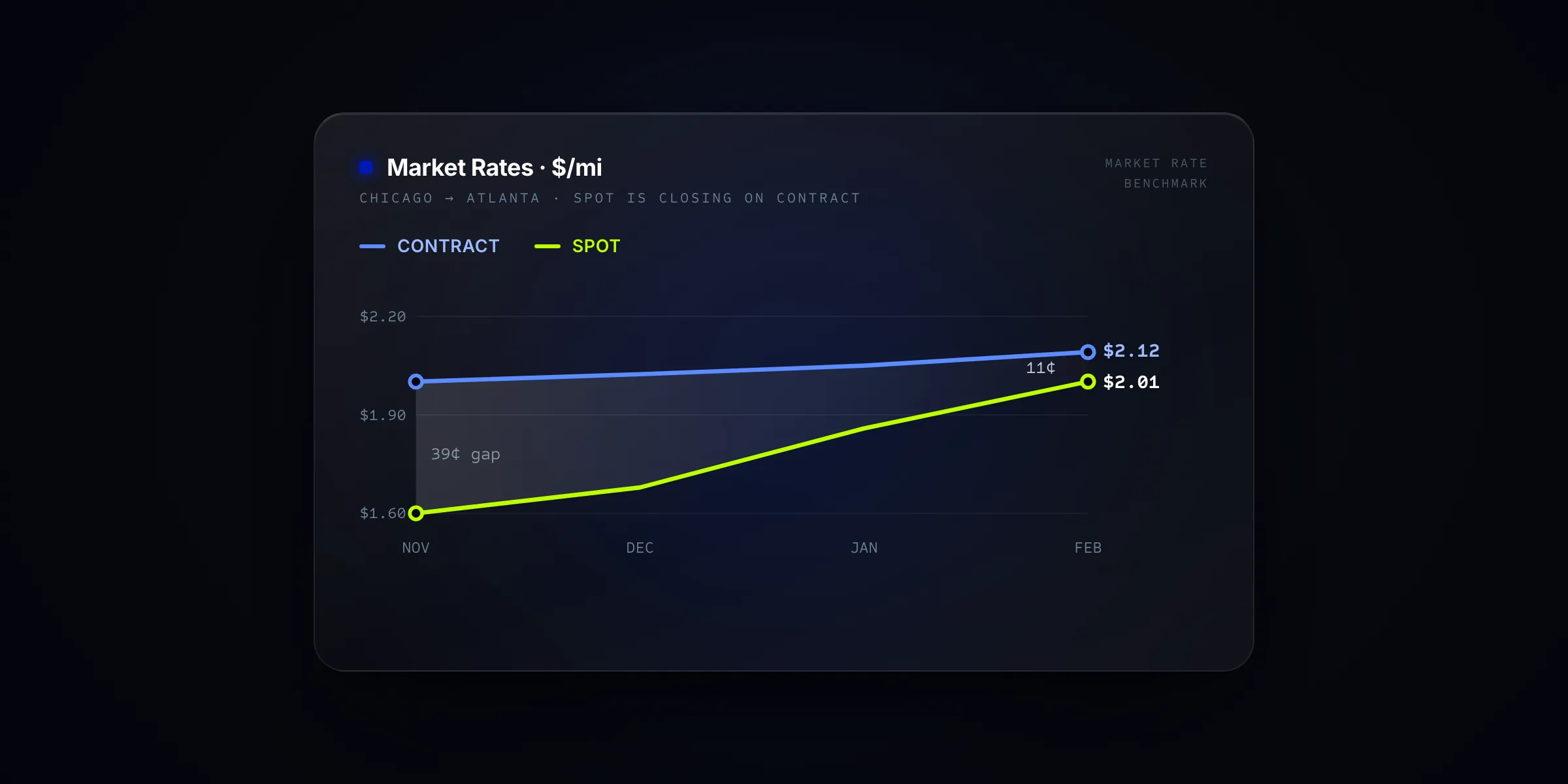
Here's why the timing matters so much right now. According to the U.S. Bank Freight Payment Index, spot rates climbed from $1.65 to $2.01 per mile between November and February while contract rates barely moved, collapsing the gap between the two from about 39 cents per mile to 11 cents. Shippers who locked contract rates in the soft market are protected as spot climbs toward and past them. Shippers who bet everything on spot got squeezed.
A year ago, the lesson ran the other direction. That's the whole point. You can't reliably predict which way the market turns, and it often turns inside a single contract term. So the shippers who stay ahead don't try to time it perfectly, they keep a contract base on their predictable lanes, run spot on everything else, watch the market continuously, and adjust the balance as conditions move.
This is also the case for running both in one place. When your spot quoting, your contract bids, and your market data live in separate tools, rebalancing is a project. When they live in one platform, it's a Tuesday. Emerge was built to handle spot, contract, and capacity together for exactly that reason.
Shippers who get the balance right and keep their rates current consistently run below market.
In a study of shippers using Dynamic Book It Now, which auto-books spot loads against a live market benchmark, 85% secured rates below market, averaging 8.5% below, with the best lanes hitting 23% below. On the contract side, Dollar Tree runs 1.9% below market on average by bidding against current data rather than last year's numbers.
Shippers describe the same shift in their own words. As Nicole Pierzina, Director of Outsource Freight, Presort Services at Pitney Bowes, put it:
"I'm very happy we decided to move forward with Emerge — it's taking us to the next level and giving us insights we haven't had before. Our planners build their loads, step away, and come back to multiple competitive bids instead of manual back-and-forth with carriers. In our first month alone, we're already seeing meaningful cost savings and are thrilled about the expanded carrier network available to us."
The shippers seeing those results aren't choosing spot over contract or contract over spot, they're using both deliberately and revisiting the mix before the market forces them to.
What is the difference between spot and contract freight?
Contract freight is a fixed rate agreed with a carrier for a set lane over a set term, usually a year, in exchange for committed volume. Spot freight is priced per load at the current market rate with no commitment. Contract offers budget certainty; spot offers flexibility to match the market.
Is spot freight always cheaper than contract freight?
No. Spot can run below contract when capacity is loose and the market is soft, but it can climb above contract when capacity tightens. In early 2026, spot rates rose sharply while contract rates held, narrowing the gap to a few cents per mile. Which one is cheaper depends entirely on where the market is at the moment you book.
Should I use spot or contract freight when the market keeps changing?
Use both. Keep a contract base on your steady, high-volume lanes for budget certainty, and use spot for overflow, new lanes, and soft-market opportunities. The key is rebalancing the mix more often than once a year and tracking the market rate continuously so you can move with it.
Can one platform handle both spot and contract freight?
Yes. Emerge runs spot quoting, contract bidding, and carrier capacity in a single platform, with market-rate data built in, so you can shift the balance between spot and contract as conditions change without juggling separate tools.
Spot versus contract was never the right question. Both are tools, and each wins in conditions the other loses in.
The shippers who come out ahead aren't the ones who picked correctly. They're the ones who stopped picking, ran both with intent, and kept their rates honest against a market that never sits still.
Ready to reinvent your procurement strategy?
 SOC 2 Type II