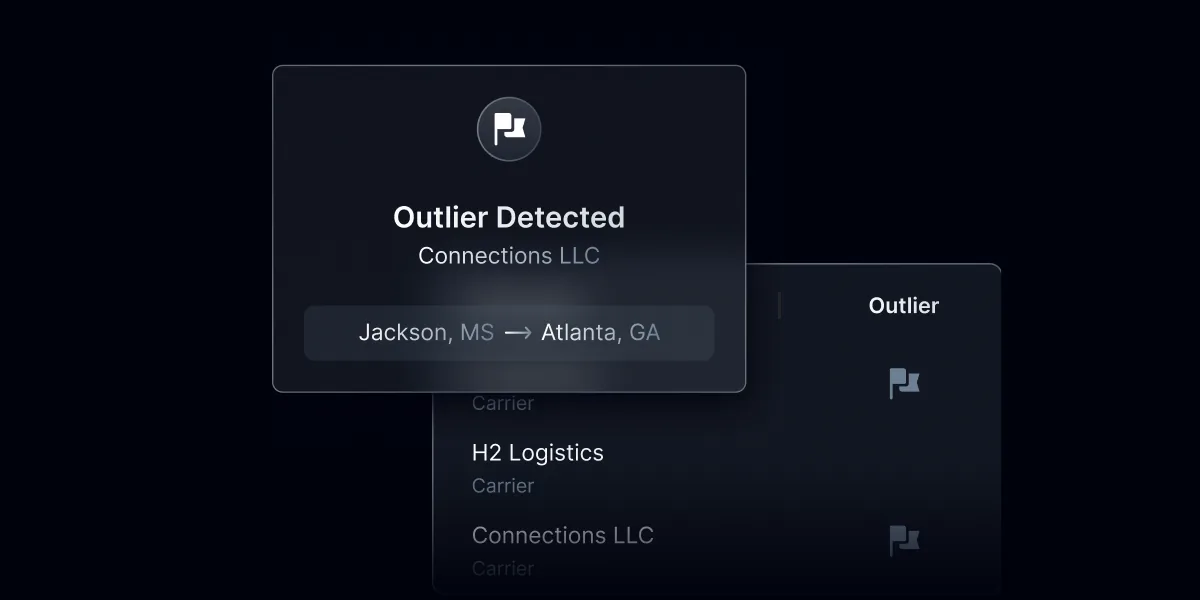
Bid leveling is the step between collecting freight bids and comparing them. You normalize every response to the same basis, then flag the rates sitting far outside the expected range so they do not distort the comparison. Those rates are outliers, either suspiciously low or unrealistically high, and leaving them in quietly corrupts your bid feedback, your award scenarios and your routing guide.
Freight procurement is built on data. Historical trends, market conditions and shipper defined benchmarks all play a role in determining competitive rates. But what happens when a bid falls well outside the expected range?
Most shippers focus on bid averages when reviewing proposals, but outliers quietly disrupt the entire process. Here is how:
The bottom line is that ignoring outliers leads to bad data, bad feedback and bad decisions.
An outlier is not simply the cheapest bid. It is a bid that cannot be explained by the lane, the equipment or the carrier. Three checks catch most of them:
Run these before you publish any feedback. Once a carrier has been told they are third, telling them the two ahead were excluded is a harder conversation.
Flagging is not the same as deleting. In order of preference:
Not every low bid is a paper rate, and treating them the same costs you real savings. The difference usually shows up in three places:
Emerge lets shippers flag and exclude outlier rates from bid feedback and scenarios. Filtering them out gives you cleaner data, better feedback and more reliable outcomes, and carriers benefit by seeing where they truly rank without misleading bids distorting their competitiveness.
From there you can run award scenario modeling on the leveled set rather than the raw one, which is the difference between a projection you can budget against and one that falls apart in execution.
Bid leveling is normalizing every carrier response to the same basis so the bids can be compared fairly, then flagging rates that sit far outside the expected range for that lane. It happens after bids are collected and before feedback or award scenarios are run.
An outlier is a rate that cannot be explained by the lane, the equipment or the carrier, either well below or well above the lane median. The low ones are more damaging, because they win awards and then fail in execution.
Not usually. Keep them on record, but exclude them from the ranking carriers see and from the optimization that projects your spend. Ask the carrier first, since some low bids are genuine and backed by a backhaul.
Look for committed capacity, a network reason for the price, and a track record of honoring aggressive bids. A conservative price has at least two of the three. A paper rate has none.
Outliers are one of several things a clean bid document prevents. If you are building the event now, start with the full annual freight RFP process and the freight RFP template.
Book a demo to see how bid feedback and optimization work in Emerge.


 SOC 2 Type II