
Follow us


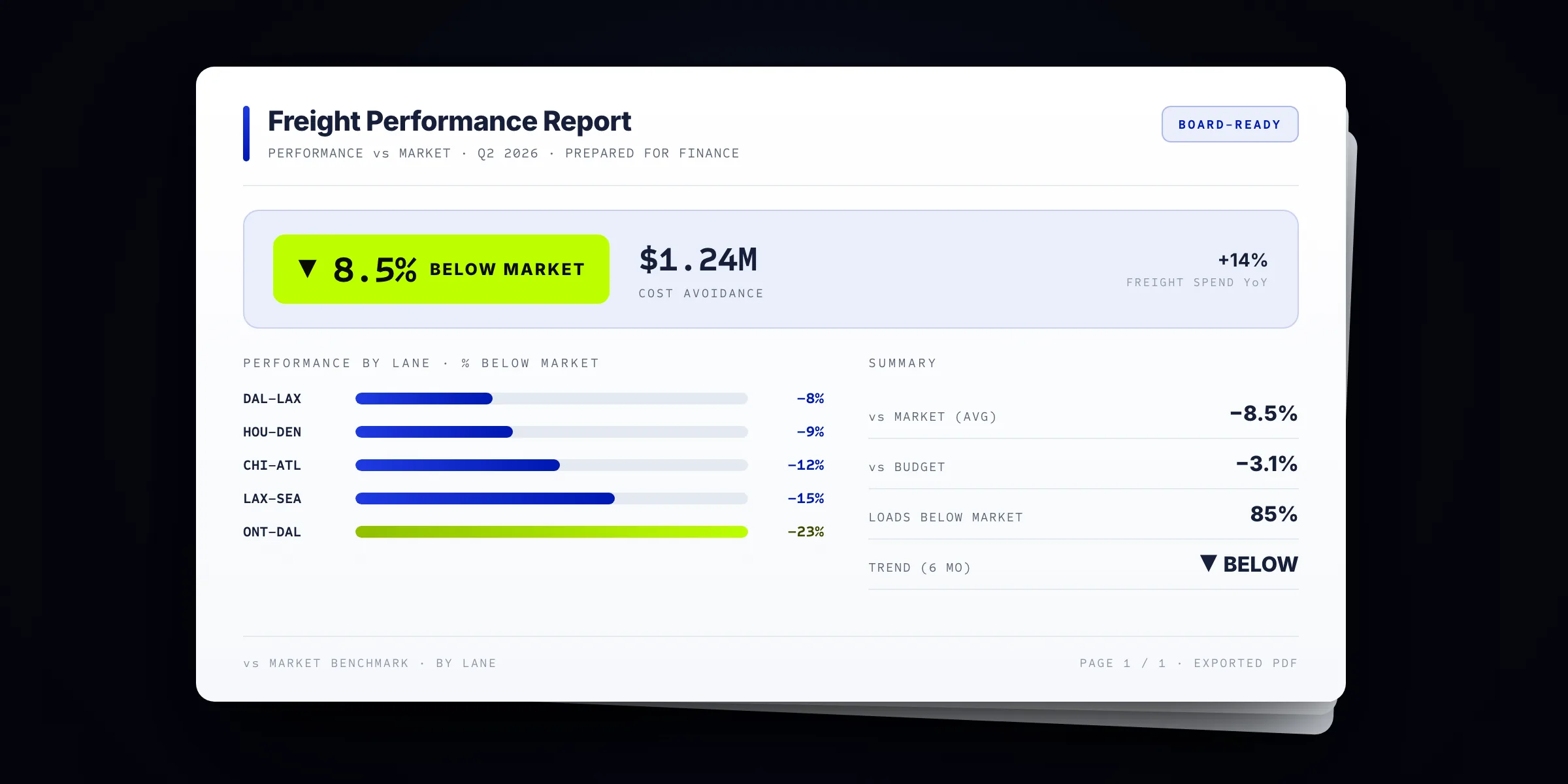
To prove freight savings to your CFO, show performance against the market, not just spend versus last year. The number that lands is how far below the market rate you booked, backed by lane-level detail and a clear trend. In a rising-rate market, beating the market is the savings story a CFO actually trusts.
You found something that works, and now you have to convince the person who controls the budget.
This is where a lot of good freight decisions stall. The logistics lead sees the value, but turning that into a yes from leadership is a different skill. One operator told us flat out: I don't have the story to sell it. Another, asked to produce a report for the boss, said the quiet part out loud: I can't pull it. I can't even get it.
The problem usually isn't the program, it's the proof. And in this market, the proof is harder to build than it used to be, because the obvious way to show value no longer works.
Two reasons, and they compound.
The first is that the data is scattered. When quoting and booking live across inboxes, carrier portals, and spreadsheets, there's no clean place to pull performance from. Building a report means stitching numbers together by hand. One shipper said that if someone asked for a report, it could ruin the next couple of days. That's not an exaggeration when the data lives in fifteen places.
The second is that the math is built on guesswork. Without a market benchmark, you're measuring against what you think you should have spent. As one logistics manager put it, proving value was hard because it came down to a lot of assumptions. A CFO can smell an assumption from across the building.
The fix upstream of the proof is a repeatable process. Our guide to transportation spend management lays out the five parts, from the lane file to the monthly report finance will accept.
Here's the trap: Most people walk into the CFO's office trying to prove freight spend went down year over year.
In this market, it didn't. Rates have climbed. Spot rates are elevated year over year across dry van, reefer, and flatbed, and the contract market is less favorable than it was during the soft stretch of 2024 and 2025. Your total freight spend is very likely up, not down, and your CFO already knows it, because every company moving freight is in the same position.
So when you lead with "we spent less," one of two things happens. Either the number isn't true, or it's true only because volume dropped, and a sharp CFO will catch either one. You lose credibility in the first thirty seconds.
Shippers who win the room concede the market moved against everyone, then prove they beat it.
A CFO doesn't need you to have spent less. They need to know you spent well. Three numbers prove that.
Performance against the market. This is the headline. If the market rate on your lanes was a certain number and you consistently booked below it, that gap is real value: the difference between what you paid and what those loads would have cost at market. Finance calls this cost avoidance, and it's a metric CFOs respect because it holds up even when absolute spend rises.
Performance against budget. Did you come in under the freight budget the company planned around? In a rising market, holding to budget is itself a win worth showing.
The trend. One good month is luck. Six months of booking below market is a program. Show the line over time, by lane, so leadership sees consistency rather than a single data point.
Notice what ties all three together: a credible market benchmark. You cannot prove you beat the market without knowing what the market rate actually was at the moment you booked. That benchmark is the foundation the entire CFO conversation rests on.
Once you have the right metric, the report itself has to clear two bars: it has to be fast to produce, and it has to be board-ready.
Fast matters because a report that takes two days to assemble gets built once and never again. Board-ready matters because your CFO is going to forward it up, and it needs to stand on its own without you in the room to explain it.
Practically, that means performance reporting that pulls from your actual booking data, shows results against the market benchmark at the lane level, and exports clean. The goal is to walk in with one page that says: here's what the market did, here's what we did, here's the gap, here's the trend. When your quoting, booking, and market data live in one place, that page is a click, not a project. That is the difference between a champion who can sell the program up and one who keeps meaning to.
Shippers who measure against the market can show leadership exactly where they stand.
In a study of shippers using Dynamic Book It Now, which books spot loads against a live market benchmark, 85% secured rates below market, with the best lanes reaching 23% below market. Each of those points is a cost-avoidance number a champion can take to finance.
Dollar Tree runs 1.9% below market on average and reports against that benchmark continuously, which turns the quarterly leadership update from a scramble into a routine. Golden State Foods described the shift in plainer terms, calling having everything housed in one tool revolutionary for their transportation operation, precisely because the visibility made performance provable.
None of this is about squeezing a lower invoice. It's about being able to prove, with the market as your yardstick, that the freight program is working.
How do I prove freight savings to my CFO?
Show performance against the market rate, not spend versus last year. Document how far below the market benchmark you booked, broken out by lane and trended over time. That gap is cost avoidance, a metric finance recognizes and one that holds up even when total freight spend rises with the market.
How do you measure freight savings when rates are rising?
You measure against the market, not the calendar. When rates climb, spending more than last year is unavoidable, so the meaningful number is the difference between what you paid and the market rate for those same loads. Booking consistently below market is the win, and it requires a credible benchmark to prove.
What's the best metric to show freight performance to leadership?
Performance versus market benchmark, expressed as percent below market and the dollar cost avoidance it represents, supported by a trend line by lane. Pair it with performance against budget. Together they tell a CFO the program is controlled and effective regardless of which way the market is moving.
Can I get a board-ready freight report automatically?
Yes, if your quoting and booking data lives in one platform with a market benchmark built in. Emerge generates performance reporting against the market at the lane level and exports it cleanly, so the report your CFO needs is a click rather than a two-day project.
The market moved against everyone this year. You can't change that, and your CFO won't expect you to.
What they will respect is proof that you beat the market while it climbed. Concede the thing everyone knows, show the gap you earned against the benchmark, and bring the trend to back it up. That's the story that gets the program funded.
Ready to reinvent your procurement strategy?
 SOC 2 Type II