
Follow us


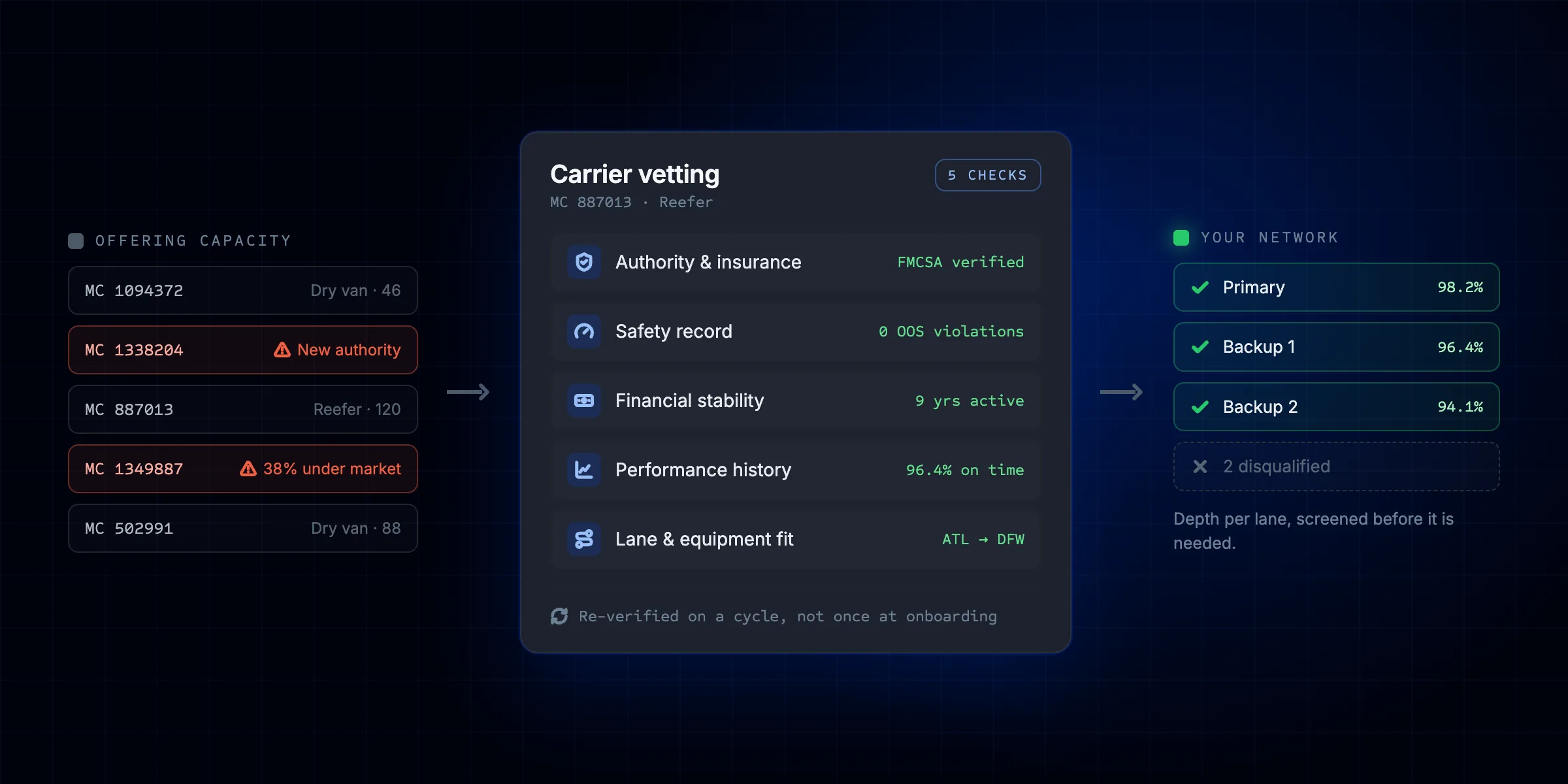
Vetting a carrier comes down to five checks: operating authority and insurance, safety record, financial stability, performance history, and fit for your freight. Each one screens out a different kind of risk, from fraud to service failures. But vetting one carrier isn't the goal. The goal is a deep network of vetted carriers, because in a tight market, the shippers who stay covered are the ones with qualified options competing for every load.
Every post we write about tight markets lands on the same advice: build a deep, vetted carrier network. Fair question in response: what does "vetted" actually mean, and how do you do it?
It matters more than it used to. Carrier fraud and double brokering have climbed in recent years, capacity is tightening, and a bad carrier costs you more than a late load. It can mean a stolen shipment, an uninsured claim, or a liability problem with your name on it. Vetting is how you keep those risks out of your routing guide before they become incidents.
Here's the practical version: what to check, why each check matters, and how to turn individual vetting into a network that actually covers you.
Five things, each screening a different risk.
A few patterns show up again and again in fraud and service failures.
Brand-new authority combined with eagerness to haul anything, anywhere, at any rate. Contact information that doesn't match FMCSA records, or that changed recently. Reluctance to provide insurance certificates directly from their insurer. Rates dramatically below market, which usually means the carrier either doesn't understand the lane or doesn't intend to haul it themselves. And pressure to move fast before you've finished checking, since urgency is the fraudster's favorite tool.
None of these alone is disqualifying. Two or three together are a reason to walk.
Here's what most shippers miss: vetting isn't an onboarding event. It's a standing discipline.
A carrier who passed every check last year can be a different company today. Safety scores drift, insurance lapses, financial health changes, and authority can be revoked. Fraudsters specifically target the gap between when a carrier was vetted and when anyone looks again. That means the real requirement is continuous monitoring: re-checking authority, insurance, and safety data on a cycle, and tracking performance on every load, not just the first one.
This is where the honest cost of vetting shows up. Doing all of this well, for every carrier, continuously, is a serious operational lift. A shipper working with a handful of carriers can manage it manually. A shipper who wants real network depth, dozens or hundreds of qualified options, can't, and that's precisely the tension: the market rewards deep networks, but deep networks are exactly what manual vetting can't scale to. That tension is one reason vetting increasingly lives inside the quoting workflow rather than beside it; our freight quoting software guide shows which platforms pair quoting with a pre-vetted, continuously monitored carrier network.
Three moves close the gap between "a few carriers I trust" and "a network that holds up in a tight market."
"To protect shippers from the liability risks posed by renegade and unqualified carriers, Emerge uses a multifaceted approach that ensures incident-free pickups and deliveries. We combine various internal and external data sources with our proprietary software to monitor and automatically disqualify high-risk carriers. This automation is supported by an internal compliance team with over 45 years of experience, who further vets carriers before onboarding and conducts routine audits of our carrier network to meet the stringent standards of Emerge and our shipping partners." — Compliance Team at Emerge
The point isn't to replace your trusted incumbents. It's to add qualified depth around them without taking on the vetting workload yourself.
However you get there, the destination is the same: more quality carriers competing for your freight than you could vet by hand, with the risky ones screened out before they reach you.
Network depth built on real vetting is what holds up when the market tightens.
When capacity gets scarce and tender rejections climb, the shippers who stay covered are the ones with qualified backups already in place on every lane, relationships that were built before they were needed. The ones who get caught are those whose "network" was three carriers and a prayer, now scrambling to onboard strangers mid-crunch, which is exactly when vetting shortcuts get taken and fraud finds its opening.
That's the real payoff of vetting discipline: not just avoiding the bad carrier, but being free to widen your network aggressively because the screening is handled.
How do you vet a trucking carrier?
Check five things: active operating authority and adequate insurance verified through FMCSA rather than carrier-provided documents, safety record and inspection history, financial stability, real performance data like on-time rates and claims history, and fit for your specific lanes and freight. Then keep checking, since authority, insurance, and safety status can all change after onboarding.
What are red flags when vetting a carrier?
Brand-new authority paired with willingness to haul anything at any rate, contact details that don't match federal records, reluctance to provide insurance certificates directly from the insurer, rates far below market, and pressure to book before checks are complete. One flag warrants caution; several together warrant walking away.
How many carriers should a shipper work with?
Enough for primary and backup coverage on every lane you run, which is more than most shippers carry. The right number depends on your lane count and volume, but the pattern is consistent: shippers with deep, vetted networks stay covered and keep competitive rates in tight markets, while thin networks get exposed the moment a key carrier tightens.
Is one-time carrier vetting enough?
No. A carrier's authority, insurance, safety scores, and financial health can all change after onboarding, and fraud specifically exploits the gap between vetting events. Effective vetting is continuous: re-verify credentials on a cycle and track performance on every load, or work through a network where that monitoring is built in.
Vetting a carrier is five checks done honestly: authority and insurance, safety, financial stability, performance, and fit. Vetting a network is those five checks done continuously, at a scale most teams can't staff.
That's the real decision. Not whether to vet, but how to get vetted depth without making vetting your full-time job. Solve that, and the advice in every tight-market playbook, build a deep, vetted network, stops being a slogan and becomes something you actually have.
Ready to reinvent your procurement strategy?
 SOC 2 Type II