Key takeaways
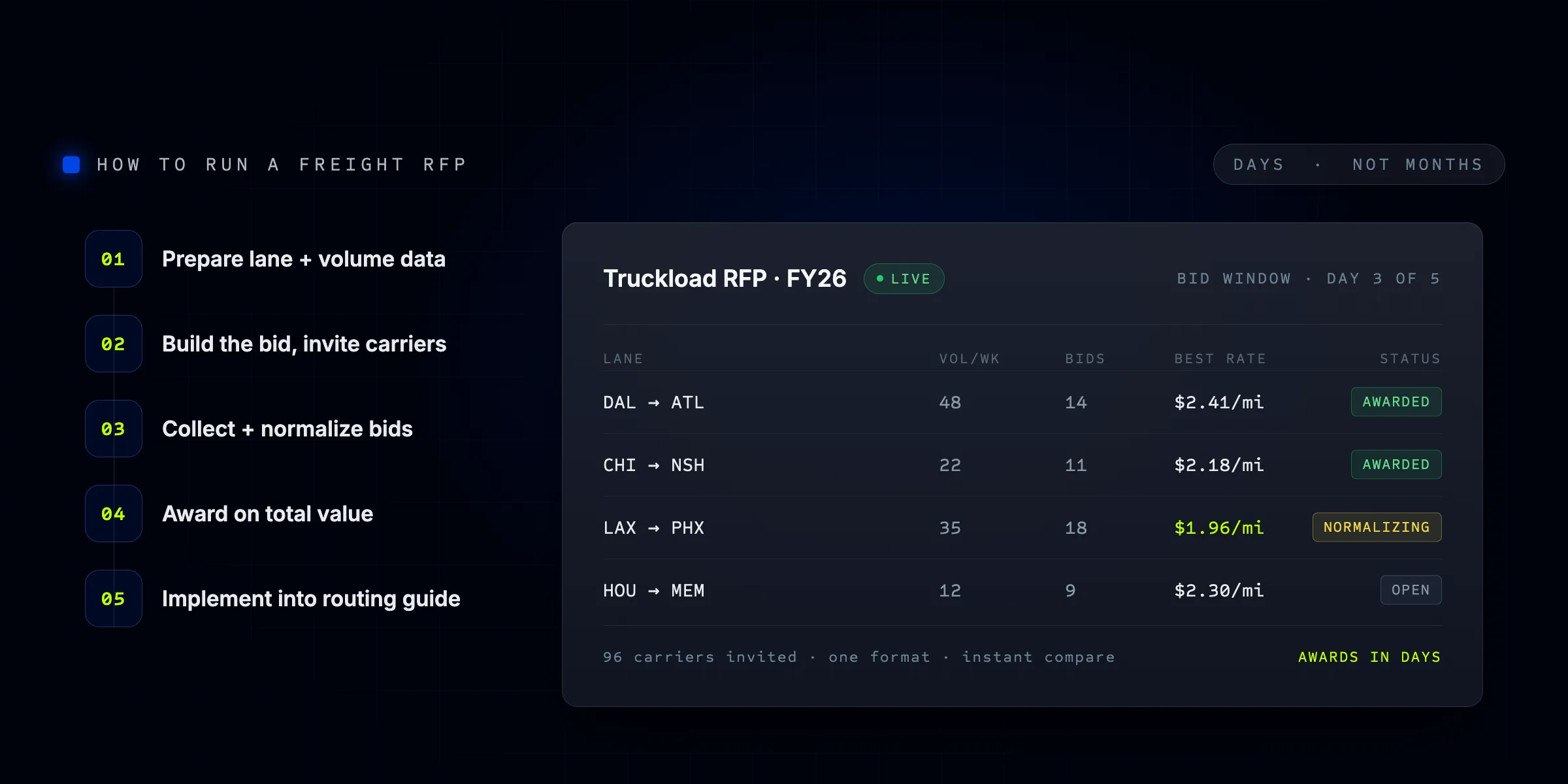
Running a freight RFP comes down to five steps: prepare your lane and volume data, build the bid and invite carriers, collect and normalize rates, award by total value rather than lowest price alone, and implement the awarded rates into your routing guide. The reason RFPs drag on for months is rarely the bidding itself. It's manual data wrangling and slow tools. Tighten those, and a bid runs in days.
Ask most shippers about their annual freight RFP process and you'll hear the same word: dread. It's the project that eats a quarter, buries a team in spreadsheets, and often ends with rates that are already drifting from the market by the time they go live. If you want the full version, here is the annual freight RFP process end to end.
It doesn't have to work that way. The bidding itself was never the slow part. The slow part is everything around it: chasing lane data out of a dozen sources, emailing rate sheets back and forth, normalizing bids that all came back in different formats, and waiting on tools that take weeks to configure. Strip that friction out and an RFP becomes a focused, days-long event instead of a months-long ordeal.
Here's how to run one that actually gets done, step by step.
First, though, it's worth being clear about what an RFP is actually for. A freight RFP isn't paperwork. It's how you turn transportation spend from something that happens to you into something you plan. With U.S. business logistics costs reaching $2.58 trillion in 2024, transportation is a board-level line item, and a well-run bid sets your rates, anchors your budget, and gives finance a number they can count on. Skip it or let it lapse, and you're not saving effort, you're trading planned, forecastable spend for whatever the market decides to charge you.
An RFP also locks in a pricing model for a year. If some lanes are too volatile for a fixed rate, read our guide to freight pricing models before you build the bid.
A freight RFP, or request for proposal, is the process a shipper uses to source truckload capacity at agreed rates for a set period. You put your lanes and expected volumes in front of carriers, they submit rates to haul them, and you award each lane to the carrier (or carriers) that offer the best combination of price, service, and capacity.
The output is your routing guide: the ranked list of which carrier gets tendered each lane first, second, and third. A good RFP builds a routing guide that holds up under real conditions. A rushed one builds a guide that falls apart the first time the market moves.
What happens next, tender by tender, is covered in our guide to load tendering and tender times.
This is where RFPs are won or lost, and where most of the time gets wasted.
Before you invite a single carrier, you need clean data: every lane you're bidding (origin and destination), the expected volume on each, the equipment type, and any special requirements. If that information lives in scattered spreadsheets, old emails, and someone's memory, assembling it is the single biggest time sink in the whole process.
Get this right and everything downstream moves faster. Carriers bid more accurately when your data is clean, you spend less time answering questions mid-bid, and your awarded rates actually reflect the freight you run. Rushing this step is why so many bids stall halfway through.
With clean data in hand, you build the bid event and decide who's invited.
Set the scope clearly: the lanes, the bid deadline, how rates should be submitted (all-in, fuel included), the contract term, and your service requirements. Then invite your carriers. This is also the moment to think about network depth: the more quality carriers competing for your freight, the better your rates and coverage. Inviting only your incumbents guarantees you never find out whether better capacity was available.
A strong bid invites your trusted carriers and gives you a way to add vetted capacity where you have gaps, without forcing you to rebuild your network from scratch.
Carriers submit their rates, and here's where the second big time sink hits: making all those bids comparable.
If bids come back as email attachments in different formats, someone has to manually pull them into a single view before you can compare anything. That manual normalization is slow, error-prone, and exactly the kind of work that stretches a bid from days into weeks. The fix is collecting bids in one structured place, so every rate arrives in the same format and comparison is instant rather than a data-entry project.
The cheapest bid isn't always the best award, and treating it that way is how shippers end up with rates that look great on paper and fall apart in execution.
Award lanes on the full picture: rate, but also the carrier's service history, their capacity to actually cover the volume, and their reliability when the market tightens. A rock-bottom rate from a carrier who rejects your tenders the moment spot rates climb costs you far more than a slightly higher rate you can count on. Build your routing guide with primary and backup carriers per lane, so you have depth when your first choice can't cover.
This is also where knowing the market rate matters. Awarding against a live market benchmark tells you whether the rates you're accepting are actually competitive or just the best of a weak field.
A bid isn't done when you award it. It's done when the rates are live in your routing guide and your team is tendering against them.
This is the step where slow tools quietly cost you. If implementing awarded rates means manual data entry into a separate system, or worse, a multi-month software rollout, the market can move before your new rates are even active. The point of running an efficient bid is lost if execution lags for weeks. The goal is a short path from award to live rates, so the numbers you fought for are working for you right away.
There's a real cost to letting a bid slip, too. When contract rates expire and no new event is in place, you're exposed to whatever the spot market is doing, and in a volatile stretch, fuel swings, capacity crunches, a sudden demand spike, the rates you agreed to last year may not hold anyway. Reactive procurement is the most expensive kind. A faster RFP process is really a way to stay ahead of that exposure without adding lift.
Almost every delay in an RFP traces back to two things: manual data work and slow tools.
Manual data work. Assembling lane data by hand, chasing bids over email, and normalizing rate sheets in spreadsheets is where weeks disappear. Centralizing that work, clean data in, structured bids back, collapses the timeline more than anything else.
Slow tools. Some procurement software takes months to implement before you can even run a bid, which defeats the purpose. The shippers who run fast bids use tools that go live in days, not quarters. That speed is the difference between a bid that reflects the current market and one that's stale before it starts. Our comparison of shipper-side quoting software scores every major platform on exactly this: time to value in days versus enterprise implementation quarters.
There's also a cadence question hiding here. If your RFP is a giant annual event, it's slow by design, and your rates are stale for most of the year. Running smaller, more frequent bids alongside your annual event keeps your rates closer to the market and each event lighter to run. We cover that approach in the evergreen freight model, a practical alternative to the annual RFP cycle.
A freight RFP should take 6 to 8 weeks from the start of data collection to award, plus another 2 to 4 weeks to implement for truckload or 4 to 6 weeks for LTL. Anything past 12 weeks usually means the lane data was not ready when the bid opened.
A realistic timeline:
| Timing | Phase | What happens |
|---|---|---|
| Weeks 1 to 2 | Data preparation | Pull 12 months of shipment history, normalize origins and destinations to five-digit zip, clean duplicate and dead lanes, forecast volume by lane. |
| Week 3 | Bid design and carrier invitation | Set the pricing template, the award criteria and their weightings, and the carrier list. |
| Weeks 4 to 5 | Round one bidding and Q and A | Establish the market and find coverage gaps. |
| Week 6 | Round two | Give structured feedback, rebid the gaps and the outliers. |
| Weeks 7 to 8 | Award scenario modeling and award | Model constraints, compare scenarios, award, publish the routing guide. |
| Weeks 9 to 12 | Implementation | Load rates into the TMS, brief carriers, monitor tender acceptance against the awarded plan. |
The variable that moves this timeline most is not the number of lanes or carriers. It is whether the shipment history was clean before the bid opened.
An efficient RFP process shows up in two places: how fast you can run a bid, and how your awarded rates perform.
Pepsi Bottling Ventures compressed bid events that once took months down to hours, and in the process tripled the number of carriers they invited to bid. ND Paper moved from annual bidding to a quarterly cadence, keeping rates closer to the market year-round. Both did it by cutting the manual work and the tool lag out of the process, not by working their teams harder.
The result of a bid run well isn't just speed. It's a routing guide that performs, backed by real carrier depth. Shippers running structured bids through Emerge's Premier Carrier Program awarded $3.9M in freight across 355 primary and 172 backup carriers in 60 days, the kind of coverage that holds up when a lane tightens and your first-choice carrier can't take the load.
How do you run a freight RFP?
Run it in five steps: prepare clean lane and volume data, build the bid and invite carriers, collect and normalize the rates, award each lane by total value rather than lowest price alone, and implement the awarded rates into your routing guide quickly. The bidding is the easy part; clean data and fast tools are what keep it from dragging on.
Why do freight RFPs take so long?
Mostly because of manual data work and slow tools, not the bidding itself. Assembling lane data by hand, exchanging rate sheets over email, and normalizing bids in spreadsheets consumes weeks, and some procurement software takes months to implement before a bid can even run. Centralizing the data and using tools that go live quickly collapses the timeline dramatically.
How often should a shipper run a freight RFP?
It depends on your freight, but the once-a-year approach leaves rates stale for most of the year. Many shippers now run smaller, more frequent mini-bids to keep contracted rates closer to the market, which also makes each event lighter to run than a single massive annual bid.
What should you consider when awarding a freight bid?
Look beyond the lowest rate. Weigh each carrier's service history, capacity to cover the volume, and reliability when the market tightens, and build primary and backup carriers into each lane. Awarding against a live market benchmark also tells you whether the rates you're accepting are genuinely competitive.
If your RFP keeps sliding down the list, you're not alone, and you didn't forget it. Most shippers deprioritize bids not because they don't matter, but because the day-to-day never lets up. That's exactly why cutting the time and effort out of the process matters: it lets you stay ahead without stealing weeks you don't have. And the timing compounds, as Q4 and peak season approach, bid windows compress and capacity tightens, so the longer a bid waits, the harder it is to run well. If you're heading into a busy bid cycle, making RFP season your smoothest yet comes down to structure and the right tools.
A freight RFP doesn't have to consume a quarter. The bidding was never the bottleneck. The manual data wrangling and the slow tools around it were.
Clean your data, collect bids in one structured place, award on total value, and implement fast. Do that, and the RFP stops being the project everyone dreads and becomes what it should be: a quick, repeatable way to keep your rates sharp and your freight covered.
Ready to reinvent your procurement strategy?


 SOC 2 Type II