
Follow us


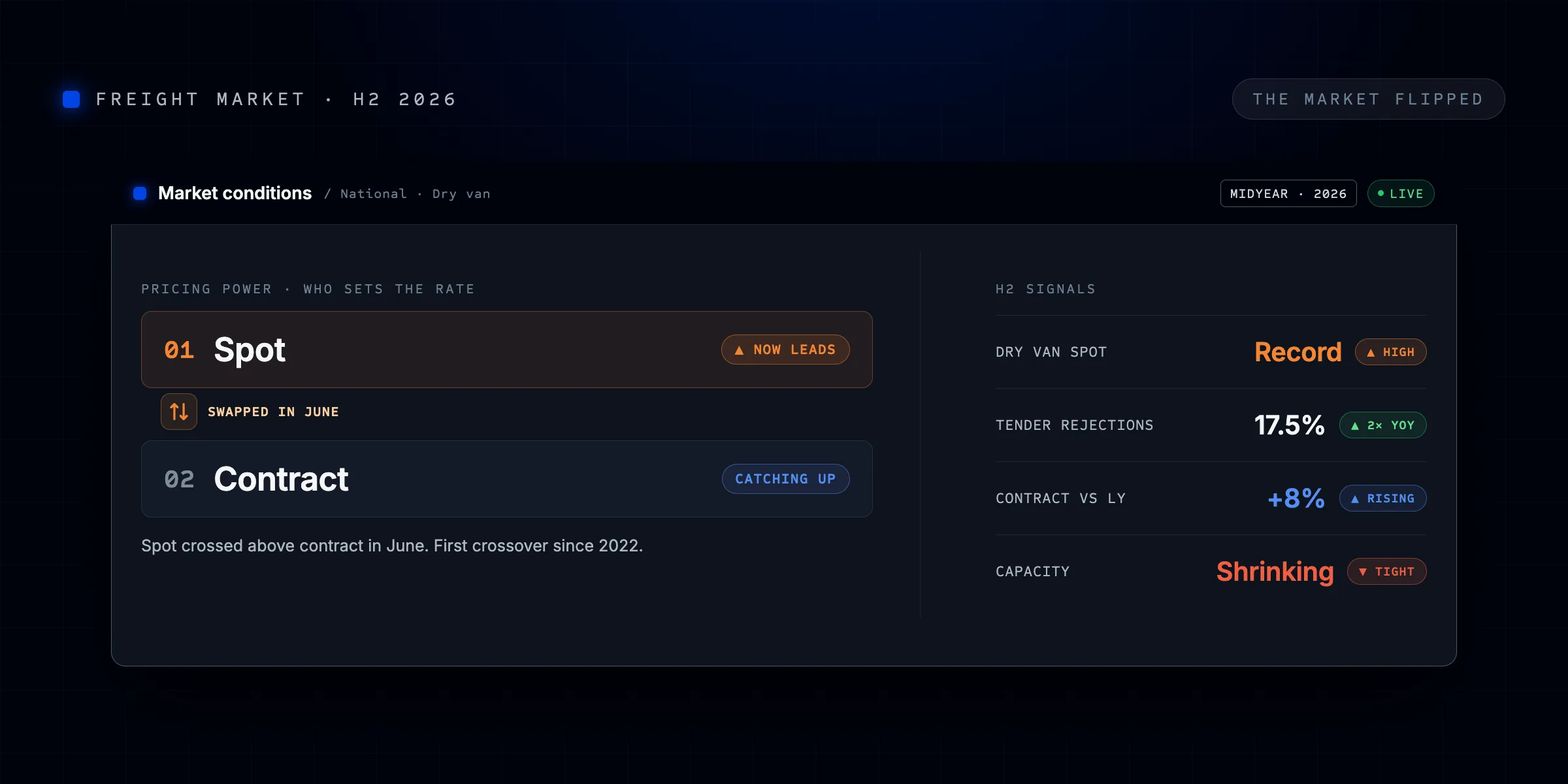
The truckload market tightened faster than expected in the first half of 2026, with record spot rates, tender rejections at multi-year highs, and forecasts revised upward repeatedly. Heading into H2, analysts broadly agree on a firmer market: capacity keeps shrinking, spot strength is feeding into contract bids, and volatility stays elevated. For shippers, the window to lock in rates and deepen carrier networks is now, not after the next increase lands.
Freight forecasters rarely agree on anything. Heading into the back half of 2026, they mostly do, and that alone tells you something.
The first half of the year ran tighter than nearly every projection. Spot rates set records around July 4. Tender rejections climbed to their highest levels since early 2022. Forecasts that called for modest single-digit rate growth at the start of the year have been revised upward more than once as the market outran them. And in June, spot rates crossed above contract rates for the first time since early 2022, a shift confirmed across multiple industry rate indices and the clearest sign that pricing power has moved back toward carriers.
That's the midyear picture. Here's what's driving it, where it points for the rest of 2026, and what to do about it while the window to act is still open.
Tighter than the forecasts said it would be, and the signals all point the same direction.
The clearest evidence came over the July 4 week, when dry van spot rates hit an all-time high and reefer reached its fourth-highest level on record, with rates running dramatically above last year. Tender rejections, the share of contracted loads carriers turn down, have roughly doubled year over year, sitting at levels last seen in 2022. And this is happening without a demand boom: freight volumes are uneven, not surging.
If you are new to the metric, our guide to load tendering and tender acceptance explains what a tender rejection is and what counts as a good acceptance rate.
That last point is the defining feature of this cycle. The tightening is coming from the supply side, not a demand spike, which changes what happens next.
Because the supply of trucks has been shrinking for three years, and the cost of running one keeps climbing.
Tens of thousands of carriers and drivers have exited the market since the 2022 highs, thinned out by the long soft-rate stretch that followed. The ones still operating face relentless cost inflation: industry research from ATRI puts the three-year rise in truckload operating costs around 25%, with further increases layered on since, excluding fuel. Add tighter licensing and enforcement rules shrinking the driver pool, and new equipment costs pushed higher by tariffs on imported trucks and parts, and the result is a market where capacity keeps leaking out even as freight demand just treads water.
We covered the structural side of this in the future of truckload capacity, and the short version holds: this isn't a blip that reverses when a few carriers return. The supply curve has genuinely shifted.
The demand side is where the volatility lives.
Imports surged to a projected record in July as retailers pulled back-to-school and holiday goods forward ahead of expected tariff changes, an early, compressed peak season that concentrated freight into the summer and left forecasters expecting softer import volumes in the fall. Trade policy keeps generating exactly this kind of whipsaw, surge now, drag later, and we broke down how tariffs move freight in its own post.
So the honest demand picture for H2 is not "strong." It's uneven and lumpy, with pull-forward distortions working through the system. But against a shrinking supply base, even flat demand keeps the market tight, and any regional or seasonal bump, harvest season, a weather event, a big freight market disruption, hits harder than it would have two years ago.
Three things, with unusual consensus.
The consistent thread in every analyst outlook is timing: the shippers who move early, before the next leg of contract increases lands, are the ones who come through H2 in control. Four moves, in priority order.
None of this requires calling the market perfectly. It requires not being the shipper who waited for certainty that never comes.
The shippers best positioned for H2 are the ones who compressed their reaction time before they needed it.
Pepsi Bottling Ventures cut bid events that once took months down to hours, and tripled the number of carriers invited to compete. ND Paper moved from annual bidding to a quarterly cadence, keeping contracted rates close to a moving market instead of locked to last year's. In a market where contract rates are climbing and conditions shift month to month, that speed and cadence is the difference between rates that track the market and rates that trail it.
That's the real H2 playbook: not predicting the market, but being able to move with it faster than it moves against you.
Will freight rates go up in the second half of 2026?
Most analysts expect a firmer market through H2. Spot rates set records at midyear and that strength is feeding into contract bids, with aggregate contract pricing already up high single digits year over year and larger increases expected at renewal. The market should stay volatile rather than climb smoothly, but the underlying direction is firmer, driven by shrinking capacity more than surging demand.
Why is the truckload market tightening in 2026?
Mainly supply. Tens of thousands of carriers and drivers have exited since 2022, operating costs have climbed roughly 25% over three years, licensing and enforcement changes have thinned the driver pool, and tariffs have raised equipment costs. Freight demand is uneven rather than booming, but against a shrinking supply base, even flat demand keeps conditions tight.
Should shippers bid now or wait for the market to settle?
The analyst consensus favors moving early. Contract rates are expected to rise further in H2 as spot strength works into bids, so waiting typically means bidding into higher rates. Locking core-lane capacity now, keeping the bid process fast, and maintaining flexibility on the spot side positions a shipper better than waiting for a stability that isn't forecast to arrive.
What should shippers watch in the freight market for the rest of 2026?
Tender rejection rates (the clearest tightening signal), spot-to-contract rate spreads, import volumes as the front-loaded peak unwinds, tariff developments that could swing demand, and seasonal pressure from harvest and holiday freight. Live lane-level market rates matter most of all, because national averages hide the regional spikes where budgets actually get hit.
The first half of 2026 settled the argument: the freight market has turned, and it turned faster than the forecasts. Capacity keeps shrinking, spot rates led the way up, and contract rates are following.
The second half rewards shippers who act like the turn already happened, because it did. Lock your core lanes before the next round of increases, keep your bids fast, deepen your network, and watch the market in real time. The market will stay volatile either way. Whether you're ahead of it or behind it is the part you control.
Ready to reinvent your procurement strategy?
 SOC 2 Type II