
Follow us


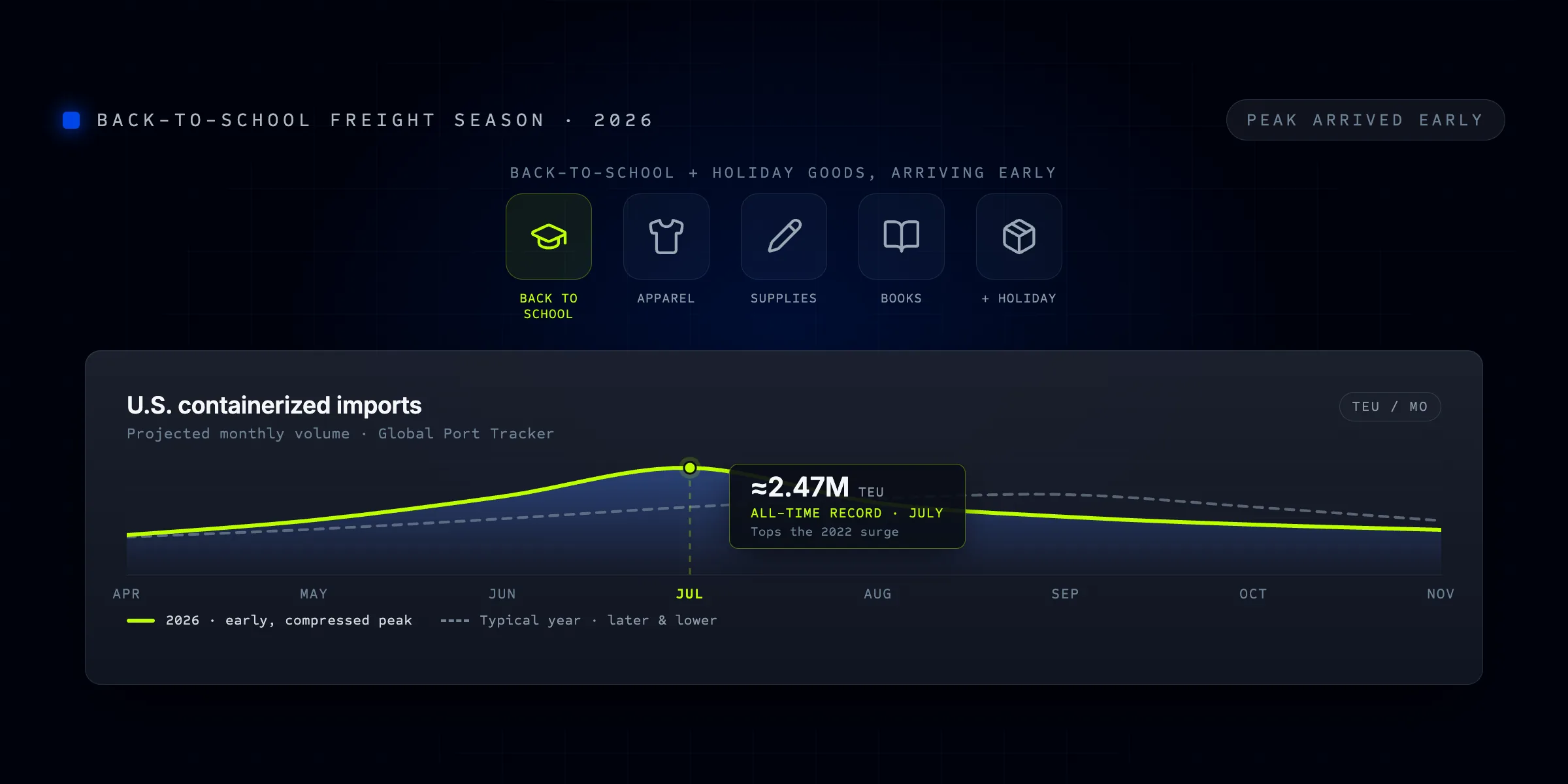
Back-to-school freight is the first big retail wave of the second half of the year, and in 2026 it is arriving early. Retailers are front-loading back-to-school and holiday merchandise ahead of possible August tariffs, pushing imports toward a record in July. That freight lands at ports and moves inland by truck, tightening capacity on retail and port-adjacent lanes sooner than usual.
Back to school used to be a tidy, predictable freight event. Retailers restocked in mid-to-late summer, capacity tightened for a few weeks, and the market settled. That rhythm is breaking, and 2026 is a clear example of why.
This year, the back-to-school rush is landing early and colliding with something bigger. Retailers are pulling imports forward, not just for school supplies and apparel but for holiday merchandise too, to get ahead of tariff increases expected in August. The result is a freight surge that is arriving sooner and hitting harder than the calendar would suggest.
For any shipper moving retail-adjacent freight, or just sharing lanes with those who do, that timing shift matters. Here is what is actually happening and what to do about it.
Earlier than usual, and it has already started.
The traditional pattern put retail import peaks in July and August, as stores stocked up for back-to-school and the holidays. That peak has been migrating earlier for a few years, and in 2026 it compressed hard. According to the National Retail Federation and Hackett Associates' Global Port Tracker, U.S. container imports were projected to hit roughly 2.47 million TEU in July, an all-time monthly record, topping even the post-pandemic surge of 2022.
The reason is timing, not underlying strength. Retailers are rushing back-to-school and holiday goods into the country early to get ahead of potential tariff increases in August. The NRF expects volume to fall sharply after July, with August and the fall months coming in below last year. So this is a front-loaded, compressed peak: an intense surge now, followed by a cooldown, rather than a long steady climb into fall.
That shape is the whole story for shippers. The pressure is concentrated in a narrow window, and it is happening now.
The same way any import surge does: through the ports and onto domestic trucks.
Every container of back-to-school apparel, supplies, and holiday inventory that lands at a U.S. port has to move inland. That means drayage out of the port, transload, and truckload hauls to distribution centers and stores. A record month of imports becomes, a few weeks later, a wave of domestic truckload and drayage demand concentrated on retail and port-adjacent lanes.
This is the same mechanism behind the early peak season the Strait of Hormuz helped accelerate: ocean and trade uncertainty pulls imports forward, and that front-loaded freight lands on domestic lanes weeks later. Back to school is the retail face of that same surge. The freight moving now was ordered early precisely to beat what is coming.
And because capacity is a shared pool, you feel it even if you are not moving a single backpack. When retail freight floods the lanes out of Los Angeles, Savannah, New York, and the inland hubs that feed them, it pulls carriers toward that freight and firms rates on everything sharing those corridors.
On the retail corridors, and it radiates out from there.
The tightest markets are the ones that move imported retail goods: the major port gateways and the inland distribution hubs they feed. Dry van is the equipment most in demand, since that is what carries the bulk of back-to-school and general merchandise. Reefer feels it too where food and beverage overlap with the back-to-school and early-holiday grocery pull.
If your freight runs through or near those retail corridors, expect the tightest conditions there first. If it does not, watch for the ripple: carriers chasing the retail surge leave thinner coverage on adjacent lanes, and rates firm accordingly.
You cannot move the tariff deadline or slow the retail rush. You can prepare your freight for a surge that is concentrated and already underway. Because the timing is compressed this year, moving quickly matters more than usual.
Act on the window now, not in August. In a normal year, you would prep for a late-summer peak. This year the peak is front-loaded into July, so the time to secure capacity is now, not once the surge is obvious in your rates. Waiting for the traditional back-to-school window means arriving late.
Widen the pool of carriers competing for your freight. The shippers who stay covered through a surge are the ones with more quality carriers bidding on their loads, not the ones scrambling to add capacity mid-crunch. A deep, vetted carrier network is the single best buffer against a concentrated demand spike.
Know the market rate as it moves. When a surge is compressing rates fast, a benchmark from a few weeks ago is stale. Knowing the live market rate on your lanes tells you whether a quote is competitive right now, so you are not overpaying on top of an already-rising market.
Get your spot and contract balance right for the window. Committed capacity protects your core retail lanes when rates climb; spot covers the overflow. Setting that balance ahead of the surge beats reacting once the wave has already hit.
None of this requires forecasting the tariff outcome. It requires being ready for the freight that is already on the water and about to hit the road.
Preparation shows up as coverage and cost control when the surge lands.
The shippers who ride out a retail peak best treat it like any other tightening market: they build carrier depth and market visibility before the wave, not during it. Dollar Tree, a retailer that lives and dies by seasonal freight, runs 1.9% below market on average by bidding against current market data rather than stale rates. That is the discipline that holds up when a compressed peak pushes rates fast: a broad network and a live read on the market keep competition on every load exactly when capacity gets scarce.
The goal is simple. Be the shipper who saw the early surge coming and locked in coverage, not the one who prepped for an August peak that had already passed.
When is back-to-school freight season?
Traditionally July and August, as retailers restock for the school and holiday seasons, but the peak has moved earlier in recent years. In 2026 it is especially early: retailers front-loaded imports to beat possible August tariffs, pushing container volume to a projected record in July before a sharp drop-off in the fall. The surge is concentrated in a narrow, early window.
How does back-to-school retail demand affect truckload capacity?
Imported retail goods land at ports and move inland by truck, so a surge in back-to-school and holiday imports becomes a wave of drayage and truckload demand weeks later. It concentrates on retail and port-adjacent lanes, mostly dry van, tightening capacity and firming spot rates, including on nearby lanes that share the same carriers.
Why is peak shipping season early in 2026?
Retailers accelerated imports of back-to-school and holiday merchandise to get ahead of tariff increases expected in August, according to the National Retail Federation. That pulled the usual late-summer peak forward, producing a record-setting July for container imports followed by projected year-over-year declines in the fall.
How can shippers prepare for the retail freight surge?
Act early rather than waiting for the traditional peak, widen the carrier network competing for your freight, track live market rates as they move, and set your spot and contract balance ahead of the window. Because the 2026 peak is compressed and front-loaded, securing capacity early matters more than in a typical year.
Back to school is still the first big retail freight wave of the second half, but it no longer waits for the calendar. In 2026 it arrived early and merged with a broader rush to beat tariffs, pushing imports to a record and concentrating the pressure into a narrow summer window.
You cannot control the trade calendar or the retail rush. You can control whether your network and your visibility are ready before the freight hits the road. The shippers who prepared for an early surge come through it. The ones waiting for the old calendar get caught.
Ready to reinvent your procurement strategy?
 SOC 2 Type II