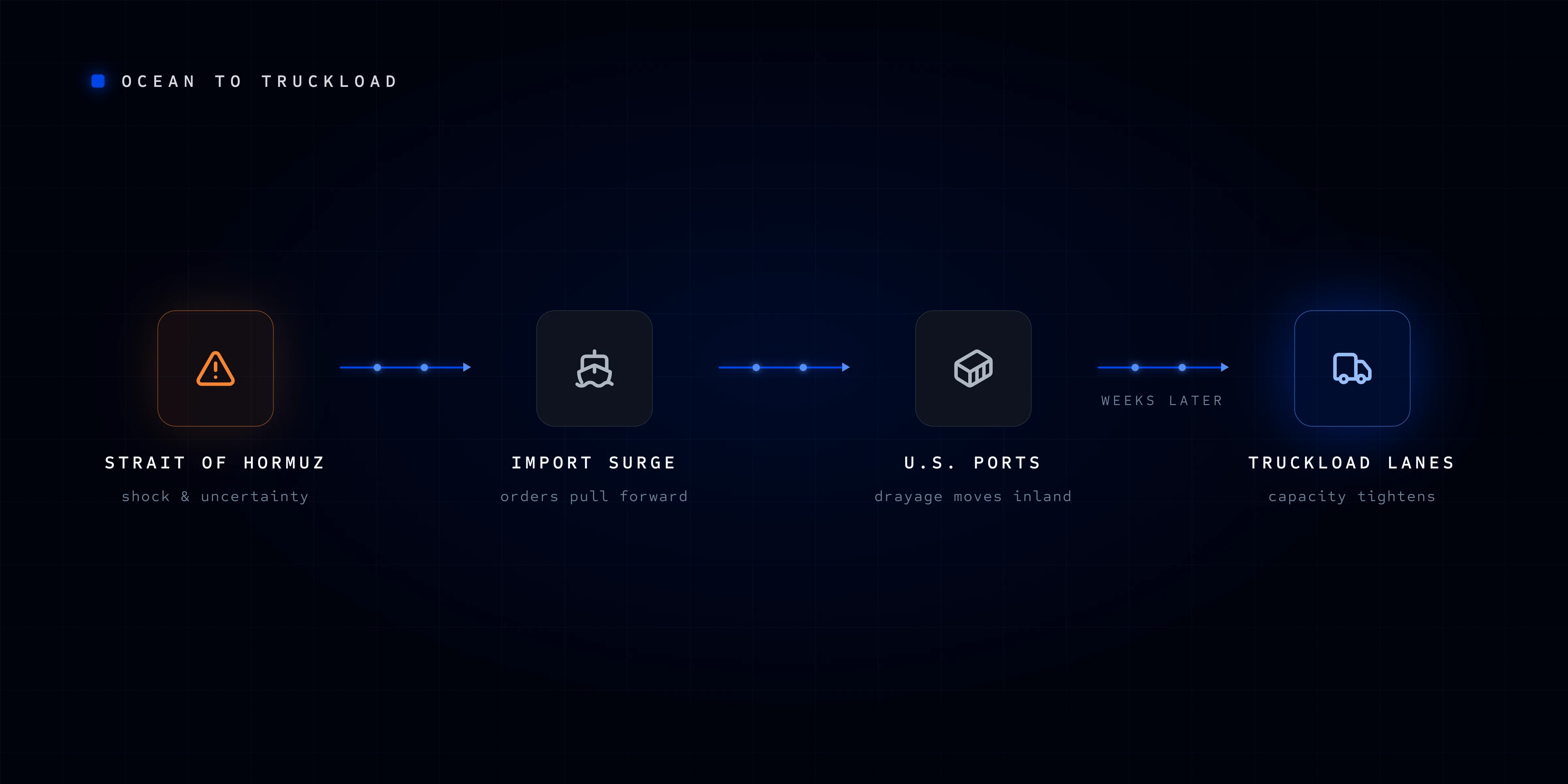
A shock in the Strait of Hormuz doesn't raise your domestic truckload rates directly. It works through demand. Disruption and uncertainty push importers to pull orders forward, which front-loads containers into an early, elevated peak season. Those imports hit U.S. ports, move by drayage, and feed inland truckload lanes, tightening capacity right as the freight arrives. The ocean story becomes a domestic capacity story weeks later.
It's easy to assume a crisis in the Persian Gulf has nothing to do with the trucks moving your freight across the Midwest. It does, just not in the way most headlines imply.
When conflict flared around the Strait of Hormuz in 2026, the first reaction was to expect fuel-driven rate spikes everywhere. And early on, that happened on the ocean side. But analysts now point to peak-season demand, not oil prices, as the main driver of container rates, with crude having eased back toward pre-conflict levels for stretches of the crisis. What didn't fade was something less obvious and more durable: the effect on demand and timing.
That's the real connection between an ocean chokepoint and your truckload lanes, and it's worth understanding, because it's the part that actually reaches your freight.
Not directly, and that distinction matters.
The Strait of Hormuz is an oil and LNG chokepoint, not a container lane to Los Angeles. A disruption there doesn't reroute the containers headed for your distribution center. What it does is inject uncertainty into global shipping, and uncertainty changes how importers behave. When shippers fear disruption, higher costs, or a closing window, they pull orders forward to get ahead of it. That behavior, not fuel prices, is what eventually lands on domestic trucking.
So the honest answer is that Hormuz affects your truckload lanes indirectly, through a chain of demand and timing that plays out over weeks. Follow that chain and you can see it coming.
The path from a Gulf chokepoint to a tight domestic lane runs through a few steps.
Uncertainty pulls imports forward. Facing an unpredictable ocean market, and layering on tariff uncertainty that's been running in parallel, importers front-load. They order earlier and heavier to build buffer, rather than risk a disruption hitting mid-shipment. Analysts have described exactly this in 2026: demand pulled forward into an early peak season across the major trades.
Front-loaded imports compress into a bigger, earlier peak. Instead of a normal fall ramp, volume arrives sooner and in larger waves. Peak season effectively starts early and runs hotter, which is what forecasters have been flagging this year.
Those imports land at ports and need trucks. Every front-loaded container that hits a U.S. port has to move inland. That means drayage out of the port, transload, and then long-haul truckload to distribution centers. A surge of imports is, a few weeks later, a surge of domestic truckload demand.
Demand tightens capacity on the connected lanes. Port-adjacent markets and the inland lanes fed by import gateways feel it first: more loads chasing the same trucks, higher tender rejections, and firmer spot rates. It's the same tightening we've tracked all year in truckload capacity, given an extra push by the timing of the imports.
The ocean disruption you read about in June shows up in your July and August lane costs. That lag is the whole point: it's predictable enough to prepare for.
Here's the part domestic shippers miss: you don't have to import anything to feel this.
Capacity is a shared pool. When a wave of imported freight floods the truckload market on port-adjacent and inland lanes, it pulls carriers toward that freight and away from everything else. A domestic shipper moving goods that never saw an ocean has to compete with all that pulled-forward import volume for the same trucks. Rates firm on lanes that have nothing to do with the Gulf, because the trucks are busy with freight that does.
That's why an event thousands of miles away, on lanes you don't run, can still land on your budget. The freight market doesn't segregate imported capacity from domestic capacity. It's one pool, and a surge anywhere tightens it everywhere.
You can't influence a geopolitical chokepoint or when importers front-load. You can prepare your freight for the tightening that follows. The moves are the same ones that protect you in any firming market, which is exactly why they're worth having in place before the surge arrives.
Watch the leading indicators, not the headlines. The useful signals aren't the crisis updates; they're import bookings, port volumes, and rising tender rejections on port-adjacent lanes. When those move, domestic tightening is usually a few weeks out. Knowing the live market rate on your lanes tells you the moment the squeeze reaches you.
Widen your carrier network before you need it. The shippers who stay covered in a surge are the ones with more quality carriers competing for their freight, not the ones scrambling to add capacity mid-crunch. A deep, vetted network is the single best buffer against a demand spike you didn't cause.
Get your spot and contract mix right ahead of the wave. Committed capacity on your core lanes protects you when the market firms; spot keeps you flexible for the overflow. Rebalancing spot and contract before peak beats reacting once rates have already moved.
Make your freight the freight carriers want. In a tight market, carriers get selective. Consistent volume, fast loading, and flexible scheduling keep you a priority when capacity is scarce and everyone is competing for the same trucks.
None of this depends on predicting the next Gulf headline. It depends on being ready for the predictable domestic echo.
Preparation shows up as coverage and cost control when the surge hits.
In a study of shippers using Dynamic Book It Now, which books spot loads against a live market benchmark across a large carrier network, 85% secured rates below market, averaging 8.5% below. A deep network with live pricing is precisely the buffer that holds when an import wave tightens the lanes around you, because competition on every load matters most when trucks are scarce.
The shippers who handle an import-driven squeeze best aren't the ones who predicted the Strait of Hormuz. They're the ones who built a broad carrier network and real-time visibility before the freight arrived.
Does the Strait of Hormuz crisis affect U.S. truckload rates?
Indirectly, and with a lag. The strait is an oil and LNG chokepoint, so it doesn't reroute containers bound for U.S. ports. What it does is add uncertainty that pushes importers to pull orders forward, front-loading an early peak season. Those imports land at ports and move inland by truck, tightening domestic capacity weeks after the ocean headlines.
How do ocean freight disruptions reach domestic trucking?
Through demand and timing more than fuel. Disruption prompts importers to order earlier and heavier, compressing volume into a bigger, earlier peak. That freight arrives at ports, moves by drayage and long-haul truckload, and competes for domestic capacity, raising tender rejections and firming spot rates on port-adjacent and inland lanes.
Why would domestic freight rates rise if I don't import anything?
Because truckload capacity is a shared pool. When pulled-forward imports flood port-adjacent and inland lanes, carriers follow that freight, leaving fewer trucks for everyone else. A purely domestic shipper still competes with that import surge for the same capacity, so rates can firm on lanes with no connection to the ocean at all.
How can shippers prepare for an import-driven capacity squeeze?
Watch leading indicators like import bookings, port volumes, and tender rejections rather than crisis headlines. Widen your carrier network before the surge, set your spot and contract mix ahead of peak, and make your freight attractive to carriers. Real-time market visibility tells you when the squeeze is reaching your lanes.
The Strait of Hormuz is a reminder that freight is one connected system. A shock on the far side of the world doesn't hit your truckload lanes through fuel prices. It hits them through demand, as importers pull freight forward and that wave rolls through ports and onto domestic lanes weeks later.
You can't control the chokepoint. You can control whether your network and your visibility are ready for the echo. The shippers who prepare for the predictable part come through the unpredictable part just fine.
Ready to reinvent your procurement strategy?


 SOC 2 Type II