
Follow us


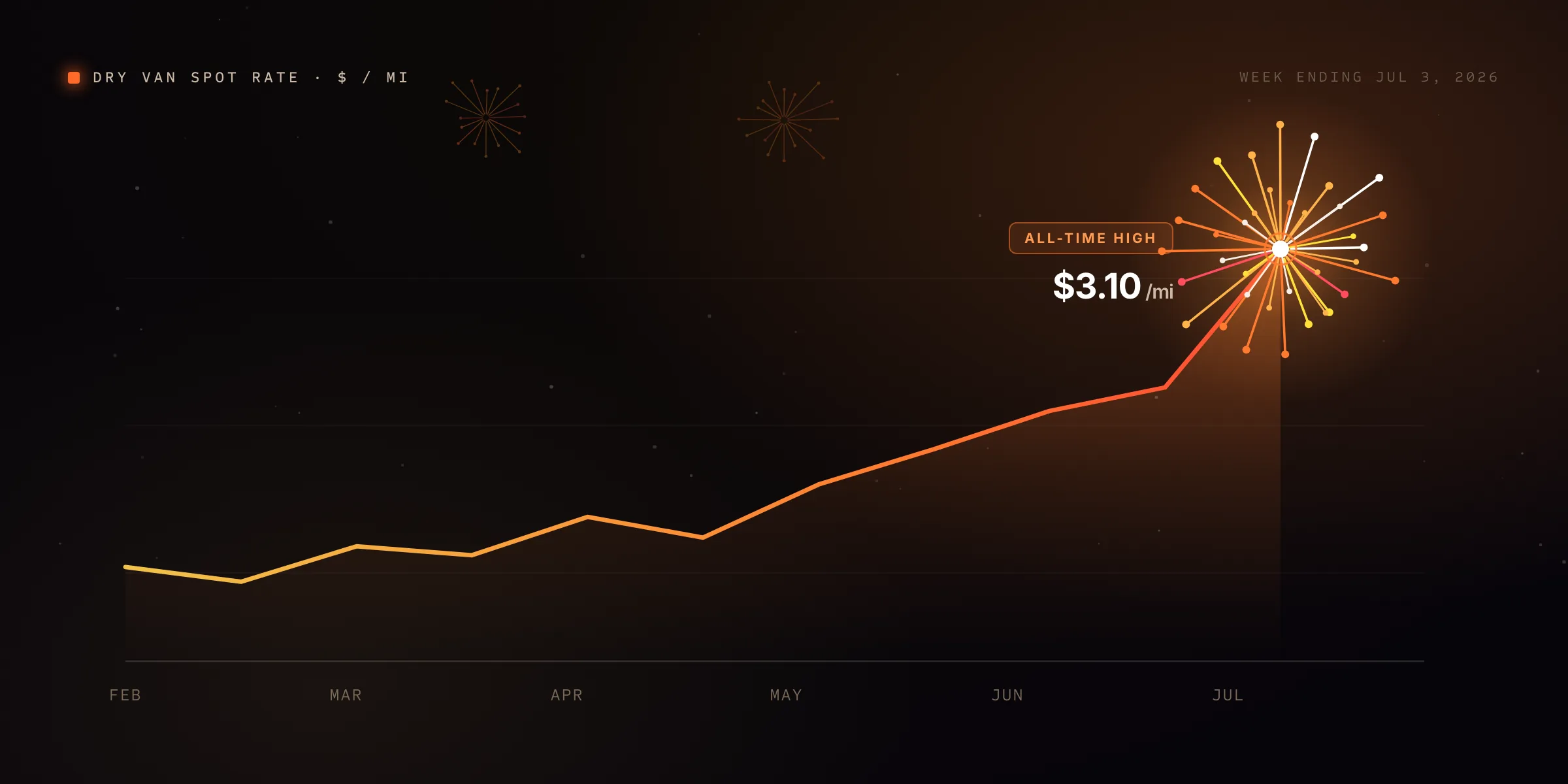
Dry van spot rates hit an all-time high during the week ending July 3, 2026, with reefer near record levels and broker-posted rates running almost 50% above the same week last year. Part of the jump is the usual pre-July 4 seasonal bump, but the year-over-year strength reflects a genuinely tight market. Shippers should expect firm rates to hold and adjust how they buy.
Fireworks this year weren't just in the sky.
According to FTR and Truckstop, broker-posted dry van spot rates hit an all-time high the week ending July 3, reaching roughly $3.10 per mile. Reefer rates climbed to about $3.71 per mile, their fourth-highest level on record, and flatbed held within a few cents of its own record at around $3.82. Zoom out and the picture is starker: FTR noted broker-posted rates are running almost 50% higher than the same week last year, with all-in dry van up more than 40% and flatbed above 50% year over year.
So the obvious question for any shipper watching a number like that: is this a holiday blip, or the market telling you something? The honest answer is both, and the part that matters most to your budget is the part that isn't seasonal.
Two things are happening at once, and it helps to separate them.
The seasonal bump. The week leading into July 4 is one of the most reliably strong weeks of the year for van rates. Shippers push freight out ahead of the holiday, drivers take time off, and load volume compresses into fewer days. FTR called this week's gain exactly what it expected seasonally. On its own, a pre-holiday spike would fade within a couple of weeks.
The underlying strength. What's not seasonal is the year-over-year gap. Rates running nearly 50% above last summer don't come from a holiday; they come from a market where capacity has tightened against demand. That's the signal underneath the noise, and it lines up with what forecasters have been saying all year: truckload capacity is tightening and rates are firming into the back half of 2026.
The takeaway: don't dismiss the record as a holiday quirk. The spike will ease, but the elevated baseline it's sitting on is likely to stay.
Both, eventually, which is the part shippers tend to miss.
Spot rates move first because they reprice in real time. But sustained spot strength pulls contract rates up behind it as carriers push for higher rates at the next bid. Analysts are already seeing contract rates accelerate, with aggregate contract pricing up close to 10% year over year, and expecting bigger contract increases in the second half of 2026 as this spot strength works into bids.
For shippers, that means a hot spot market isn't just a spot-market problem. It's an early warning for your next RFP. The shippers who get caught are the ones treating spot and contract as separate worlds instead of running both deliberately and rebalancing as the market moves.
You can't argue the market down, but you can control how exposed you are to it. Four moves.
None of these predict the market. They reduce how much a spike like this one costs you.
The shippers who ride out a hot market best are the ones who can see it clearly and put competition on every load.
In a study of shippers using Dynamic Book It Now, which books spot loads against a live market benchmark across a large carrier network, 85% secured rates below market, averaging 8.5% below. That below-market gap is worth the most precisely when the market is at a record, because beating a high market rate protects more dollars than beating a soft one.
The platforms that help here combine live market-rate visibility, a deep carrier network, and spot and contract in one place, so you can respond as the market moves instead of finding out where rates went after you've already booked.
Why are freight spot rates so high right now?
As of early July 2026, spot rates hit record or near-record highs from a combination of the usual pre-July 4 seasonal bump and a genuinely tight market. Broker-posted rates were running almost 50% above the same week last year, reflecting capacity that has contracted faster than freight demand. The seasonal part will ease; the elevated year-over-year baseline is expected to hold.
Will freight rates keep going up in 2026?
The immediate post-holiday spike typically softens, but forecasters expect a firm market through the back half of 2026, with contract rates accelerating as sustained spot strength feeds into bids. Most analysts see a firmer, tighter capacity environment rather than a return to the soft rates of 2024.
Do rising spot rates affect contract rates?
Yes. Spot reprices first, but sustained spot strength pushes contract rates up as carriers seek higher rates at the next bid. Aggregate contract rates were already up close to 10% year over year in mid-2026, so a hot spot market is an early signal for your next RFP.
How can shippers avoid overpaying when spot rates spike?
Book against a live, lane-level market benchmark so you know whether a quote is competitive rather than just riding the spike, keep a broad carrier network competing for each load, protect your committed capacity, and time bids with the rate cycle. Real-time visibility is what separates paying the market from beating it.
A record-high spot market is a stress test. It exposes which shippers built resilience before they needed it and which are finding out how exposed they are in real time.
You can't control where the market goes. You can control whether you can see it clearly, how much capacity competes for your freight, and how ready your next bid is. That's what turns a spike from a budget shock into a manageable quarter.
Ready to reinvent your procurement strategy?
 SOC 2 Type II