
Follow us


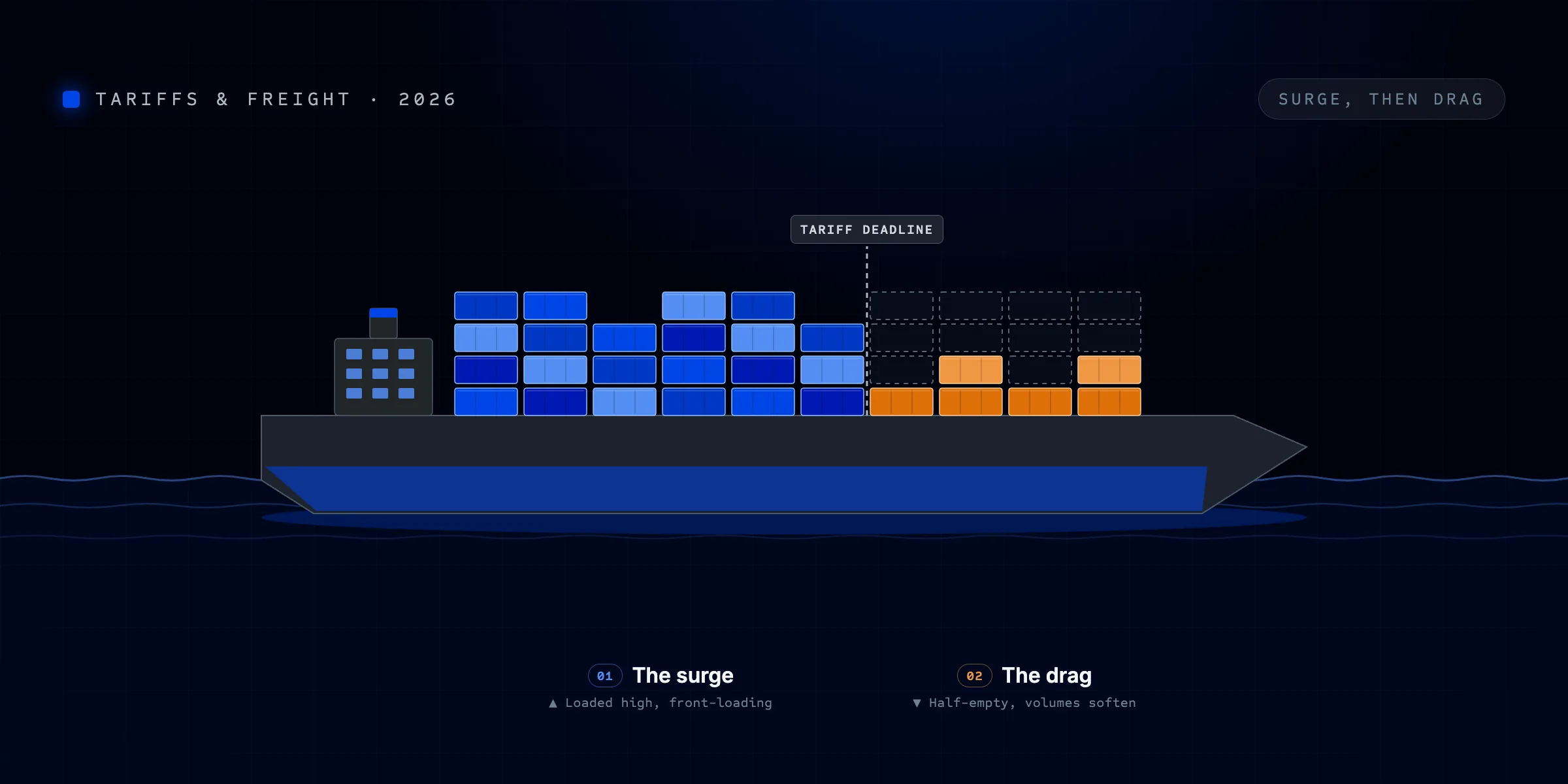
Tariffs move freight in two opposing waves. First, importers front-load, rushing goods in ahead of deadlines, which spikes near-term import and truckload demand. Then, as higher costs dampen buying, volumes soften. Tariffs also raise the cost of imported trucks and parts, adding pressure to capacity over time. The specific rates keep changing, so the shippers who cope best plan for volatility rather than trying to predict policy.
Few forces have whipsawed the freight market in recent years like trade policy. Rates and deadlines change by the month, court rulings reshape what's even in effect, and every shift sends importers scrambling. It's enough to make any shipper want to wait for the dust to settle.
The problem is that the dust doesn't settle, and waiting is its own decision. But here's the useful part: you don't need to predict the next tariff to prepare for what tariffs do to freight. The specific policies change constantly. The pattern they create in the freight market is remarkably consistent, and once you see it, you can plan around it.
Here's what tariffs actually do to your freight, and how to stay ahead of it.
Through two opposing waves that hit at different times.
That whipsaw, surge then drag, is the core of how tariffs move freight. It's less about the rate on any given product and more about the timing shifts the policy creates.
There's a second, slower effect that's easy to overlook: tariffs make trucks more expensive to buy.
A large share of the trucks and parts on U.S. roads are imported. Roughly half of Class 8 trucks sold in the U.S. come from Mexico, and a significant portion of parts come from foreign suppliers, so tariffs on those goods raise what carriers pay for equipment. Analysts including ACT Research have estimated tariffs could add thousands of dollars to the price of a new Class 8 truck. When equipment gets more expensive, some carriers delay buying or shrink their fleets, which thins capacity over time and adds one more upward pressure on rates, on top of the demand swings.
So tariffs squeeze from two directions: they whipsaw freight demand in the short term, and they quietly raise the cost of the capacity that moves it over the longer term.
The instinct to hold still until the rules are clear is understandable. It's also a trap.
Trade policy in this era doesn't reach a stable resting point; it moves from one deadline, ruling, or negotiation to the next. Waiting for certainty means waiting indefinitely, and in the meantime your freight still has to move through whatever surge or drag the latest policy created. Worse, the shippers who wait are the ones caught flat-footed when a front-loading surge tightens capacity or when their contracted rates lapse into a volatile market.
The alternative isn't predicting policy. No one can reliably do that. It's building a freight operation that holds up whichever way policy breaks, so you're ready for the surge and the drag without having to forecast either.
You can't control trade policy. You can control how exposed your freight is to the volatility it creates. The moves are the same ones that build resilience in any uncertain market, which is exactly why they work here.
None of this depends on knowing what the next tariff will be. It depends on being ready for the volatility either way.
In a volatile market, resilience shows up as coverage and cost control when conditions swing.
The shippers who handle tariff-driven whipsaws best treat them like any other uncertain market: they build carrier depth and market visibility ahead of time, so a surge doesn't catch them short and a slack stretch doesn't leave them overpaying. Shippers running structured bids through Emerge's Premier Carrier Program awarded $3.9M in freight across 355 primary and 172 backup carriers in 60 days, the kind of depth that keeps you covered when a front-loading surge pulls capacity, and keeps competition on your freight when the market softens.
The goal isn't to outguess trade policy. It's to be ready for whatever it does to the market, so tariffs become a condition you manage rather than a shock that manages you.
How do tariffs affect freight rates?
Tariffs move freight in two waves. First, importers front-load goods ahead of deadlines, spiking near-term import and truckload demand and tightening capacity on import-heavy lanes. Then, as higher costs soften buying, volumes drop and the market slackens. Tariffs also raise the cost of imported trucks and parts, adding slower upward pressure on rates over time. The net effect is volatility more than a steady direction.
What is front-loading, and how does it affect trucking?
Front-loading, or pull-forward, is when importers rush goods into the country ahead of a tariff increase to avoid the higher cost. Because many importers do it at once, imports surge, ports fill, and that freight moves inland by truck in a compressed window, tightening truckload and drayage capacity, often on lanes with no direct connection to the imported goods.
Do tariffs make freight more expensive for domestic shippers?
They can, even for shippers who import nothing. Front-loading surges tighten shared truckload capacity, firming rates on nearby lanes. Tariffs on imported trucks and parts also raise carriers' equipment costs, which can thin capacity over time. So a purely domestic shipper still feels tariffs through tighter capacity and firmer rates.
How can shippers prepare for tariff-driven volatility?
Don't try to predict policy; prepare for the swings. Watch leading indicators like import volumes and tender rejections, build a deep carrier network that keeps you covered in a surge and honest in a lull, keep your spot and contract mix flexible, and don't let contracted rates lapse into a volatile market. Resilience beats forecasting.
Tariffs are one of the hardest things in freight to predict and one of the easiest patterns to recognize. The rates and deadlines change constantly, but the effect on the market is consistent: a front-loading surge, then a demand drag, with rising equipment costs underneath it all.
You don't need to forecast trade policy to handle it. Watch the real signals, build a carrier network deep enough to cover you in a surge and protect you in a lull, and keep your procurement flexible. The policy will keep changing. Whether it catches you off guard is up to you.
Ready to reinvent your procurement strategy?
 SOC 2 Type II