
Follow us


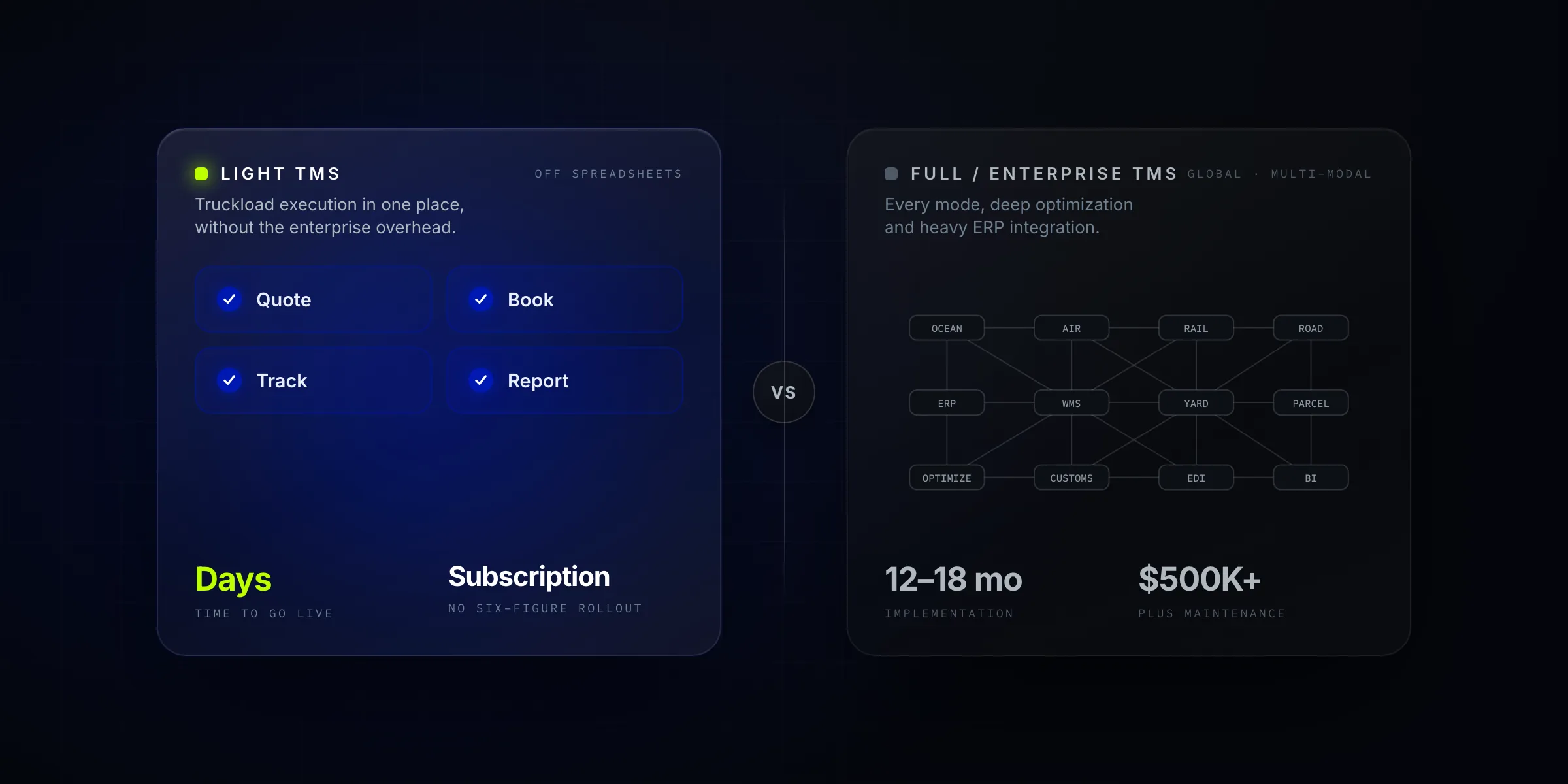
A light TMS is freight software that handles the core work of moving truckloads, quoting, booking, tracking, and reporting, without the cost, long implementation, or complexity of a full enterprise TMS. It's built for shippers getting out of spreadsheets and email who need execution and visibility, not a six-figure system that takes a year to deploy.
At some point, the spreadsheet stops working.
Maybe you took over freight a month ago and inherited a process held together by email and a shared Excel file or maybe volume grew and the manual approach that was fine at five loads a week is breaking at fifteen. Either way, you start looking at a transportation management system, and that's where it gets confusing fast.
Search "TMS" and you land on enterprise platforms built for global supply chains, the kind that cost six figures and take a year to stand up. That is not what you need. What you need is a lighter tool that solves the actual problem: getting freight out of the inbox and giving you control over quoting, booking, and tracking. That category has a name… light TMS.
A light TMS is software that runs the core execution work of freight without the weight of an enterprise system. Quoting, booking, tracking, and reporting, in one place, fast to set up and priced for a normal budget.
The "light" part isn't about being underpowered, it's about scope. A light TMS does the things a shipper actually touches every day and skips the deep configuration, custom optimization engines, and heavy integration work that drive enterprise cost and timelines. The buyer-facing version of the pitch is simple: it gets you out of spreadsheets and emails without the six-figure price tag.
For a lot of shippers, this is their first TMS. They aren't replacing an enterprise platform, they're replacing a spreadsheet, and a light TMS is the bridge.
The difference comes down to scope, cost, and time to value.
A full, enterprise TMS is built for maximum complexity: multi-modal networks spanning ocean, air, rail, and road, deep optimization, heavy ERP integration, and global operations. That power comes at a price. Industry guides put basic cloud deployments in a modest range, while enterprise rollouts regularly exceed $500,000 and 18 months to implement. Running one well also takes dedicated staff to configure and maintain.
A light TMS makes the opposite trade. It covers domestic truckload execution rather than every mode on earth, it goes live in days or weeks instead of quarters, and it's priced as a subscription a single operator can approve rather than a capital project. You give up enterprise-grade optimization and deep customization. In return you get out of spreadsheets this month, not next year.
Here's the contrast at a glance.

Neither is "better." They're built for different shippers. The mistake is buying enterprise complexity you'll never use, or staying in spreadsheets because enterprise was the only option you looked at.
A light TMS fits if you recognize yourself in any of these.
You're a lean team. If freight is one of several hats you wear, or you're running it largely solo, the value is getting hours back and keeping the operation moving when you're out. As one operator told us, it's me, myself, and I. A light TMS is built for exactly that person.
You're new in the seat and modernizing. Plenty of shippers inherit an old-school, manual process and think there has to be a quicker, easier way to do this. There is, and it doesn't require an enterprise budget to get.
You're moving real truckload volume but not enterprise-scale complexity. If you're shipping domestic full truckloads, spot or contract, and your problem is execution and visibility rather than global multi-modal optimization, a light TMS covers you without the overhead.
You want market visibility, not just a system of record. The better light TMS platforms don't only organize your freight. They show you the market rate at the moment you book, so you know whether a quote is competitive. That's the difference between digitizing your spreadsheet and actually improving how you buy.
The specifics vary by platform, but the core is consistent: replace the manual workflow end to end.
That means quoting freight in one place instead of across email threads, booking with your carriers directly, tracking loads without chasing check calls, and pulling a report without a two-day scramble. The good platforms add a market benchmark so you can see how your rates compare, and they handle both spot and contract freight so you're not running two systems.
This is the lane Emerge is built for. It gives shippers truckload quoting, booking, tracking, and reporting in one platform, with market-rate data built in and carriers bidding directly, without the cost or timeline of an enterprise rollout.
What is a light TMS?
A light TMS is freight software that handles core truckload execution, quoting, booking, tracking, and reporting, without the cost, complexity, or long implementation of a full enterprise TMS. It's designed for shippers getting out of spreadsheets and email who need execution and visibility rather than a heavily customized global system.
How is a light TMS different from a full TMS?
A full enterprise TMS supports global, multi-modal networks with deep optimization and integration, often costing six figures and taking a year or more to implement. A light TMS focuses on domestic truckload execution, goes live in days or weeks, and is priced for a smaller budget. The tradeoff is less customization in exchange for far faster, cheaper time to value.
Is a light TMS cheaper than a full TMS?
Generally, yes. Enterprise TMS implementations regularly run into six figures plus ongoing maintenance and dedicated staff, while a light TMS is typically a subscription scaled to a smaller operation. The savings come from narrower scope: a light TMS skips the customization and optimization complexity that drive most enterprise cost.
Do I need a TMS if I only move a few truckloads a week?
If those loads are being quoted and tracked through spreadsheets and email, a light TMS usually pays off well before enterprise volume. The value is less about shipment count and more about getting out of the manual process, gaining market visibility, and being able to report on performance.
The choice was never spreadsheets or a six-figure enterprise platform. That false choice is what keeps shippers stuck in the inbox longer than they should be.
A light TMS is the middle that actually fits most shippers: out of spreadsheets, into one system, with visibility into the market, and live in days instead of a year. If the spreadsheet has stopped working, that's the category to look at.
Ready to reinvent your procurement strategy?
 SOC 2 Type II