
Follow us


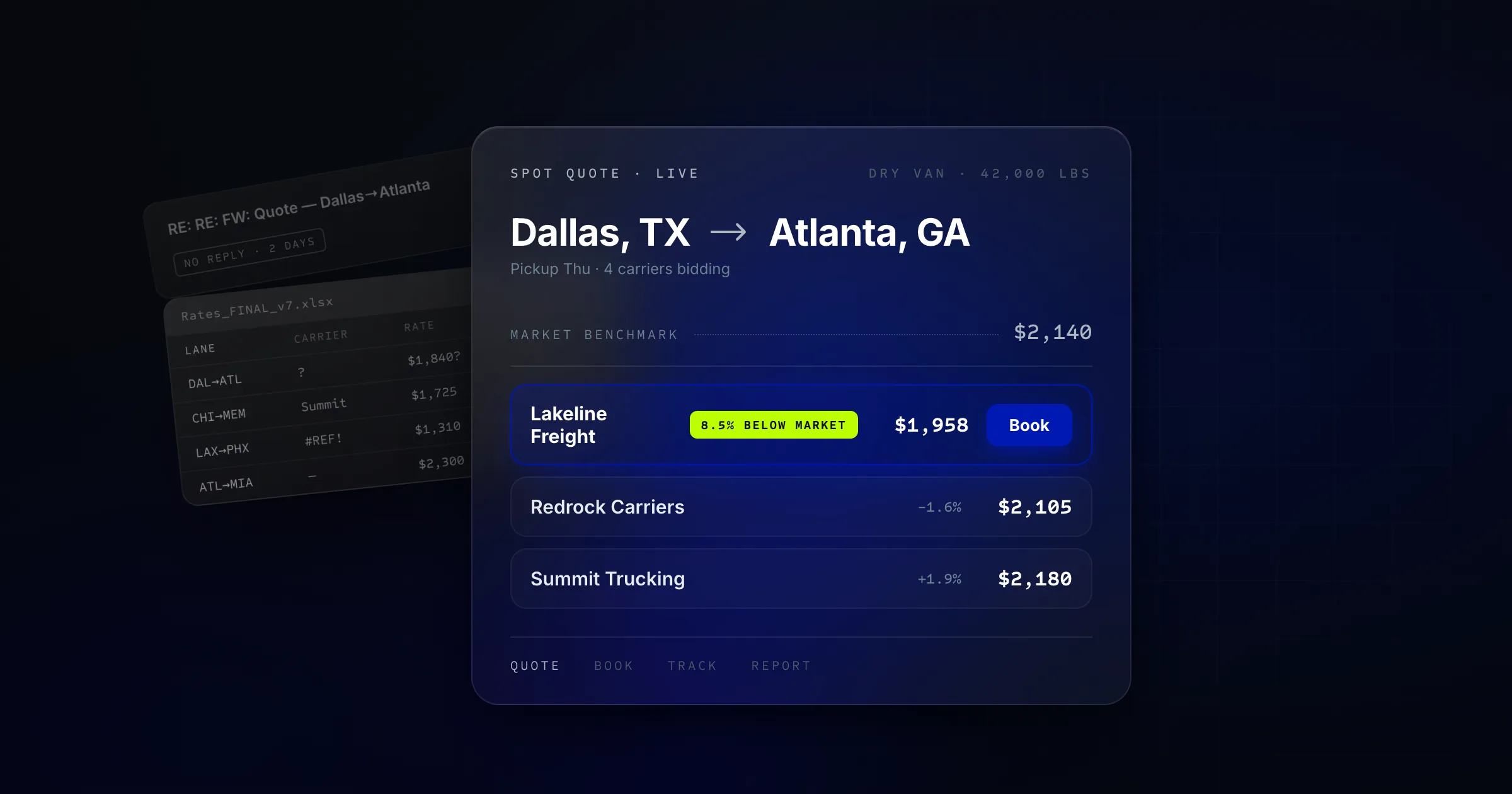
Quoting freight through spreadsheets and email chains costs shippers more than time. It limits every quote to a handful of carriers, hides the market rate, scatters records across inboxes, and leaves nothing to show leadership. Centralizing quoting in one system fixes all four.
A load drops. You email your three or four carriers. Rates trickle back over the next couple of hours, you pick one, and you key the winner into a spreadsheet.
Tomorrow, you do it again.
One shipper described this process to us as sending out carrier pigeons. Another called their setup a glorified Excel spreadsheet, unorganized and chaotic. Both were moving real freight this way, every single day.
And here's the thing: the process works, which is why it survives. But just because it works doesn’t mean it’s “free”. The costs of quoting freight by email never show up on an invoice. They show up in your rates, your hours, and your answers when leadership asks how freight is performing.
Because it's free, it's familiar, and nobody buried in daily loads has time to rebuild their process.
Email feels like zero overhead. Every carrier accepts it. The spreadsheet has years of history in it, even if only one person knows how to read it.
The problem isn't that email is broken. It's that email hides what quoting actually costs. Here's where it adds up.
1. Hours lost to chasing quotes
Every load means the same routine. Write the email, copy the same details into a portal or two, wait, follow up, compare replies that all arrive in different formats, update the spreadsheet. Multiply that by every load, every day.
For lean teams, this becomes the whole job. We hear it constantly from logistics managers who are also running a warehouse, covering production, or, as one put it, in charge of the forklift driver too. When quoting eats the day, everything else gets squeezed. And as another shipper told us: chaos tends to cause burnout.
2. Rates that never get tested against the market
Emailing three or four carriers isn't a market check. It's a poll of three or four opinions.
Without real competition on the lane and a benchmark sitting next to each quote, you're trusting that the numbers coming back are fair. One shipper summed up the doubt that comes with that: when your process doesn't show you options, you don't really know why it's $2,000 for this load.
In a market where spot rates are hitting multi-year highs, tender rejections are climbing, and pricing is swinging hard lane by lane, that blind spot matters. Shippers with broad, competitive networks consistently run below benchmark. Shippers quoting a handful of carriers by email have no way to know where they stand at all.
3. No single source of truth
Where's the quote history for that Dallas lane from March? Somewhere between your inbox, a rate confirmation PDF, and tab six of the spreadsheet.
When records live in email threads, nothing is searchable and nothing is auditable. Your rate history lives everywhere except a system you control.
There's a second cost hiding here: your carriers feel the chaos on their end too. Emailed quote requests get buried or land in junk folders. One shipper put their carrier engagement rate at 50-60%. Nearly half of every request was disappearing into the void.
4. One person holds the entire process
In most manual setups, quoting lives in one person's head. The carrier contacts, the lane knowledge, the spreadsheet logic. If that person is out for a week, freight slows down.
And when leadership asks for a report on freight performance, there's nothing to pull. One logistics manager said it plainly: I can't pull it. I can't even get it. You can't manage what you can't see, and you definitely can't defend your numbers with it.
The fix isn't more discipline with the spreadsheet. It's moving quoting into one system built for the job.
That looks like this:
You don't give up your network. You give up the inbox. This is the gap a light TMS fills, and it's why platforms like Emerge’s ProcureOS exist: one place to quote, book, track, and report, with your own network bidding free.
The shift shows up in the numbers.
In a study of shippers using Dynamic Book It Now, Emerge's automated spot booking tool, 85% of users secured rates below market. The average came in 8.5% below the market rate, and the best performers ran 23% below. That isn't about squeezing carriers. It's what happens when more of the right carriers see every load and the market rate is visible at the moment of booking.
It shows up in the workload too. Golden State Foods called having everything housed in one tool revolutionary for their transportation operation. EZRack's logistics team said it even more simply: we got planners out of emails and spreadsheets.
The pattern repeats across food and beverage shippers, manufacturers, and distributors. The work doesn't disappear. It just stops being manual.
How do I stop quoting freight in spreadsheets and emails?
Move quoting into a single platform where your carriers bid side by side. Look for three things: your existing network can join, a market benchmark is available, and history logs automatically. Most shippers are up and running in days, not months.
Do my carriers have to pay to use a quoting platform?
On Emerge, no. You invite your existing carriers at no cost to them, and they bid directly in the platform instead of over email.
Why are my carriers not responding to my emailed quote requests?
Emailed requests often land in junk folders or get buried, and carriers deprioritize formats that take effort to answer. Shippers quoting by email report engagement rates as low as 50-60%. A centralized platform gives carriers one place to see and bid on your freight, which lifts response rates.
What is a light TMS?
A light TMS handles the daily execution work of freight: quoting, booking, tracking, and reporting, without the typical high price tag or long implementation of a full enterprise TMS. It's built for shippers who need to get out of manual processes fast.
Spreadsheets and email will keep moving your freight. They'll just keep charging you for it: in hours, in rates you can't verify, and in questions you can't answer.
The shippers getting ahead in this market aren't working harder inside the inbox. They got out of it.
Ready to reinvent your procurement strategy?
 SOC 2 Type II