If you ship LTL, freight class quietly decides a big part of what you pay. Get it right and your quote holds. Get it wrong and the carrier's dimensioner finds out for you, usually a week later, on a corrected invoice.
The rules also changed. On July 19, 2025, the NMFC moved a large share of freight to a single 13-tier density scale, and the dockets since then have kept going in the same direction. A lot of the freight class guides still ranking on Google were written for the old system.
This guide walks through how to calculate freight class the way it works now: the formula, the current density scale, four worked examples (including one of the most common pallet mistakes behind reclasses), and what to do when density is not the whole story. There's a calculator right below if you just need a number.
The short answer: measure each handling unit at its longest, widest and tallest points with the pallet included, multiply length x width x height in inches, divide by 1,728 to get cubic feet, then divide the weight in pounds by the cubic feet. That gives you density in pounds per cubic foot. Find that density on the 13-tier scale and you have your estimated class.
Built on the NMFC 13-tier density scale in effect since July 19, 2025. Add each pallet, crate or skid separately, with the pallet included in height and weight.
| Density (lb per cubic foot) | Class now | Before July 19, 2025 |
|---|
An estimate for density-rated freight. Items with handling, stowability or liability provisions, and anything your carrier contract classes differently (an FAK, for example), can land in another class. Confirm the NMFC item number before you book.
Quote LTL with your own carriers in Emerge
Freight class is a number from 50 to 500 that tells an LTL carrier how easy or hard your shipment is to move. Lower numbers mean dense, durable, easy-to-load freight and lower rates. Higher numbers mean light, bulky or fragile freight that takes up space on the trailer and costs more to haul.
There are 18 classes in total: 50, 55, 60, 65, 70, 77.5, 85, 92.5, 100, 110, 125, 150, 175, 200, 250, 300, 400 and 500.
Classes are published in the National Motor Freight Classification (NMFC), which is maintained by the National Motor Freight Traffic Association (NMFTA). Each commodity in the NMFC has an item number, and that item tells you how the commodity is classed: either by a fixed class or by density.
The NMFC weighs four transportation characteristics:
One thing that trips people up: freight class is an LTL (less-than-truckload) concept. If you're buying a full truck, you're paying for the truck, not the class. If you're not sure which mode a shipment belongs in, our guide on spot vs contract freight covers how shippers decide how to buy each load once the mode is clear.
If your team learned freight class before mid-2025, some of what you know is out of date. Here is the short version of what the NMFTA has changed.
Docket 2025-1 (effective July 19, 2025). This was the big one. The NMFC consolidated roughly 2,000 commodity listings and moved them to density-based classification, and it replaced the old 11-tier density scale with a 13-tier one. The two new tiers sit at the dense end: freight at 35 to under 50 pounds per cubic foot now rates class 55, and freight at 50 or more rates class 50. Under the old scale, anything at 30 pounds per cubic foot or more topped out at class 60. You can read the NMFTA's own guidance in Decoding Density.
Docket 2025-2 (effective December 6, 2025). More consolidation in the same direction. For example, 51 separate metals items were cancelled and replaced by one consolidated entry on the 13-tier density scale.
Docket 2026-1 (effective May 23, 2026). Updated the classification of several commodity groups, including drugs, medicines and personal care products, and business and office machines, again leaning on density as the primary factor.
Docket 2026-2 (decided October 9, 2026). The NMFTA acted on all 33 proposals in Disposition Bulletin 1374. It approved 28, and many of them move more commodity groups onto the 13-tier density scale, including china and glassware, building woodwork, farm equipment and vehicle parts. Those changes take effect December 12, 2026. The one to watch was a rewrite of the mixed freight rule (Item 640), and it was disapproved. As the NMFTA's VP of Operations, Keith Peterson, explained in a FleetOwner column, it would have required shippers to identify articles separately on the bill of lading, class each handling unit by density on the 13-tier scale, and give weights and dimensions for each handling unit. The current mixed freight rules stay in place.
The direction is clear even if the details keep moving. Density is now the main way freight gets classed, and accurate dimensions per handling unit are what carriers check. That's why the rest of this guide is built around density.
Here's the scale that applies to density-rated freight since July 19, 2025. Density is in pounds per cubic foot.
Notice what's missing. Classes 77.5, 110, 150, 200 and 500 are not on the density scale at all. If an item lands in one of those, it's because the NMFC assigns that class to the specific commodity, not because of its density. That matters later when we talk about when density is not the whole story.
A handling unit is the thing the forklift picks up: a pallet, a crate, a skid, a drum. Measure each one separately.
Multiply length x width x height in inches to get cubic inches, then divide by 1,728 (the number of cubic inches in a cubic foot).
Cubic feet = (L x W x H in inches) / 1,728
If you have several identical units, work it out for one and multiply by the count.
Use the total weight of each handling unit in pounds, including the pallet, packaging, stretch wrap and anything else that travels with it. Guessed weights are another common cause of corrected invoices, along with missing pallet height.
Density (pounds per cubic foot) = weight in pounds / cubic feet
Look up your density on the chart above. That's your estimated class for density-rated freight.
The density scale only applies if your commodity's NMFC item is density-rated. Some items have a fixed class, and some carry handling, stowability or liability provisions that can move the class. Look up the item (more on how below) and put the item number and class on the bill of lading. If you skip this step, the number from steps 1 to 5 is an educated guess.
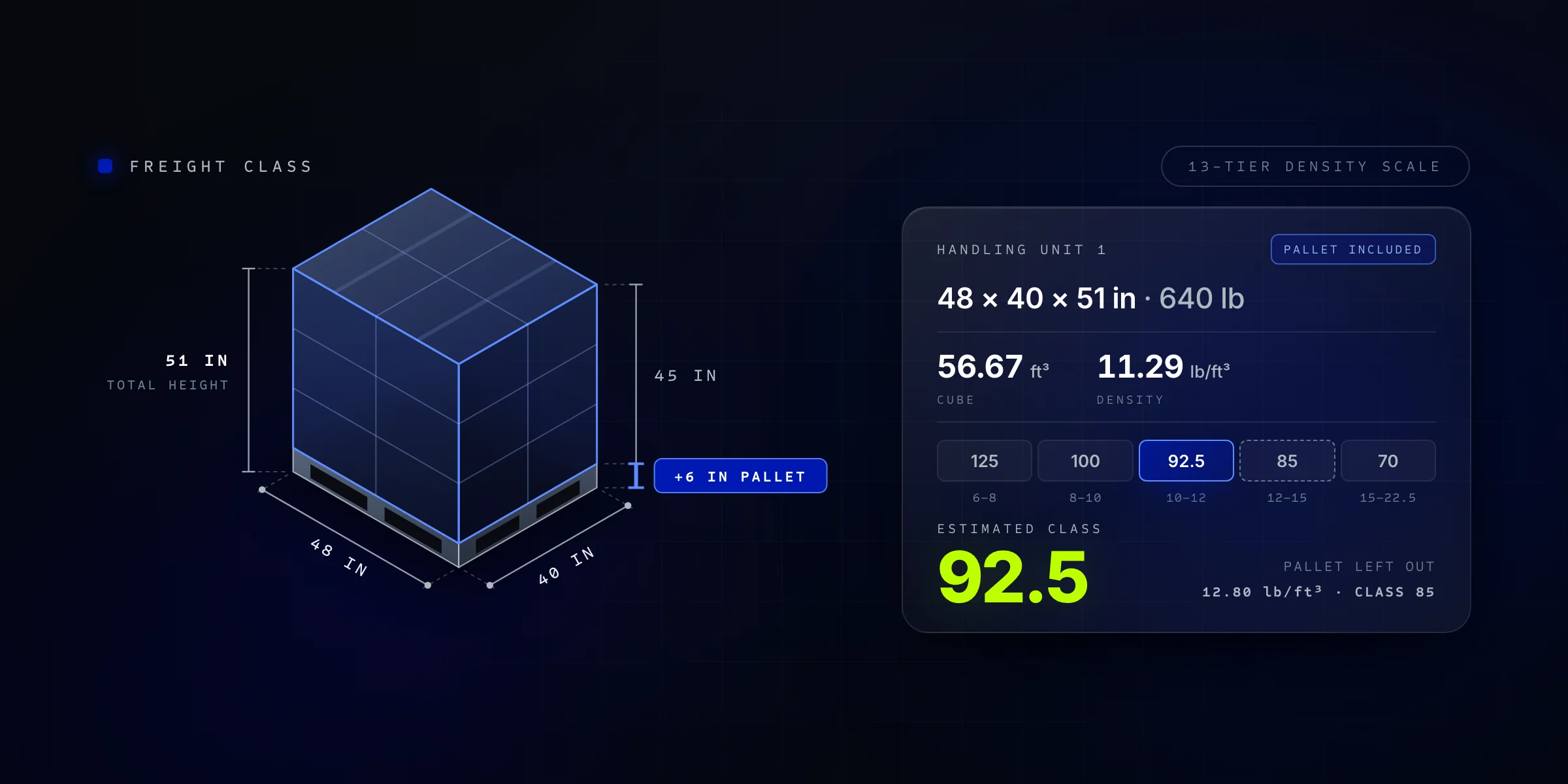
A shipper sends one pallet of boxed goods. The product stack is 48 x 40 inches and 45 inches tall, sitting on a pallet that adds 6 inches. The whole unit weighs 640 pounds.
What the shipper entered (no pallet height):
What the carrier measured (pallet included, 51 inches):
Six inches of pallet moved the shipment a full class. The carrier rebills at 92.5 and, depending on its rules tariff, may add an inspection or reclassification charge on top. Nothing about the freight changed. Only the tape measure did.
Now a shipment with two different pallets on one bill of lading.
Pallet A, light and tall: 48 x 40 x 60 inches, 450 pounds
Pallet B, dense and short: 48 x 40 x 40 inches, 900 pounds
If you lumped them together, you'd get 1,350 pounds over 111.11 cubic feet, a density of 12.15 and class 85. That blended number is tempting, but carriers generally rate each handling unit on its own density. List the two pallets as separate lines, one at 125 and one at 70, so the quote matches what the carrier will see on the dock.
The calculator above handles this for you: add each handling unit as its own row and it shows the class for every unit plus the blended figure.
Your supplier sends dimensions in centimeters and kilograms: one crate, 120 x 100 x 150 cm, 300 kg.
The calculator has a cm / kg switch, so you can skip the conversions entirely.
One pallet of metal parts, 48 x 40 x 40 inches, 1,800 pounds.
If you ship dense freight and your quotes, contracts or FAK agreements were set before July 2025, it is worth checking whether they still reflect the classes your freight rates at now. The calculator flags any unit whose class changed between the old and new scales.
Density decides most freight now, but not all of it. Four situations where your density math is not the final answer:
The official lookup tool is the NMFTA's ClassIT+. It is paid: the web app starts at $371 per seat per year for non-members on the single-seat plan ($321 for NMFTA members), with lower per-seat prices on larger plans. There is no free version. You can check current plans on the ClassIT+ pricing page.
If you don't ship enough LTL to justify a license, ask your carriers. Many will confirm the item number for commodities you ship regularly, and it's worth getting that confirmation in writing and saving it with your product master data so nobody has to look it up again.
LTL rates are built per hundredweight (every 100 pounds), and the rate per hundredweight goes up as the class goes up. On the same lane with the same weight, a class 92.5 shipment costs more than a class 85 shipment, and a class 125 shipment costs more again. The exact gap depends on the carrier's base rates and your discount, which is why two carriers can disagree on the cost of a reclass.
That's also why class has a place in your wider freight spend optimization work, not just in the shipping office. Class errors don't show up in the quote. They show up later, in rebills that make your LTL cost per shipment drift away from budget. If you report on freight cost, a recurring gap between quoted and invoiced LTL charges is usually a classification problem, and good freight reporting and analytics makes it visible by lane, facility and carrier.
LTL carriers measure freight on the dock, more and more often with automated dimensioners that capture dimensions and weight as the freight moves through the terminal. When their numbers don't match your bill of lading, they reclass the shipment and send a corrected invoice at the higher class. Many carriers also charge an inspection or reweigh fee, set in their rules tariff.
You can dispute a reclass, but you need evidence: photos of the freight with a tape measure, a scale ticket, and the NMFC item you used. In practice it's cheaper to get it right before pickup.
Nine common mistakes that lead to reclasses:
You can't argue your way into a lower class, but you can ship freight that earns one.
Many shippers run truckload with real discipline: they benchmark their freight rates, run an annual freight RFP, and score carriers with carrier scorecards. LTL often runs on habit: a couple of carrier portals, an email to a broker, quotes pasted into a sheet. We've written about the real cost of quoting freight in spreadsheets and email, and LTL is where that cost hides best, because the class on the quote is only as good as the measurement behind it.
Three habits make class part of procurement instead of an afterthought:
1. Put accurate dimensions and class on every quote request. A quote built on the wrong class is not comparable to anything. When you compare LTL rates side by side, every carrier should be pricing the same freight. In Emerge, shippers compare LTL rates from their own carriers and brokers on one screen, and the shipment details that set the price are locked at dispatch, so nobody books against a rate that no longer matches the freight.
2. Bring class into your LTL contract bid. When you go to market for LTL contracts, include your class mix per lane, your FAK expectations and your historical reclass rate. ProcureOS Pro shippers can run an LTL contract bid with lane templates they build themselves, alongside their truckload bids. If you haven't run one before, start with our guide on how to run a freight RFP and the free freight RFP template.
3. Track reclasses like you track rates. A reclass is a rate increase you didn't negotiate. Watch the rebill rate by carrier and facility, and treat a rising one the way you'd treat a rising rate. It belongs in the same conversation as peak season surcharges and fuel surcharges: costs that never show up in the base rate but always show up on the invoice. When you need to prove freight savings to your CFO, fewer rebills is one of the easiest wins to document.
If you're comparing tools for this, we put together a guide to the best freight quoting software and a more detailed look at quoting tools built for shippers, including where Emerge is and isn't the right fit.
Print this, tape it next to the scale.
Measure each handling unit at its longest, widest and tallest points with the pallet included, multiply length x width x height in inches, and divide by 1,728 to get cubic feet. Divide the weight in pounds by the cubic feet to get density in pounds per cubic foot, then find that density on the NMFC 13-tier density scale. Confirm the NMFC item number before booking, because some items have a fixed class.
On the 13-tier density scale, class 70 covers freight with a density of 15 to under 22.5 pounds per cubic foot. Many dense, durable goods on pallets land here. An item can also be assigned class 70 directly by its NMFC item.
Class 55 covers freight with a density of 35 to under 50 pounds per cubic foot. It was added to the density scale on July 19, 2025. Before that, freight this dense rated class 60.
Class 250 covers density of 2 to under 4 pounds per cubic foot, and class 300 covers 1 to under 2. Class 200 is not on the density scale, so an item in class 200 has that class assigned by its NMFC item. All three are light, bulky freight that costs more to ship per pound.
Calculate density for each handling unit separately: its own dimensions, its own weight, its own class. If the pallets land in different classes, list them as separate lines on the bill of lading. Carriers generally rate each handling unit on its own density.
Yes. Include the pallet's height in your dimensions and its weight in your total. Leaving the pallet out is one of the most common reasons shipments get reclassed.
No. Freight class is used for LTL pricing. Full truckload is priced for the truck and the lane, not the class of the freight inside it.
The official source is the NMFTA's ClassIT+ lookup tool, which is a paid subscription. Your LTL carriers can also confirm the NMFC item for commodities you ship regularly.
The NMFTA updates the NMFC through dockets, currently two a year. Recent dockets took effect July 19, 2025, December 6, 2025 and May 23, 2026. The changes approved in Docket 2026-2 take effect December 12, 2026. Recheck your classes after each one.
The carrier measures the freight, reclasses it and rebills at the correct class. Many carriers also charge an inspection or reweigh fee under their rules tariff. You can dispute a reclass with photos, a scale ticket and the NMFC item you used, but measuring accurately before pickup is cheaper.
Freight class is the one number on an LTL quote that can quietly change after you book. Measure it right, compare rates on the same freight, and track the rebills.
If your team still quotes LTL across carrier portals and email, take a look at how Emerge handles freight quoting software for shippers, from quote through automatic shipment tracking. It connects to your TMS, and AI spend optimization shows you where your freight budget is going. If you're moving off spreadsheets, building a multi-carrier shipping strategy, or want to understand how freight pricing models work before your next bid, those guides are a good next read. For truckload, here's what goes into the cost of a truckload shipment and how a spot rate estimate is calculated.
Want to see it on your own freight? Book a demo.


 SOC 2 Type II