
Follow us


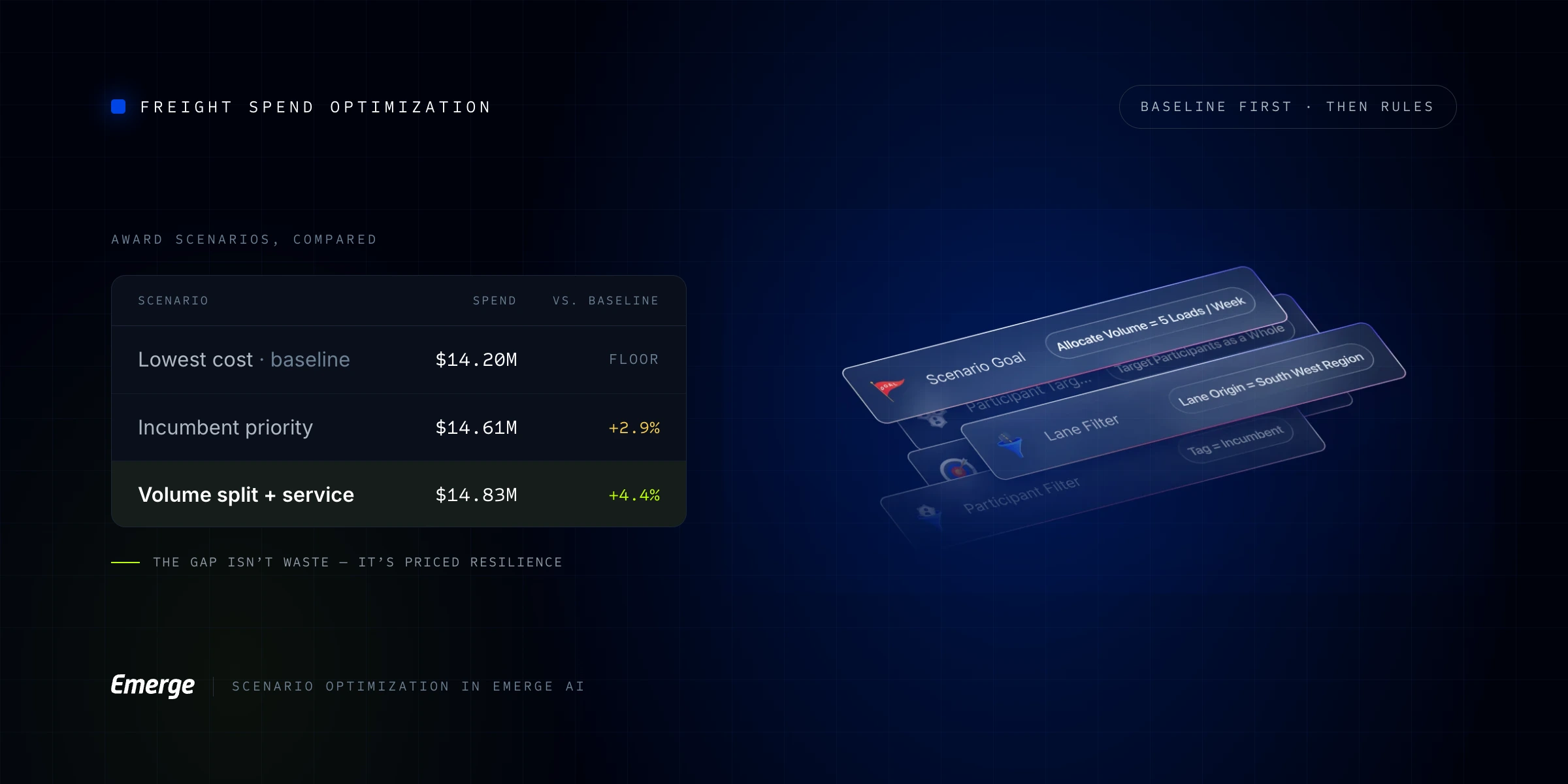
Freight spend optimization means building and comparing multiple versions of an RFP award before committing: a lowest-cost baseline first, then rule-based scenarios that apply constraints like incumbent priority, volume allocation, and service standards, with every trade-off priced against the floor. The result is an award built for cost, coverage, and service together, which is what holds up when the market tightens and price-only routing guides start failing.
Every freight RFP produces a tempting spreadsheet: sort by rate, award every lane to the cheapest bid, and show your CFO the biggest possible number. Almost no experienced shipper actually awards that way, and this bid season, the first since the market flipped and handed carriers real leverage again, the reasons have never been clearer.
The discipline top shippers use instead is spend optimization: building multiple versions of the award, comparing them side by side with every trade-off priced, and choosing the one built for the market they'll actually ship in. To break down how it works, we put the questions shippers ask most to the Emerge product team, the people who support RFP events of every size each year. Their answers, below.
Award optimization is one step in a wider routine. Our guide to transportation spend management shows where it sits alongside benchmarking, execution control and reporting.
There are two basic ways to allocate volume once bids are in.
In practice, nearly every sophisticated shipper runs a hybrid: generate the lowest-cost baseline first, then layer constraints and measure exactly what each rule costs against that floor. That gap isn't waste. It's the price of resilience, made visible so you can decide it deliberately.
Constraints are the guardrails that make an award match your strategy, not just your spreadsheet.
Three come up more than any others in the events we run: only award to specified participants, protecting lanes for incumbents or carriers with unique capabilities; allocate volume, splitting high-volume lanes across multiple carriers so a single rejection wave can't strand your freight; and favor specified participants, a thumb on the scale for proven partners without locking others out. Shippers with specialized freight go further, rules for white-glove service, equipment types, or regional coverage.
Every constraint carries the same honest trade: you may pay above the lowest bid on some lanes in exchange for the strategic benefit. What optimization changes is that the trade becomes measurable. You see precisely what "favor incumbents" costs against the baseline, and precisely what it buys, instead of discovering both in February.
Because price-only awards are exactly what's failing right now, and this is the first bid season being priced by carriers with leverage.
When the market flipped at midyear, carriers got selective and tender rejections climbed to multi-year highs, and the routing guides that broke first were the ones awarded purely on price in a softer market. Bids priced to win rather than to operate got rejected the moment conditions changed, and every failed tender rolled into an expensive spot scramble. The bids arriving this season will reflect the new reality too: ACT Research's 2026 outlook has contract pricing already rising and the recovery supported as much by reduced supply as by demand, meaning the rates in your inbox are being set by carriers who no longer have to win on price alone. A lowest-cost award is a bet that the market stays soft. Constraints are how an award absorbs a market that doesn't.
Carriers are also choosing which bids deserve their sharpest pricing this fall. A structured event with clean lane data and a clear award approach signals a shipper worth pricing well; a messy one gets the hassle priced in. Structure and scenarios aren't just internal hygiene this season. They're how you earn better bids in the first place, before optimization even starts.
Five practices, learned across thousands of events.
Optimized awards show up in coverage, not just cost.
Shippers running structured bids through our Premier Carrier Program awarded freight across 355 primary and 172 backup carriers in 60 days, volume spread and backups built into the routing guide by design, before anyone needed them. That's a constraint strategy doing its job: when a primary tightens, the award already contains the answer.
The tooling that makes it manageable is the point of scenario optimization in Emerge AI: side-by-side scenarios in minutes, constraints validated against your actual bids, and the cost of every strategic choice visible before you commit.
What is freight spend optimization?
Building and comparing multiple versions of an RFP award before committing: a lowest-cost baseline that establishes the minimum-spend floor, then rule-based scenarios applying business constraints like incumbent priority, volume allocation, and service requirements. Comparing scenarios side by side prices every strategic choice, turning award strategy into a measured decision instead of a spreadsheet sort.
Why shouldn't you award every lane to the lowest bidder?
Because the lowest bid and the bid that will actually operate are often different things, especially in a tight market. Price-only awards concentrate risk, strain carrier relationships, and produce routing guides that fail when carriers get selective, which is precisely what happened when the market flipped at midyear. The lowest-cost scenario is the right baseline for comparison, not the award.
What constraints do shippers use most in freight RFPs?
Three lead: restricting certain lanes to specified carriers, protecting incumbents or unique capabilities; allocating volume across multiple carriers on high-volume lanes to spread risk; and favoring proven participants in the allocation. Shippers with specialized freight add service-specific rules like white-glove requirements or equipment standards.
How should shippers approach RFP season in 2026?
As the first bid season in years where carriers have leverage: structure the event cleanly to earn carriers' best pricing, generate the lowest-cost baseline, build rule-based scenarios with coverage and service constraints, keep the process fast so awards price against the current market, and plan mini bids mid-cycle so the annual event doesn't have to predict the whole year.
The cheapest award on paper is rarely the cheapest year of freight. Top shippers know their real objective is an award that performs, on cost, on coverage, and on service, and spend optimization is how they get all three priced against each other before signing anything.
Run the baseline. Build the rules. Compare the scenarios. Award the one built for the market you're actually in, because this season, that market is pricing back.
 SOC 2 Type II