
Follow us


Most explanations of freight pricing are written for the people selling it. They show a carrier or a broker how to build a rate that wins the load and protects the margin. That is useful if you are quoting freight. It is much less useful if you are the one paying the invoice.
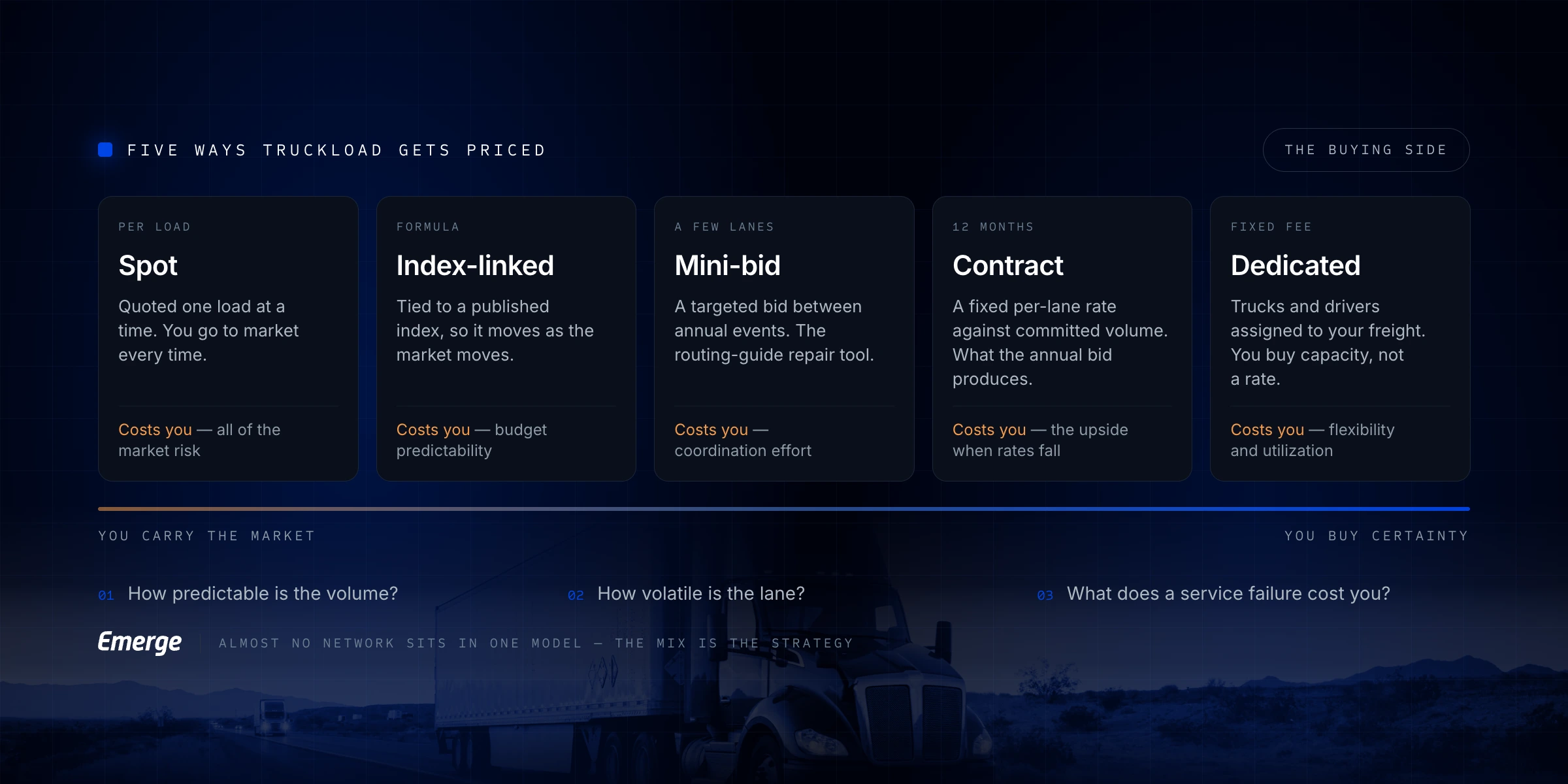
This one is for the buying side. Five ways truckload freight gets priced, what each one actually costs you, and how to decide which belongs on which lane.
A freight pricing model is the commercial structure behind a rate: how the price gets set, how long it holds, and who absorbs the cost when the market moves. In domestic truckload the main models are spot, contract, mini-bid, dedicated and index-linked. Most shippers run several at once, because different lanes carry different risk.
Choosing between them is not really a pricing decision. It is a decision about how much rate certainty you want to buy, and what you are willing to give up to get it.
A rate quoted for one load, good for that load only. You go to market each time.
When it fits: low or irregular volume, lanes you cannot forecast, overflow above a contracted commitment, and anything seasonal. If you move a lane four times a year, there is nothing to contract.
What it costs you: you carry all the market risk. In a tight market the number moves against you and you have no protection. Spot also costs time, because somebody has to work each load. That is the hidden expense most shippers underestimate, and it is worth reading how a spot rate estimate is built before you assume the quote in front of you is the market.
A fixed rate per lane, agreed for a set period, usually a year, in exchange for committed volume. This is what the annual bid produces.
When it fits: steady, forecastable volume on lanes you run every week. The more predictable the lane, the more a carrier can price it sharply, because they can plan around it.
What it costs you: the rate is fixed and the market is not. Contract pricing protects you when rates rise and overcharges you when they fall. It also degrades quietly. When your contract rate drifts away from the market, carriers start declining the loads, and you end up covering contracted freight at spot anyway. We have written on what happens when rejections climb, because that is usually a pricing signal rather than a carrier problem. If you are weighing the two directly, the spot and contract comparison goes deeper.
A small, targeted bid on a handful of lanes, run between annual events. Same mechanics as a contract bid, much smaller scope.
When it fits: a lane has moved, a carrier has failed, a facility has opened, or the market has shifted enough that your annual rate no longer makes sense. It is the repair tool for a routing guide.
What it costs you: effort, mostly. Each event takes coordination, and running too many fragments your carrier relationships. The usual pattern is to run the annual bid as the foundation and use mini-bids to keep the worst lanes current. That combination is what people mean by refreshing lanes through the year rather than once.
You pay for trucks and drivers assigned to your freight, typically priced on a fixed weekly or monthly basis rather than per load.
When it fits: high volume on a consistent lane or out of a single facility, tight service requirements, or freight nobody wants to haul on the open market. You are buying guaranteed capacity, not a cheap rate.
What it costs you: flexibility and utilization risk. You pay for the equipment whether your volume shows up or not, which makes dedicated expensive on anything seasonal. It usually only pencils when your volume is both high and boringly consistent.
A rate tied to a published market index or a formula, so it moves as the market moves. Fuel surcharges are the version almost everyone already runs.
When it fits: long contracts, volatile lanes, and relationships where both sides would rather adjust automatically than renegotiate. It removes the argument about who is above or below market.
What it costs you: budget predictability, and a lot of definitional detail. Which index, measured over what window, with what floor and ceiling, reset how often. Get those wrong and you have a contract neither side can forecast. Index-linked also only works if you and the carrier trust the same reference.
Three questions settle most of it.
Almost no network sits in one model. A realistic shape is contract on the core lanes that carry most of the volume, mini-bids on the handful that have drifted, and spot on the tail. The mix is the strategy.
Treating the annual bid as the only pricing event of the year.
A rate agreed in October is a forecast about the following twelve months, and forecasts age. By the middle of the year some of those lanes are above market and some are below, and the ones below are the lanes your carriers are quietly declining. Shippers usually find out through fallout rather than through a rate review, which means the first signal is a coverage problem rather than a pricing one.
The fix is not a different model. It is checking your rates against the market often enough to notice the drift, then repricing the lanes that have moved instead of waiting eleven months to fix all of them at once. That is also where spot procurement stops being a fallback and becomes a measurement: what you are paying on the open market this week is the clearest evidence of what your contract rates should look like.
In domestic truckload the common structures are spot rates, contract rates, mini-bid rates, dedicated pricing and index-linked rates. Fuel surcharges sit alongside all of them, and accessorials are billed separately again.
A spot rate applies to a single load and reflects the market that day. A contract rate is fixed for a period, usually a year, in exchange for committed volume. Spot follows the market, contract insulates you from it in both directions.
It is the agreement that sets a per-lane rate for a defined period against a volume commitment. The important terms are rarely the rate itself. They are the committed volume, the tender lead time, the accessorial schedule and what happens when either side misses.
There is no fixed answer, but annually is usually too infrequent on volatile lanes. Most shippers who avoid mid-year fallout are reviewing performance against the market quarterly and repricing the lanes that have drifted rather than the whole network.
None of them, reliably. Spot is cheapest in a soft market and the most expensive in a tight one. Contract is the reverse. The cheapest network over a full year is usually the one that matched the model to the lane rather than the one that picked a single approach.
A rate that adjusts automatically against a published market index or an agreed formula, rather than staying fixed. Fuel surcharges work this way. Applied to linehaul it removes the renegotiation, but only if both parties agree on the index, the measurement window and the reset frequency.
 SOC 2 Type II