
Follow us


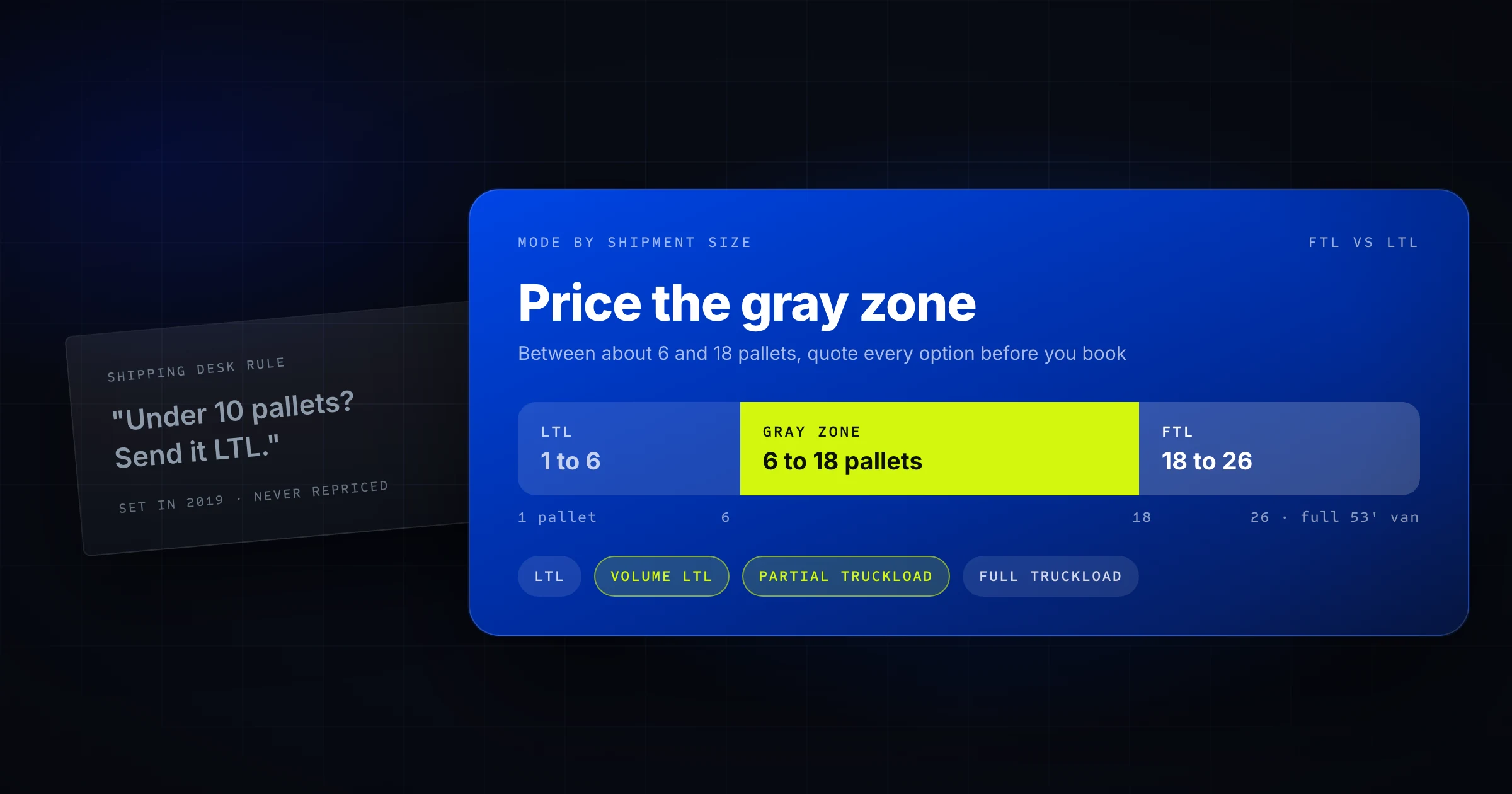
FTL (full truckload) means one shipper books a whole trailer. LTL (less than truckload) means you pay for the part of a shared trailer your freight uses, priced by freight class and weight.
The short version: under about six pallets, LTL is usually cheaper. Above about 10 to 12 pallets or 15,000 pounds, a full truckload usually wins. In between is a gray zone where you should price both, plus volume LTL and partial truckload, before you book anything.
This guide covers the real differences between the two modes, how each one is priced in 2026, what changed when NMFTA moved freight classes to a density scale in July 2025, a decision framework by pallet count and weight, and the mistakes that quietly make shippers pay full truckload prices for LTL freight, or the other way around.
Full truckload shipping means your freight is the only freight on the trailer. You book the whole truck, the carrier picks up at your dock, and the trailer travels sealed to the consignee without stopping at terminals to load or unload other shippers' goods.
You pay for the full capacity of the trailer whether you fill it or not. That is the trade: you get speed, fewer touches and a predictable delivery window, and in exchange you pay for every foot of the trailer.
A standard 53-foot dry van holds about 26 pallets of 48 by 40 inches in a single layer, and Amazon Freight puts the range at 26 to 30 pallets depending on loading. Payload usually tops out around 45,000 pounds, because the federal limit for a loaded truck on the Interstate system is 80,000 pounds gross vehicle weight, according to the Federal Highway Administration, and the tractor and trailer take up a big share of that.
Full truckload is the core of most shippers' freight budgets, and it is where most of the procurement discipline lives: annual bids, routing guides, carrier scorecards and benchmarking. If you want to see how that price is built, this breakdown of what goes into the cost of a truckload shipment walks through linehaul, fuel and the variable costs on top.
Less-than-truckload shipping means your freight shares a trailer with freight from other shippers. You pay only for the space and weight you use, and the carrier combines many smaller shipments into one trailer.
To make that work, LTL carriers run a hub-and-spoke network. Your pallets are picked up, taken to a local terminal, moved through one or more break-bulk terminals where freight is consolidated into full loads for long-haul lanes, and then delivered from a terminal near the consignee. Estes defines a break-bulk terminal as the consolidation of freight from several terminals to build full loads on long-haul lanes.
That network is what makes LTL affordable for small shipments. It is also why LTL is slower and less predictable than a full truckload, and why freight gets handled more often along the way. RXO notes that LTL freight is loaded and unloaded in and out of trailers and warehouses several times, which raises the chance of damage.
LTL pricing is built on a published tariff, freight class, weight and distance, with discounts negotiated off the base rate. More on that below.
Here is how the two modes compare on the factors that actually drive the decision:
If you only remember one line from this list, make it this one: LTL prices the freight, FTL prices the truck.
LTL pricing confuses people because it is built on several moving parts at once. Here is how a quote comes together.
Every LTL shipment is assigned a freight class under the National Motor Freight Classification (NMFC), which is maintained by NMFTA. Classes run from 50 to 500 and are based on four transportation characteristics: density, handling, stowability and liability. Lower classes are dense, easy-to-handle freight and cost less per pound. Higher classes are light, bulky or fragile freight and cost more.
LTL rates are quoted per hundredweight, usually written as CWT, which equals exactly 100 pounds. A rate of a given amount per CWT on a 2,000-pound shipment is multiplied by 20.
Each carrier publishes base rates by origin, destination, class and weight break. Those published rates and charges are the tariff.
Most shippers do not pay the tariff. They pay the tariff minus a negotiated discount. Every carrier also sets a minimum charge, the least amount it will bill for a shipment no matter how small.
Some shippers negotiate a freight-all-kinds (FAK) agreement, which lets a mix of commodities ship at one class rate. Estes describes FAK as freight pooled and shipped together at one freight rate. It simplifies billing, but read it carefully: a FAK that looks generous on paper can cost more if your actual freight is denser than the class you agreed to.
On top of the line haul, carriers add a fuel surcharge tied to a national diesel index, plus accessorial charges for anything beyond a standard dock-to-dock move: liftgates, residential delivery, inside delivery, appointments and limited-access locations.
LTL carriers can inspect your freight at the terminal to check the weight, class and density you declared. If the numbers are off, the invoice changes. This is one of the most common sources of surprise LTL charges, and it is almost always avoidable with accurate dimensions and weights at the dock.
Full truckload pricing is simpler on the surface and harder to manage underneath.
A truckload rate is usually quoted as a linehaul rate per mile or a flat rate per lane, plus a fuel surcharge and any accessorials. The rate depends far less on what is inside the trailer and far more on the lane, the equipment, the timing and the market.
Truckload freight is bought two ways. Contract rates are agreed in a bid, usually annual, and held for a period. Spot rates are priced load by load at today's market. Our guide to spot vs contract freight explains when each one makes sense, and the broader menu of freight pricing models, including index-linked and dedicated, covers the options in between.
Truckload rates move with capacity. In June 2026, DAT reported that the national average van spot rate moved above the contract rate for the first time since February 2022, at $3.00 a mile spot versus $2.89 contract. By the week of September 13 to 19, 2026, DAT's national van spot rate was $2.96 a mile all-in, with the van linehaul rate of $2.17 a mile up 33% year over year, and the EIA diesel average at $6.285 a gallon for the week of September 14.
Cass tells the same story from the invoice side. Its Truckload Linehaul Index rose 11.3% year over year in August 2026, and Cass shipments posted their first year-over-year gain since January 2023, ending a 42-month downturn.
That is why truckload buyers spend so much time on timing and benchmarking. If you want the context behind those numbers, read our freight market outlook for the second half of 2026.
When you get an instant truckload price, it is an estimate built from recent market data on that lane. Here is how a spot rate estimate is calculated, and why it can move between the moment you quote and the moment you tender.
If your team's LTL rules of thumb were set before mid-2025, they may be out of date.
NMFTA's Docket 2025-1 changes took effect on July 19, 2025. The update adopted a standard 13-subprovision density scale for classifying freight. Under that scale, the lightest freight (under 1 pound per cubic foot) falls into class 400, and the densest (50 pounds per cubic foot or more) falls into class 50, with class 55 covering freight from 35 to under 50 pounds per cubic foot.
What this means in practice:
This is one of the clearest reasons to recheck your LTL setup this year, even if nothing else about your freight changed.
Both modes got more expensive this year, but not in the same way, and that changes where the crossover point sits.
On the truckload side, the shift has been sharp. DAT's national van spot rate moved above contract in June 2026 for the first time since February 2022, and by mid-September the van linehaul rate was up 33% year over year. Cass reported its Truckload Linehaul Index up 11.3% year over year in August, the twentieth consecutive monthly increase according to FreightWaves.
On the LTL side, the movement has been steadier and driven more by price than by volume. Old Dominion Freight Line, one of the largest LTL carriers in the US, reported for August 2026 that revenue per day rose 12.4% from August 2025 while LTL tons per day fell 0.9%. Its quarter-to-date LTL revenue per hundredweight was up 11.3%, or 4.8% excluding fuel. In plain terms: carriers are moving slightly less freight and charging more for it, and fuel is a big part of the increase.
What this means for shippers:
Most FTL vs LTL guides treat this as a two-way choice. It isn't. Between a few pallets and a full trailer, there are two more options worth quoting.
Volume LTL is for larger shipments that still move through the LTL network. Redwood Logistics describes it as six or more pallets that weigh over 5,000 pounds or take up more than 12 linear feet. It is priced off the carrier's LTL rates and still needs a freight class, so accurate dimensions matter just as much as in standard LTL.
Partial truckload is closer to a truckload move. Redwood puts it at roughly 8 to 18 pallets weighing between 8,000 and 27,500 pounds. It is priced on mileage, lane, weight and linear space, does not need a freight class, and typically involves fewer stops and less handling than LTL because the freight does not go through a hub-and-spoke network.
Worldwide Express gives similar ranges: volume LTL from six pallets at about 8,000 to 10,000 pounds, and partial truckload from 8 to 18 pallets at about 8,000 to 27,500 pounds.
These two options matter because the cheapest mode for a 10-pallet shipment is genuinely different from lane to lane and week to week. The only way to know is to price them side by side.
Here is the decision framework we recommend. Treat the thresholds as starting points, not rules, because carriers define the boundaries differently.
For shipments between about 6 and 15 pallets, do not pick a mode from habit. Quote LTL, volume LTL, partial and full truckload for the same shipment and compare the landed cost, not just the line haul. In a tight truckload market a partial can beat both. In a soft one, a full truckload can cost about the same as a large LTL shipment while arriving faster.
The right mix depends heavily on what you ship and who you ship it to. Here is how the decision usually plays out for the shippers we work with.
Distribution center to store moves are usually full truckloads on regular lanes, often multi-stop. LTL shows up for small stores, new locations and replenishment between scheduled deliveries. The opportunity is usually consolidation: turning repeat LTL shipments to the same cluster of stores into planned truckloads.
Inbound raw materials and outbound finished goods are often heavy and dense, which reaches the weight limit before the space limit. Dense freight also tends to sit in lower LTL classes, so LTL can stay competitive for longer than you might expect. Our page on industrial and manufacturing freight covers how these shippers buy capacity.
Temperature-controlled freight changes the math. Refrigerated LTL capacity is more limited than dry van LTL, and delays carry more risk, so many food shippers move to full or partial refrigerated loads earlier than a dry freight shipper would. Seasonal swings, like produce season, also tighten truckload capacity. See how food and beverage shippers approach procurement.
Every terminal touch is a chance for damage. For electronics, glass, finished retail goods or anything with a high claim value, the lower handling of a dedicated truck can be worth paying for even when the freight would fit on a few pallets.
If you ship a few pallets a day to many different customers, LTL is usually the backbone. The goal here is not to switch modes but to buy LTL well: accurate class, negotiated discounts, compared quotes and fewer accessorial surprises.
The mistake most teams make is comparing an LTL line haul to a truckload all-in rate. Compare like for like:
Here is a simple way to run the comparison for any shipment in the gray zone:
If you quote truckload freight regularly, it is worth knowing how your rates sit against the market. Emerge lets shippers benchmark spot rates on each lane before they book, and benchmark contract rates against what the market is paying before a bid.
These come up again and again when we look at how shippers handle the two modes.
Most shippers run truckload with discipline and LTL out of habit. Truckload gets benchmarks, bids and scorecards. LTL gets a login to the same two carrier portals and a broker email. That gap is often where money leaks, quietly, one small shipment at a time. It is the problem behind the hidden cost of quoting freight in spreadsheets and email.
With density-based classes, a guessed pallet height can push freight into a higher class. A reclass on one shipment is annoying. A reclass on every shipment for a year is a budget problem.
Three LTL shipments to the same region in the same week might cost more, and arrive slower, than one consolidated truckload. Good load planning catches those patterns before the freight leaves.
Peak season changes both modes. Parcel and LTL networks add surcharges, and truckload capacity tightens. Our guide to peak season surcharges shows the 2026 windows and how to budget for them.
A truckload quote from Monday and an LTL quote from Thursday are not comparable in a market moving this fast.
The carrier matters as much as the mode. Before you add a new provider for either mode, vet the carrier properly, and know whether you are booking an asset-based carrier or a broker.
Most procurement teams have a playbook for truckload and almost none for LTL. Here is how to close that gap without building a second department.
The single biggest LTL saving is usually the simplest: compare your direct carrier rates and your broker rates on the same screen for every shipment, instead of defaulting to whoever answers first.
Bring your actual shipment history to discount negotiations: lanes, weights, densities and frequency. Carriers price risk, and clean data with accurate densities lowers it. If you are considering a FAK agreement, test it against your real density mix first.
If LTL is a meaningful share of your spend, it deserves a bid like any other mode, with lane templates built for how LTL is priced: class, weight breaks, discounts and accessorials, rather than cost per mile.
On-time delivery, claims, reclass frequency and invoice accuracy matter just as much in LTL as in truckload. A simple carrier scorecard applied to both modes makes renewals and rebids far easier. If you are building one from scratch, start with what a carrier scorecard should measure.
Reclasses, reweighs and unexpected accessorials show up on the invoice, not the quote. Compare billed amounts with quoted amounts every month and dispute what does not match.
The cleanest way to stop overpaying on either mode is to quote both the same way, side by side, with the same discipline.
For full truckload, Emerge shippers run their spot and contract freight in one platform. On the spot side, you can collect and compare spot quotes from your own carriers and brokers, use Dynamic Book It Now to book at a price that reflects the market, and source capacity from pre-vetted carriers in the Emerge Marketplace when your own network cannot cover a lane. On the contract side, you can run an annual freight RFP and use freight mini bids to rebid problem lanes between annual events.
For LTL, Emerge added LTL quoting and rate comparison in August 2026. Shippers connect their own direct carrier and brokerage accounts, pull real-time rates from all of them in a single quote, and compare them side by side before booking. The connections run through Emerge's partnership with SMC3. To be clear about what it is: Emerge does not broker LTL. The pricing comes from your providers, not from Emerge.
And if you buy LTL on contract, ProcureOS Pro shippers can now run LTL contract bids alongside their truckload, air and ocean bids, on lane templates built for how each mode is actually priced.
If you are still deciding what kind of tool you need, this explainer on what a light TMS is and how it differs from an enterprise system is a good place to start, and our overview of freight quoting software shows what a shared quoting workflow looks like.
Choosing the right mode once is easy. Keeping the mix right as volumes and markets shift takes a few numbers you watch every month.
These sit naturally alongside your truckload KPIs and roll up into broader transportation spend management, which looks at every dollar across every mode from bid to invoice.
Print this and keep it by whoever books freight:
FTL means one shipper books and pays for an entire trailer, which travels dock to dock without other freight. LTL means several shippers share a trailer, each paying for the space and weight their freight uses, and the freight moves through carrier terminals along the way.
LTL is usually 1 to 6 pallets, though some carriers accept up to 10. Above about 10 pallets or 15,000 pounds, a full truckload usually makes more sense, and a 53-foot dry van holds about 26 standard 48 by 40 inch pallets in a single layer. Between about 6 and 18 pallets, volume LTL and partial truckload are worth quoting too.
Most LTL shipments fall between about 150 and 15,000 pounds, although carriers draw the lines differently, and Amazon Freight cites a range of 100 to 10,000 pounds. Above roughly 15,000 pounds, a full truckload is usually the better option.
For small shipments, yes, because you only pay for the space you use. As shipments grow, the gap closes. For mid-size shipments of about 6 to 15 pallets, a partial or full truckload can cost the same as or less than LTL, especially once accessorials and reclass risk are counted.
Usually, yes. A full truckload goes directly from pickup to delivery, while LTL freight moves through terminals where it is unloaded, sorted and reloaded. That extra handling adds time and makes delivery dates less predictable.
Freight class is the NMFC rating, from 50 to 500, that LTL carriers use to price your freight based on density, handling, stowability and liability. Since July 19, 2025, NMFTA uses a 13-level density scale for classification, so accurate dimensions and weights matter more than ever.
Yes, and most shippers do. Use LTL for small or irregular shipments, FTL for full and time-critical loads, and quote volume LTL and partial truckload for the shipments in between. The key is to compare all of them on landed cost rather than picking a mode from habit.
Volume LTL moves through the LTL network, is priced off the carrier's LTL rates and needs a freight class. Partial truckload is priced on mileage, lane, weight and linear space, needs no freight class, and usually means fewer stops and less handling.
 SOC 2 Type II