
Follow us


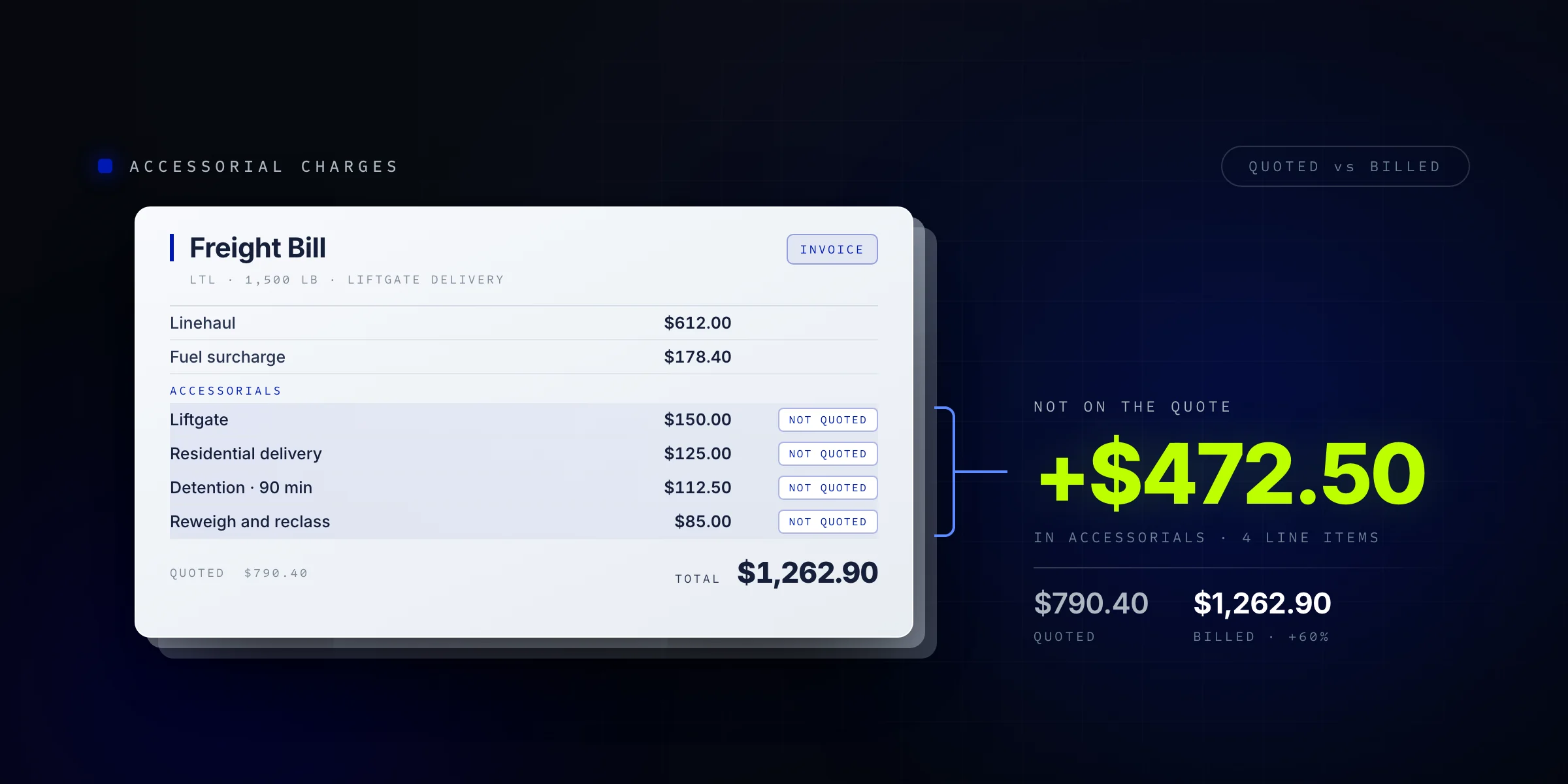
Accessorial charges are fees added on top of the linehaul rate for anything beyond a standard pickup and delivery, such as detention, a liftgate or a truck ordered and not used. In truckload they are mostly about time. In LTL they are mostly about service and location.
They are also where a good freight rate quietly turns into an expensive one. As our annual freight RFP guide puts it, a bid 4 percent below the field on linehaul with an open-ended accessorial schedule is not the cheapest bid.
This guide explains what accessorial charges are, how they differ between truckload and LTL, what carriers actually publish for the most common ones (with real 2025 and 2026 tariff numbers), what the research says about detention, and a practical playbook for cutting surprise fees, including exactly what to put in your next RFP.
Accessorial charges are any charges beyond the linehaul. ArcBest defines them as additional costs from extra services outside of standard pickup and delivery. They cover extra time, extra equipment, extra labor, special locations and anything that changes the shipment after it was quoted.
Most carriers publish them in a separate document from their rates. XPO, for example, keeps its accessorial rules in one tariff, its linehaul rates in another and its fuel surcharge in a third. That separation is exactly why accessorials catch shippers off guard: the rate you negotiated is one document, and the fees that end up on the invoice are another.
On the invoice, they usually show up as separate line items after the linehaul and fuel. That is the place to look when a freight bill comes in higher than the quote.
The same word means different things depending on the mode.
In full truckload, the carrier has dedicated a truck and a driver to your load, so the costs that matter are the ones that tie up that truck: waiting at the dock, an overnight delay, a cancelled load, an extra stop or a driver asked to unload. The common ones are detention, layover, truck ordered not used, stop-off charges, driver assist and lumper fees.
In LTL, your freight moves through a network of terminals, and the carrier prices the extra work your shipment needs on either end: a liftgate because there is no dock, a residential or limited-access delivery, inside delivery, an appointment, a redelivery or a reweigh. These are published in each carrier's rules tariff, usually with a minimum, a rate per hundred pounds and a maximum.
Our freight RFP template makes the same point for bids: in LTL, accessorials should be itemized in detail, because liftgate, residential and inside delivery drive a larger share of LTL cost.
If you are still deciding which mode fits a shipment, this guide to what goes into the cost of a truckload shipment shows how linehaul, fuel and accessorials stack up. For a full comparison of the two modes, see FTL vs LTL.
Asset-based truckload carriers rarely publish a shipper rate card for accessorials. Brokers and large logistics providers sometimes do, and those public policies are the best benchmark available. Here is what two of them publish.
Detention is the charge for keeping a truck and driver waiting at pickup or delivery beyond the agreed free time. Uber Freight's published shipper policy charges $50 an hour after two hours of free time, up to a maximum of $250, rounded up to the nearest 15 minutes. On the carrier side, J.B. Hunt's published carrier accessorial standards start detention two hours after arrival and pay $50 an hour for automated tracking or $40 an hour for manual, up to five hours, after which it becomes layover.
The two-hour free time is common, but it is not a law. It is whatever your contract says. If your contract says nothing, the invoice decides.
Layover applies when a driver has to wait overnight or for an extended period before loading or unloading. Uber Freight lists layover at $250 a day. J.B. Hunt's carrier standards list $250 a day with automated tracking or $150 a day when recorded manually.
TONU is charged when a carrier dispatches a truck and the load is cancelled too late, or is not ready. Uber Freight charges $150 for dry van and flatbed or $200 for refrigerated if the load is not cancelled at least 24 hours before pickup.
Driver assist is charged when the driver helps load or unload. Uber Freight lists $75 per facility. Lumper fees cover third-party labor hired to unload at the receiver, and are usually passed through at cost. Uber Freight's policy, for example, bills lumper charges, tolls and scale tickets on top of the linehaul.
Multi-stop loads usually carry a charge for each extra stop. J.B. Hunt's carrier standards list $50 plus out-of-route miles for a stop added after tender.
None of these show up in a cost-per-mile comparison. A carrier with a slightly higher linehaul and a clean, capped accessorial schedule can be cheaper all-in than a carrier with a low rate and open-ended fees.
LTL carriers publish their accessorials in detail. Here is how two large carriers price the most common charges, from their own current tariffs: XPO's CNWY 199 tariff effective August 17, 2026, and Estes's EXLA 105 accessorial schedule effective November 17, 2025.
Two lessons jump out. First, the same service can cost several times more from one carrier than another, so accessorial schedules deserve as much attention as base discounts when you choose LTL carriers. Second, these are tariff prices. Shippers with negotiated agreements often pay less, which is the point: they are negotiable if you ask before you sign.
Here is how the published tariffs above play out on real shipments. The math uses each carrier's own minimums, rates and maximums.
A 1,500-pound shipment is 15 hundredweight.
Same shipment, same service, a difference of $199 on one line item. Across a few hundred liftgate deliveries a year, that gap is larger than many base-rate negotiations.
A 4,000-pound shipment is 40 hundredweight.
Under Uber Freight's published shipper policy, the first two hours are free and detention runs at $50 an hour after that, up to $250. A truck that waits four hours generates two billable hours, or $100. A truck that waits eight hours hits the $250 cap, and if the wait runs overnight, a $250 layover can follow.
The lesson is not that one carrier is cheap and another is expensive. Carriers price differently, and the right choice depends on your freight. The lesson is that accessorials need to be compared line by line, using your real shipment profile, before you award freight.
Fuel is technically an accessorial, and it is usually the largest one.
Most carriers tie their fuel surcharge to the US Energy Information Administration's weekly on-highway diesel price, which EIA publishes every week. XPO's fuel tariff sets the surcharge as a percentage of linehaul, pegged to bands of the Department of Energy average price per gallon. Truckload fuel surcharges are more often a cents-per-mile table against the same index.
As of October 5, 2026, the EIA's US average diesel price was $6.199 a gallon, down $0.183 from the week before. At that level, fuel is a large part of every freight bill, which is why fuel terms matter in every contract.
The rule from our annual freight RFP guide applies to every bid: specify which index, what peg and how often it updates. If carriers choose their own index, base and update frequency, you are not comparing rates, you are comparing fuel assumptions. For more on how fuel moves rates and bids, read our take on diesel price volatility and RFP strategy.
In LTL, one of the most common surprise charges is not a service fee at all. It is a correction.
Carriers can inspect your freight at the terminal to check the weight, class and density you declared. If the numbers are off, they reweigh or reclassify the shipment, add a fee (XPO charges $50.70 for a reweigh or for an inspection that corrects the bill of lading), and rebill at the corrected class.
This matters more since NMFTA's Docket 2025-1 changes took effect on July 19, 2025, adopting a 13-level density scale for classifying freight. With density deciding the class for more items, a guessed pallet height can move freight into a more expensive class. NMFTA's own guidance tells shippers to capture accurate handling unit dimensions and weight when freight classes depend on density, to reduce classification changes.
The fix is simple and cheap: measure and weigh at the dock, and keep your product master up to date.
Some fees only show up at certain times of year. Parcel and LTL carriers add peak surcharges during high-demand windows, and while full truckload has no surcharge line, it has its own seasonal premium in the form of higher spot rates and more rejected tenders. Our guide to peak season surcharges covers the 2026 windows and how to budget for them.
Here is the honest answer: there is no reliable industry-wide number.
Cass, which processes freight payments and publishes widely followed freight indexes, builds its Truckload Linehaul Index specifically to exclude fuel and accessorials, and does not publish an accessorial share. Some vendors publish estimates, often 20 to 30 percent, but those figures tend to be unsourced or borrowed from parcel shipping, so treat them as opinions rather than benchmarks.
The better number is your own. Pull the last 12 months of freight invoices, separate linehaul, fuel and every other line, and calculate accessorial spend as a share of the total by mode, by carrier and by facility. That one exercise usually shows exactly where the money is going, and it is the starting point for transportation spend management, which tracks every dollar from bid to invoice.
Detention deserves its own section because it is the most common truckload accessorial, the most disputed, and the one with the most research behind it.
The American Transportation Research Institute (ATRI) published detention research in September 2024 based on 2023 data, defining detention as a wait of more than two hours. It found that drivers were detained at 39.3% of stops, rising to 56.2% for refrigerated freight and 42.5% for fleets working the spot market. ATRI estimated more than 135 million hours lost across for-hire trucking.
ATRI put the cost at $3.6 billion in direct expenses plus $11.5 billion in lost productivity. It also found that 94.5% of fleets charge detention, yet truckload carriers are paid for fewer than half of their detention incidents, which explains why detention is such a source of friction between shippers and carriers.
The US Department of Transportation's Office of Inspector General reported in 2018 that detention is associated with $1.1 billion to $1.3 billion a year in lost earnings for truckload drivers, and reduces the net income of truckload carriers by $250.6 million to $302.9 million a year. It also found that a 15-minute increase in average dwell time increases the expected crash rate by 6.2%. ATRI's 2024 research found that detained trucks drove 14.6% faster on average than trucks that were not detained.
Detention is not only a fee. Facilities with long dwell times get a reputation, and carriers price that reputation into future bids or reject the loads. Reducing dwell time cuts accessorials today and makes your freight more attractive to carriers tomorrow, which shows up in better tender acceptance. Our guide to why tender rejections are rising explains how the two connect.
Where your freight picks up and delivers often matters more than who carries it. A few patterns show up again and again.
Refrigerated freight sees the most detention. ATRI found drivers were detained at 56.2% of refrigerated stops in its 2023 data, well above the overall rate. Busy grocery receivers, strict appointment windows and temperature checks all add time. If you ship food, detention and layover terms deserve extra attention, and seasonal peaks such as harvest and produce season make it worse. Grocery supply chains carry their own layer of complexity that shows up on the freight bill.
Large retail DCs usually run strict appointments and can reject or reschedule late trucks, which can lead to redelivery, layover or TONU charges. Accurate appointment booking and realistic transit planning are the main defenses.
These are where LTL accessorials pile up: no dock means a liftgate, a jobsite or school can count as limited access, and a home address triggers a residential charge. Flag these at the quote stage, every time.
Your own docks generate detention too. If your warehouse loads slowly, carriers bill you for it, and over time they price it into your rates. Measuring dwell time at your own facilities is often the fastest way to cut accessorial spend.
Most accessorial charges are avoidable. These are the steps that make the biggest difference.
Put free hours and an hourly detention rate in every contract and bid. Detention terms left unstated get set by whoever writes the invoice.
Ask every carrier to price detention, layover, stop-offs, tarping and driver assist as separate line items, with caps. Then compare all-in costs, not linehaul alone.
Specify the index, the peg and the update frequency. Use the EIA weekly diesel price as the common base.
Detention is mostly a scheduling problem. Clear appointment windows, staffed docks and realistic load times cut dwell time more than any contract clause.
Most TONU charges come from late cancellations. Uber Freight's policy, for example, uses a 24-hour cutoff. Know your carriers' cutoffs and build them into your planning.
If a delivery needs a liftgate, an appointment or inside delivery, say so on the quote. Accessorials added at delivery cost more and cause delays.
Accurate dimensions and weights prevent reweighs and reclasses, especially under the density-based classification that took effect in July 2025.
Fewer, fuller shipments mean fewer pickups, fewer appointments and fewer chances for an accessorial. Load planning is where those savings get found.
When one warehouse generates most of the detention, the fix is at that warehouse, not in the carrier contract.
Add billed-versus-quoted accuracy and accessorial disputes to your carrier scorecards, next to on-time and tender acceptance.
Most accessorial disputes are lost because nobody checks. A simple monthly comparison of quoted versus billed amounts catches most of the problem.
If a lane keeps generating detention or layover, it may need a different carrier, a different appointment structure or a new rate. Freight mini bids let you fix specific lanes between annual events.
If you only take one thing from this guide into your next bid, take this list. Ask every carrier to quote each of these as a separate line, with a cap where it applies:
Our freight RFP template already includes an accessorial section built this way, and this step-by-step guide on how to run a freight RFP shows where it fits in the full process.
When the bids come back, watch for outliers in the accessorial columns as well as the rates. One carrier with a much higher detention rate can quietly cost more than its linehaul savings. This guide to spotting outliers in freight RFPs covers how to level bids fairly.
The number to compare is not the linehaul. It is the all-in rate: linehaul plus fuel plus expected accessorials. That is the definition we use in our guide to freight pricing models, and it is the only fair way to compare a low rate with open fees against a higher rate with tight terms.
To estimate expected accessorials, use your own history: how often each lane or facility triggered detention, layover or stop-offs last year, multiplied by each carrier's quoted rate. It does not need to be perfect. It needs to be applied the same way to every bid.
When you model award scenarios, include those all-in numbers. Spend optimization in Emerge lets you build scenarios with constraints, so you can see what an award really costs, not just what the rate column says. And before you sign, it helps to benchmark contract rates against the market so the base rate is right too.
Spot loads are where accessorials are most likely to be forgotten. A rushed quote often covers the linehaul and fuel and nothing else, and the extras show up on the invoice.
Three habits help:
For LTL, Emerge's LTL quoting and rate comparison lets shippers pull real-time rates from their own direct carrier and brokerage accounts in a single quote. Emerge does not broker LTL, and pricing comes from the shipper's own providers.
Not every accessorial on an invoice is valid. When one looks wrong, a clear process gets it resolved quickly:
The best disputes are the ones you never have to file, because the contract defined the rules clearly before the freight moved.
Carriers remember facilities. A shipper with fast docks, clear appointments, accurate paperwork and fair accessorial terms gets better tender acceptance, more competitive bids and fewer disputes. A shipper known for long waits gets the opposite, even at the same rate.
A few habits make the difference:
Accessorials are one of the easiest places to show savings, because they are measurable, controllable and often ignored. When you present freight performance, include:
Paired with rate performance against the market, these numbers make a strong case. Our guide on how to prove freight savings to your CFO shows how to structure that story, and Emerge's reporting and analytics make the numbers easier to pull.
Keep this next to whoever books freight and whoever pays the invoices:
Accessorial charges are fees carriers add on top of the linehaul rate for services beyond a standard pickup and delivery. Common examples are detention, layover, truck ordered not used, liftgate, residential delivery, inside delivery, reweighs and fuel surcharges.
It depends on the contract. Published policies are a useful benchmark: Uber Freight charges shippers $50 an hour after two hours of free time, up to $250, and J.B. Hunt's published carrier standards start detention two hours after arrival at $40 to $50 an hour. LTL carriers price detention differently, for example XPO lists $76.50 per 15 minutes after a minimum charge.
TONU stands for truck ordered not used. It is charged when a carrier dispatches a truck and the shipper cancels too late or the load is not ready. Uber Freight, for example, charges $150 for dry van and flatbed and $200 for refrigerated if a load is not cancelled at least 24 hours before pickup.
Yes. Free time, hourly rates, caps, TONU cutoffs and LTL accessorials can all be negotiated, and the best time to do it is during a bid, when carriers are competing. Published tariffs are a starting point, not a final price.
Detention covers waiting time beyond the agreed free time during a pickup or delivery, usually billed by the hour. Layover applies when the wait stretches long enough that the driver has to stay overnight or for an extended period, usually billed as a daily rate.
In LTL, carriers can inspect freight to verify its weight, class and density. If the declared information is wrong, the carrier reweighs or reclassifies the shipment, may charge an inspection or reweigh fee, and rebills it at the corrected class.
Yes. Fuel surcharges are usually treated as an accessorial and are tied to the US Energy Information Administration's weekly diesel price. They are often the largest accessorial on a freight bill, so the index, peg and update frequency should be written into every contract.
Define free time and caps in contracts, itemize accessorials in RFPs, run docks on appointments, cancel early, request special services at the quote stage, measure LTL freight accurately, track charges by facility and audit every invoice against the quote.
A lumper fee pays for third-party labor that unloads a truck at the receiving facility, common at grocery and retail distribution centers. It is usually paid at the dock and passed through to the shipper at cost, often with a receipt required. Uber Freight's published policy, for example, bills lumper charges on top of the linehaul.
A liftgate fee is charged when a delivery or pickup needs a truck with a hydraulic lift because the location has no loading dock. LTL carriers publish it with a minimum, a rate per hundredweight and a maximum. In their current tariffs, XPO lists a $274 minimum and Estes a $75 minimum.
 SOC 2 Type II