
Follow us


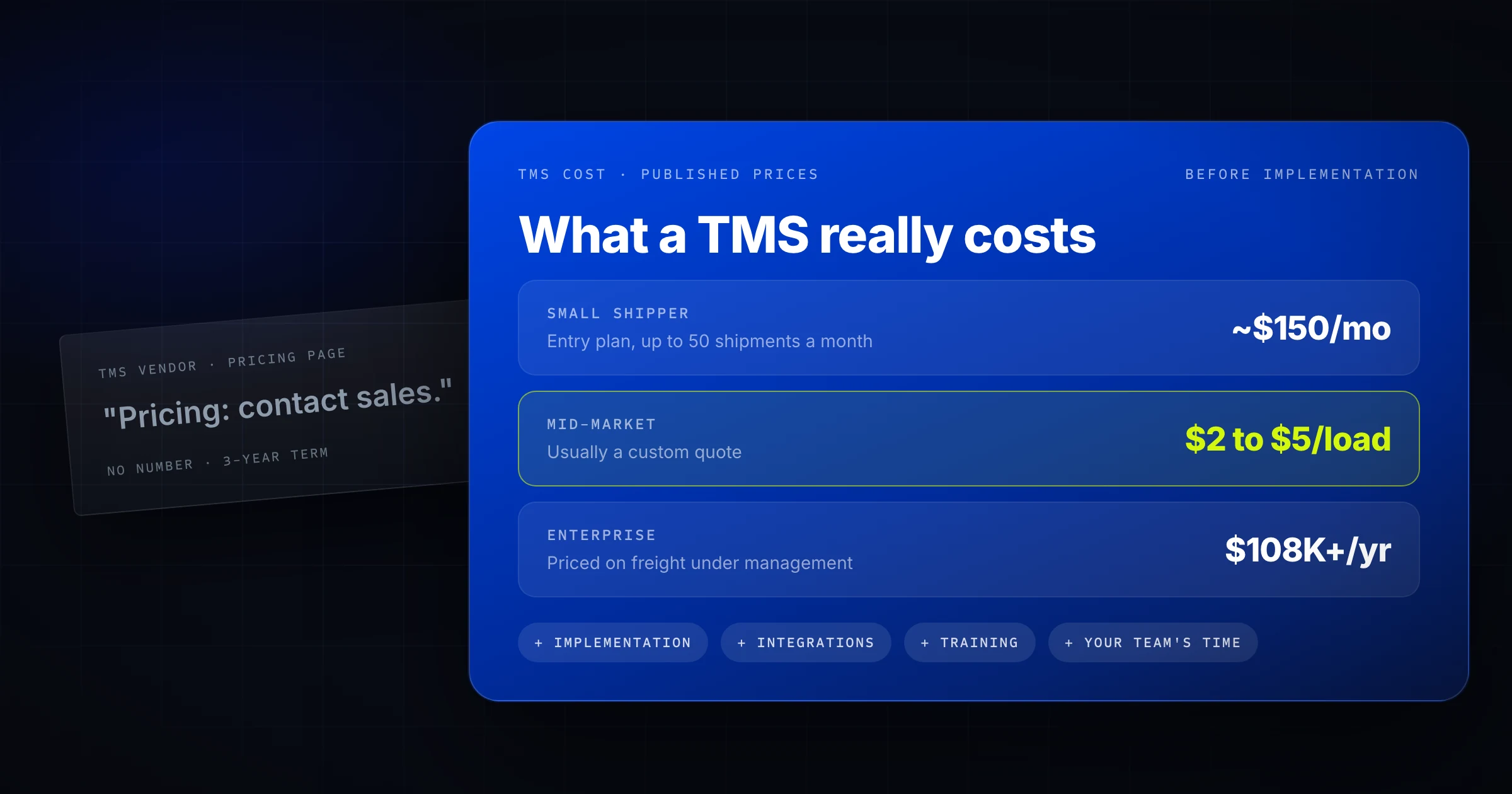
A transportation management system can cost as little as about $150 a month for a small shipper's entry plan, or more than $100,000 a year in subscription fees for an enterprise platform, before implementation. Most mid-market shippers land in between, and the pricing model matters as much as the number.
Pricing is the most common question in our demo calls with shippers: "What does this actually cost?" It is a fair question, and most answers online dodge it. So this guide uses real, published prices wherever vendors publish them, real implementation data, and the hidden costs that turn a reasonable quote into a painful budget.
It covers what TMS software costs by company size, the five pricing models you will run into, what implementation really takes, the hidden costs, how to estimate return on investment, when a full TMS is more than you need, and exactly how Emerge prices its own platform. A quick note on search terms: if you search "TMS cost" alone, Google will show you transcranial magnetic stimulation therapy. This guide is about transportation management systems.
Here is the realistic range, based on vendors' own published pricing and implementation estimates from vendors and industry analysts.
If you move up to about 50 shipments a month, entry-level shipper software starts around $150 a month. Freightview, for example, publishes $149 a month for 0 to 50 shipments a month, with a 14-day free trial. Logistically lists pricing starting at $400 a month with unlimited users. Setup is usually measured in days or weeks, not months.
This is where most pricing goes to a custom quote. Vendors that publish ranges put transactional pricing at roughly $2 to $5 per load, and basic cloud deployments at about $15,000 to $40,000 to implement, according to Sheer Logistics. Timelines of two to nine months are common depending on integrations.
At the top end, pricing is usually tied to the freight you manage. Oracle's published price list for Oracle Transportation Management Cloud, dated September 10, 2026, lists $450 a month per $1 million of freight under management, with a minimum of 20, which works out to at least $9,000 a month or $108,000 a year in subscription fees alone. Enterprise rollouts run from about $150,000 to more than $500,000, with timelines of 9 to 18 months or longer, according to Sheer Logistics.
The rest of this guide explains what sits inside those numbers.
Most TMS vendors do not publish prices. Here is what is public as of October 1, 2026, from each vendor's own website. Note the type of TMS, because carrier and broker systems are priced for a different buyer than a shipper.
Infios (formerly Körber Supply Chain Software, which acquired MercuryGate in 2024), e2open, Blue Yonder, Manhattan Associates, 3Gtms and Uber Freight's TMS do not publish prices. Expect a sales process, a custom proposal and, usually, a multi-year contract.
If you are comparing specific platforms, our Emerge vs Shipwell comparison covers one of the most common shortlists, and this look at what happened to Kuebix and its alternatives is useful if you used it in the past.
The model shapes your bill as much as the price. Here is how each one works and who it suits.
You pay a monthly fee for each person who logs in. It is predictable and easy to budget, and it suits teams with a few heavy users. It gets expensive when you want to give access to many occasional users, such as plant managers or customer service.
You pay for each shipment processed, often $2 to $5 per load according to Aljex and Sheer. It scales with your volume, which is great when volume is low and seasonal, and less great when volume grows quickly.
The fee is tied to how much freight spend runs through the system. Oracle's published price is a clear example: $450 a month per $1 million of freight under management. This model aligns cost with the size of your program, but your software bill rises when freight rates rise, even if you ship the same volume.
A flat monthly fee covers the platform, often with unlimited users. Logistically and Rose Rocket work this way, and Aljex's tiers charge a flat monthly fee for a set number of users. It is simple and encourages adoption across the company.
The older model: a large upfront license, then annual maintenance. Aljex puts on-premise licenses at about $50,000 to $400,000 or more, and both Aljex and QuantumByte put annual maintenance at 15 to 20 percent of the license cost. It is rarer today, but still common in large enterprises with on-premise systems.
None of them, in general. The cheapest model is the one that matches your volume curve. A shipper with 500 loads a month and 3 users may pay far less per user. A shipper with 50 loads a month and 20 occasional users may pay far less per load. Model both against your next three years of expected volume before you sign.
The subscription is only part of the cost. Implementation is where budgets and timelines most often slip.
In a 2022 Forbes analysis, ARC Advisory Group's Steve Banker reported that large TMS vendors charge around $250 an hour for implementation services, boutique firms charge in the mid-hundreds, and global system integrators up to $300 an hour. A typical project cited in that analysis used three integrator staff working about 5,000 to 6,000 hours, plus three client staff at about 6,000 hours and around ten part-time subject matter experts at about 4,000 hours.
That last part is the one budgets forget: your own team's time is a cost, and on a full implementation it can rival the vendor's.
The same Forbes analysis gave these timelines:
Sheer Logistics gives similar bands by company size: two to six months for small deployments, six to nine months for mid-size and nine to eighteen months or more for enterprise.
Published estimates range widely. Sheer puts basic cloud deployments at $15,000 to $40,000, enterprise rollouts at $150,000 to $500,000 or more, and onboarding fees at $10,000 to $75,000. QuantumByte puts a simple cloud setup at around $2,000 and complex deployments at $50,000 or more.
The spread is the point. Implementation cost depends far more on your integrations, data and processes than on the software itself.
Part of the price confusion comes from the fact that "TMS" means different things to different vendors. Before comparing quotes, check which of these capabilities each quote actually covers.
Creating shipments, tendering loads to carriers, booking appointments and managing the documents. Tendering is the heart of execution, and how well it works shows up in your tender acceptance rates. Our guide to load tendering and acceptance rates explains what good looks like.
Tracking shipments from pickup to delivery and alerting your team to exceptions. Some vendors include it, others charge per tracked load or rely on third-party visibility providers. Emerge includes tracking and visibility for spot freight booked through the platform.
Load building, mode selection, routing and network optimization. This is where enterprise TMS platforms earn their price, and where smaller shippers often pay for more than they use.
Running annual RFPs, mini bids and spot quotes, and choosing carriers based on cost and performance. Many traditional TMS platforms treat procurement as an add-on or leave it to a separate tool, even though it drives a large share of total freight cost. Emerge was built around contract procurement and spot procurement from the start.
Matching invoices to rates, approving payments and catching billing errors. Often a separate module, a separate vendor or a freight audit service.
Reporting on spend, lanes, carriers and service. Basic reports are usually included. Advanced analytics, benchmarking and custom dashboards often cost extra.
When two quotes differ by a factor of three, the first thing to check is whether they are pricing the same list of capabilities.
Most new TMS purchases today are cloud-based, and the cost structure is very different from the on-premise systems many large shippers still run.
For a mid-market shipper starting fresh in 2026, there are very few reasons to choose on-premise.
The cost of a TMS should be compared with the cost of what you are doing today, and for many shippers, today means email, phone calls and spreadsheets.
That approach has no license fee, which makes it look free. It is not. It costs hours of your team's time on every quote, it makes quotes impossible to compare cleanly, it leaves no record of what you paid against the market, and it means every bid season starts from scratch. Those costs do not appear on an invoice, which is exactly why they are easy to ignore.
If quoting is where most of that time goes, it is worth looking at dedicated freight quoting software before a full TMS. Our ranking of the best freight quoting software by seat compares the options, including what each one costs where prices are published. And because accessorials are one of the costs a good system helps control, our guide to accessorial charges is worth reading alongside this one.
You can usually lower the total cost of a new system without giving up what matters.
For many shippers, that is procurement: the rates you pay. Solving that first often pays for everything that follows.
If your current TMS handles execution well, connect a procurement platform to it instead of replacing the whole system. You avoid a second implementation and keep the workflows your team already knows.
Go live with one business unit, mode or region first. You will learn faster, spend less on services and avoid paying for capacity you are not using yet.
Ask for a capped implementation fee, a shorter first term or a pilot, price protection at renewal, and clear rules for what happens when volume grows.
The cheapest software becomes expensive if nobody has time to use it. Choose the option your team will actually adopt.
These are the costs that rarely appear on the first quote. Ask about every one of them.
Connecting your TMS to your ERP, WMS and carriers is usually the largest hidden cost. Sheer estimates $5,000 to $15,000 per system for basic API integrations, and says complex ERP integrations can exceed $50,000 each. QuantumByte puts WMS or ERP integration at $5,000 to $25,000 or more. Some plans also cap EDI connections, for example Aljex includes one customer EDI connection on its Professional tier and two on Enterprise.
If integration is your main concern, our guide to systems integration for full truckload shippers explains what typically needs to connect, and why.
Sheer estimates training at about $1,500 a day, or $10,000 to $30,000 for a full program. Some vendors include a set number of hours. Aljex's Enterprise tier includes 15 hours of support and training, for example.
Basic support is often included, while faster response times, a named account manager or after-hours coverage cost extra.
Moving historical shipments, rates, carriers and locations from spreadsheets or an old system takes time and often paid services.
Shipwell's own guide to TMS pricing lists third-party integration charges, extra feature licensing, scaling costs, data migration and contract penalties as total cost of ownership items worth checking. Ask what happens to your price when you add users, shipments, business units or modules.
Multi-year terms, auto-renewals and early termination penalties are common in enterprise contracts.
Here is how the published numbers add up for two very different shippers. These use vendors' published prices and the implementation ranges above.
On Freightview's published entry tier, at $149 a month for up to 50 shipments, the annual subscription is $1,788. Implementation is light, mostly carrier setup and training, measured in days. The main hidden cost is staff time to keep carrier rates and contacts current.
On Oracle Transportation Management Cloud's published pricing, $450 a month per $1 million of freight under management, $30 million works out to $13,500 a month, or $162,000 a year in subscription fees. Over three years, that is $486,000 before implementation. Add an enterprise implementation in the $150,000 to $500,000-plus range from Sheer's estimates, plus integrations and internal team time, and a three-year cost of ownership approaching or passing $1 million is realistic.
Neither example is right or wrong. They are built for different problems. What matters is knowing which problem you are actually trying to solve.
Cost only makes sense against savings. Here is what the research says, with honest caveats.
ARC Advisory Group has long been the most cited source on TMS savings. In its 2016 research, ARC reported average freight savings of 7.5 percent from TMS use, and noted that cloud delivery had made a TMS viable for companies with around $1 million in freight spend, compared with a historical minimum of about $20 million. A later ARC survey, published on ARC's Logistics Viewpoints blog in September 2016, put savings at 8 percent and found that for 60 percent of respondents, the TMS cost was less than 10 percent of the net savings.
Those are averages from surveys of TMS users, and they are a few years old, so treat them as a starting point rather than a promise. You will often see "2 to 10 percent" quoted as a Gartner figure. We could only trace that range to a vendor whitepaper that does not attribute it to Gartner, so we do not rely on it.
The better approach is to build your own estimate:
When you take the case to finance, show savings against the market as well as against last year. Our guide on how to prove freight savings to your CFO walks through how to frame it, and real examples help: see how Dollar Tree achieved multi-million dollar savings on contract freight and how Pepsi Bottling Ventures overhauled procurement planning in hours rather than months.
This is the question that saves the most money, and it is worth asking before you request a single quote.
A full enterprise TMS is built to plan, optimize, execute, track, settle and analyze freight across a global network. If you run hundreds of loads a day across multiple modes and regions, you may need all of it.
Many mid-market shippers do not. Their real problems are narrower:
For those shippers, a light TMS or a freight procurement platform often delivers most of the value at a fraction of the cost and implementation time. This explainer on what a light TMS is and how it differs from a full TMS goes deeper, and our roundup of the best freight procurement platforms of 2026 by category shows how the options compare.
And if you already have a TMS you are happy with, the answer may be to connect a procurement tool to it rather than replace it. Emerge offers TMS integrations for exactly that reason, alongside data partner and capacity integrations.
I will be direct, because this is the question you would ask me on a call.
Emerge is usage-based: your price scales with the freight you manage and the capabilities you use, not with seat counts. The plans, and what each one includes, are on our pricing page.
There are two ways to buy. Marketplace pairs the full ProcureOS platform with capacity from the Emerge Marketplace of pre-vetted carriers. Platform only licenses ProcureOS to run procurement across your own carrier base. Every plan includes spot procurement with Dynamic Book It Now, reporting and analytics, and onboarding and support.
The platform is SOC 2 Type II with US and EU hosting. For a number built around your freight, book a short demo with a custom quote.
Software is easiest to justify when the cost of doing without it is visible. These are the signs we see most often in shippers who are ready:
If two or more of these sound familiar, the cost of a system is probably smaller than the cost of the status quo. The next step is to define the problem precisely, because that decides whether you need a full TMS, a light TMS or a procurement platform, and that decision drives the price far more than any discount you negotiate.
Most TMS buying processes compare features and miss cost. Structure your evaluation so every vendor prices the same thing, the same way.
Write down the problems you are solving, your shipment volume by mode for the next three years, the number and type of users, and every system that must connect. Vendors can only quote accurately against a clear scope.
Require every vendor to price subscription, implementation, integrations, training, support, data migration and any usage overages over three years. Ask for the price at your current volume and at your expected volume in year three.
A short pilot on real lanes tells you more than any demo. Measure time saved, adoption by your team and the quality of the rates you get.
Entry-level shipper TMS plans start around $150 a month: Freightview, for example, publishes $149 a month for up to 50 shipments. Mid-market pricing is usually quoted and often runs per shipment or per user. Enterprise platforms can cost $9,000 a month or more, as in Oracle's published minimum for its Transportation Management Cloud.
Both exist, along with platform fees, percentage of freight under management and perpetual licenses. Per user suits small teams of heavy users, per shipment suits low or seasonal volume, and percentage of freight under management is common at enterprise scale. Model each against your own volume before deciding.
A cloud TMS typically takes three to six months, and a fully integrated, moderately complex system about four to five months, according to a 2022 Forbes analysis by ARC Advisory Group's Steve Banker. On-premise or legacy migrations can take nine to twelve months or more, and enterprise rollouts up to eighteen months or longer.
The most common are integrations with ERP, WMS and carriers, training, premium support, data migration, extra users or modules, and contract terms such as minimum periods and early termination fees. Integrations are usually the largest, and complex ERP integrations can exceed $50,000 each by some vendor estimates.
For many shippers, yes. ARC Advisory Group has reported average freight savings of 7.5 to 8 percent from TMS use. The return depends on your freight spend and on whether the system improves what you pay for freight, not only how you execute it.
A full TMS covers planning, optimization, execution, settlement and analytics for large, complex networks, and usually takes months to implement. A light TMS covers the core work of quoting, booking, tracking and reporting, is faster to set up, and costs less. Many mid-market shippers get most of the value from a light TMS or procurement platform.
Small shippers can start for around $150 to $400 a month with published plans such as Freightview's entry tier or Logistically, with setup measured in days or weeks. The bigger question for a small business is usually whether it needs a TMS at all, or a simpler way to quote, compare and book freight.
Because pricing usually depends on volume, modules, integrations and support level. Emerge, for example, is usage-based, so the price scales with your freight program. The fair expectation is a clear, written total cost once your scope is defined.
 SOC 2 Type II