
Follow us


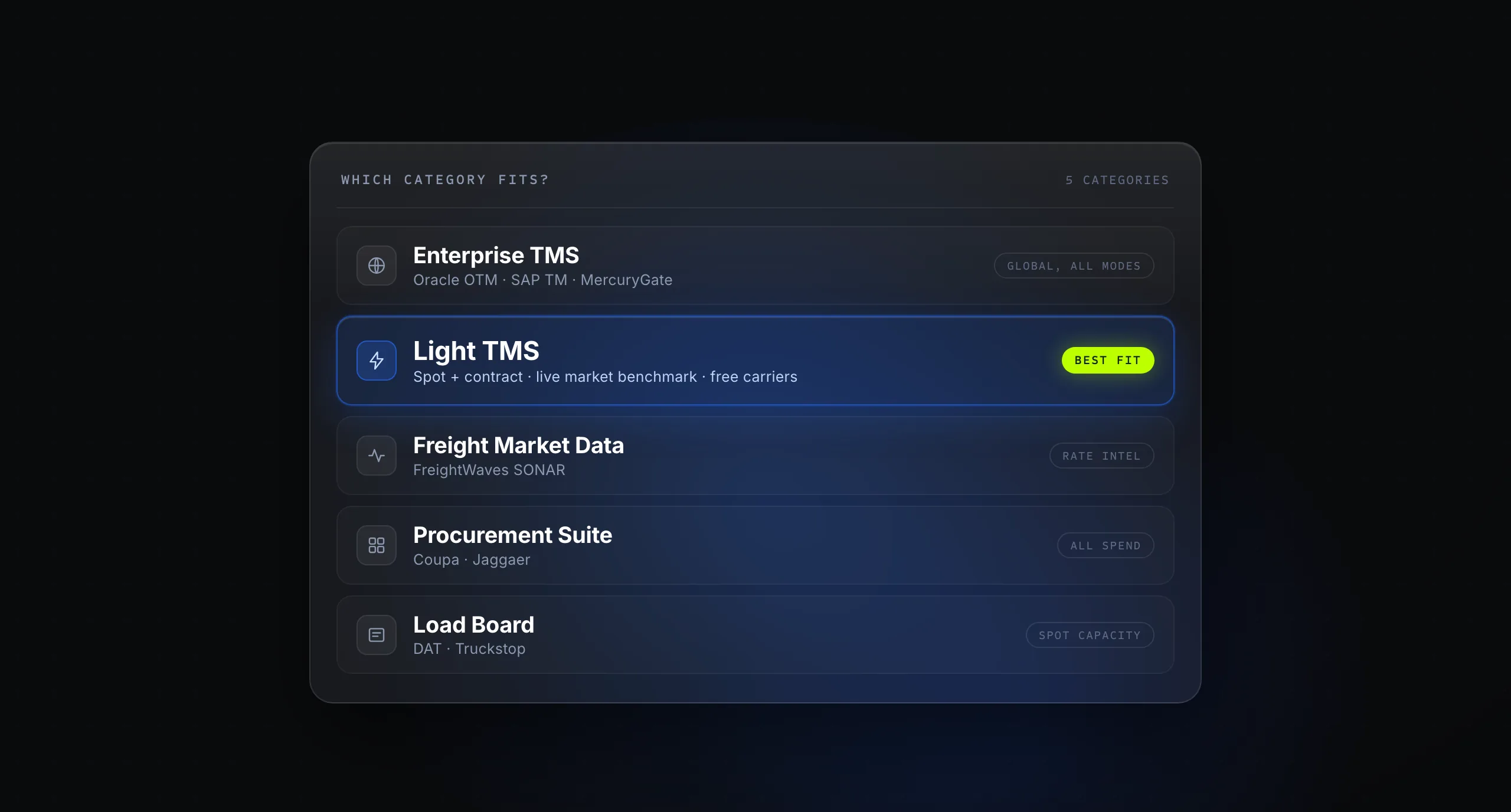
The best freight procurement platform depends on what you need it to do. The strongest enterprise TMS is different from the strongest light TMS, load board, or market-data source. This guide names a leader in each category, with the real strengths and trade-offs of each, so you can match the pick to your size, your modes, and how you actually buy freight, instead of forcing one tool to fit every shipper.
Most "best freight platform" lists have the same problem: they rank platforms that don't even do the same job, and they only talk about what each one is good at. An enterprise TMS built for global ocean and air freight has almost nothing in common with a tool a regional shipper uses to get truckload quotes out of email. Ranking them one through ten is comparing apples to forklifts.
So this list is organized the way the market actually works: by category. Each section names a leader, lays out its genuine strengths and its trade-offs, and explains the shipper it fits best. Find the category that matches your operation, and you've found your shortlist.
A note on method: these picks reflect how each platform is positioned and reviewed across the 2026 market, not a pay-to-play ranking. Every tool here is strong for the right buyer and wrong for another, and we say so directly, including for Emerge.
Best for: Global enterprises running every mode across multiple regions and currencies.
If you move ocean, air, rail, parcel, and truckload across dozens of countries, you need the heavyweight tier. These platforms deliver deep optimization and near-limitless configurability, and the right pick among them usually comes down to your existing systems. Oracle OTM and SAP TM lead when you already run the matching ERP at scale, since the native data flow is the real prize. Unlike those two, MercuryGate isn't tied to an ERP, which makes it the stronger independent choice for a shipper or 3PL that wants multi-modal breadth without committing to an Oracle or SAP backbone.
Strengths: Unmatched depth across every mode, powerful route and load optimization, mature visibility and compliance, and deep integration into enterprise finance and procurement.
Trade-offs: Cost and time. Enterprise rollouts frequently run into six figures and commonly take 6 to 24 months to implement, with dedicated staff to configure and maintain them. Configurability that powerful is also rigid: changes often require internal resources or specialized expertise. For a domestic truckload shipper, it's paying for complexity you'll never use.
Best for: Small and mid-market shippers moving domestic truckload who need to get out of spreadsheets fast.
This is the category most shippers searching for a platform actually belong in, and it's the one Emerge is built to lead. A light TMS covers the core work of freight, quoting, booking, tracking, and reporting, without the cost or year-long implementation of an enterprise system. It goes live in days or weeks and is priced as a subscription, not a capital project.
Strengths: Three things most tools in the category don't combine.
The results show up against the market, not on a license invoice. In a study of shippers using Dynamic Book It Now, Emerge's automated spot booking tool, 85% secured rates below market, averaging 8.5% below, with the best lanes reaching 23% below market. Dollar Tree runs 1.9% below market on average. Golden State Foods called consolidating its freight into one platform revolutionary for the operation.
Trade-offs: Two, and they're the flip side of the focus.
Best for: Any shipper, carrier, or 3PL that needs an independent read on where the market is.
Knowing the market rate is half of buying freight well, and the most widely cited independent source for that data is FreightWaves SONAR. SONAR tracks spot and contract rate movement, tender rejections, and capacity signals across the market, and FreightWaves' reporting is a standard reference for how freight conditions are shifting.
Strengths: Broad, independent, near-real-time visibility into market conditions, trusted enough to be cited across the industry, and useful to every role in the chain.
Trade-offs: It's a data source, not a procurement platform. Unlike a TMS, SONAR won't run your bids, manage carriers, or book loads, and acted on from a separate screen, market data is easy to glance at and forget. It does its best work paired with a platform that builds the benchmark into the booking workflow, so the data informs the decision at the moment you make it.
Best for: Organizations standardizing all indirect spend, including freight, on a single enterprise system.
If your mandate is to manage every category of indirect spend, not just transportation, in one place, a broad procurement suite like Coupa or Jaggaer fits. They offer a freight sourcing module inside a much larger spend-management platform.
Strengths: One source of truth across all spend categories, strong sourcing, approval, and analytics workflows, and tight fit with finance and procurement processes.
Trade-offs: Depth in freight specifically. Unlike a purpose-built freight platform, a general suite is rarely built for spot execution, carrier marketplaces, or lane-level market benchmarking. Many organizations run a dedicated freight platform alongside the suite for exactly that reason, the suite owns total spend governance, the freight tool owns how freight actually gets bought and moved.
Best for: Raw spot capacity discovery and as a rate reference, not as a system of record.
When you need to find a truck fast or check a lane's going rate, the established load boards (DAT and Truckstop) are the market standard. They're useful inputs for capacity and rate reference.
Strengths: Enormous carrier and capacity reach, a long-standing rate-data benchmark, and unmatched speed for finding a truck on an open lane.
Trade-offs: A load board is a marketplace, not a procurement system. Unlike a TMS, it doesn't run your bids, manage your carrier relationships, or report on your performance against the market, and posting freight openly is a different model from sourcing through your own vetted network. Most shippers use a load board as one tool inside a larger process, not as the process itself.
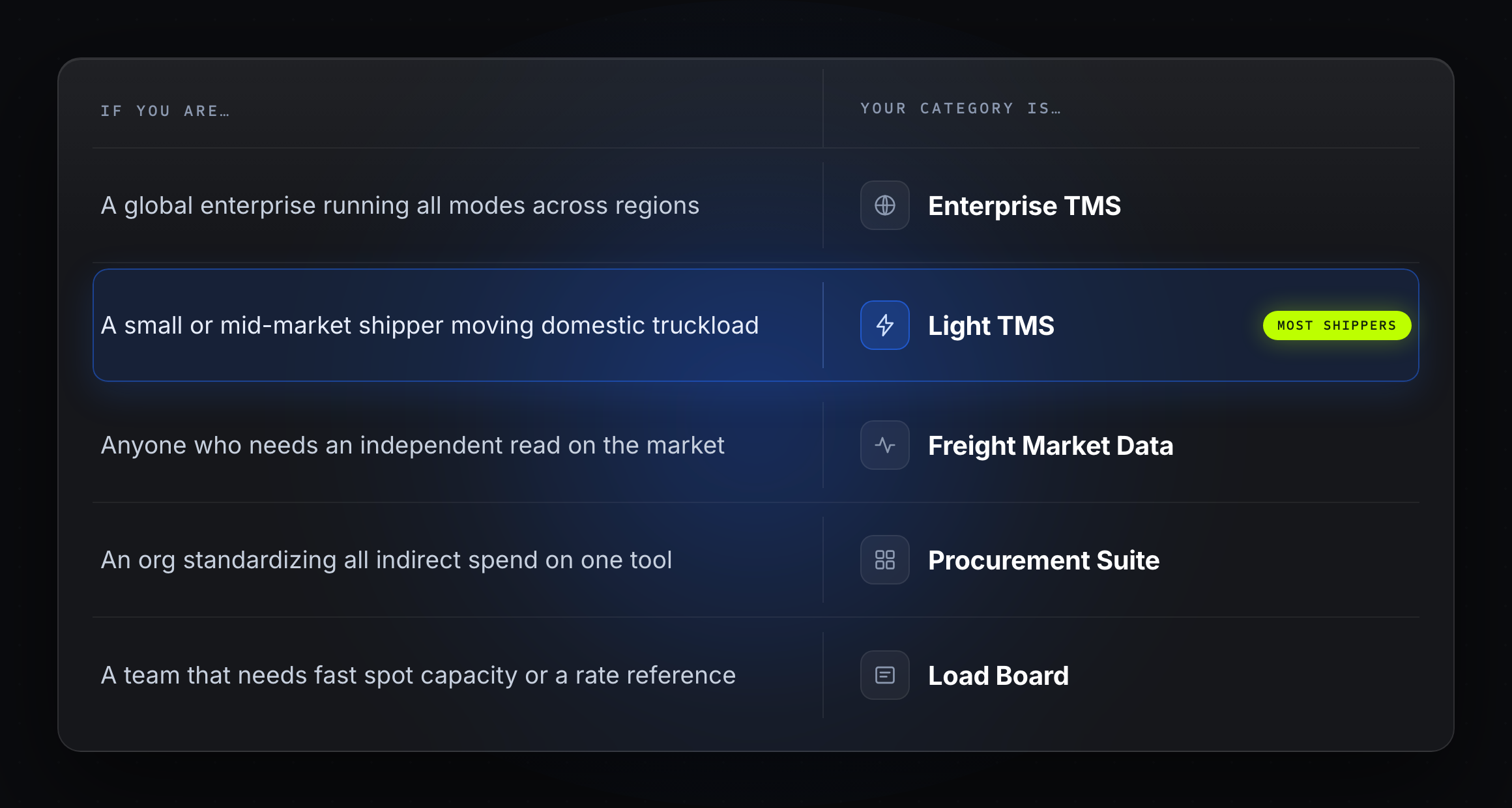
The most common mistake is buying up a tier, paying for enterprise complexity when a light TMS would solve the actual problem in a fraction of the time and cost. The second is staying in spreadsheets because enterprise looked like the only alternative. For most shippers moving domestic truckload, the light TMS category is the one worth a serious look. And if quoting is the specific job you are solving, we rank the best freight quoting software across 15 tools and three seats (shipper, broker, forwarder) in a separate guide.
What is the best freight procurement platform?
It depends on your category. The best enterprise TMS (Oracle OTM, SAP TM, MercuryGate) suits global multi-modal networks; the best light TMS (Emerge) suits small and mid-market shippers moving domestic truckload; the best market-data source (FreightWaves SONAR) is an input for anyone. Match the pick to how you actually buy freight.
What is the best TMS for a small or mid-market shipper?
For shippers moving domestic truckload and getting out of spreadsheets, the best fit is a light TMS, because it delivers quoting, booking, tracking, and reporting quickly and affordably without enterprise complexity. Emerge leads this category by combining spot and contract, a market benchmark on every quote, and free carrier access in one platform. That combination matters most when running an annual freight RFP.
What is the best source for freight market and rate data?
FreightWaves SONAR is the most widely cited independent freight-data source, tracking spot and contract rates, tender rejections, and capacity across the market. It's a reference tool rather than a procurement platform, and it works best paired with a platform that builds market-rate data into the booking workflow.
How should I choose between these platforms?
Start by identifying your category based on your size and modes, then evaluate the specifics: does it cover your lanes and modes, does it handle both spot and contract, does it show market-rate data, can your carriers join free, and how long is implementation. Match the tool to your operation rather than to a feature checklist, and talk to references in your industry.
There's no single best freight procurement platform, only the best one for your category. Global enterprise networks, mid-market truckload shippers, and procurement teams standardizing spend each have a different right answer.
For the large share of shippers moving domestic truckload and trying to get out of spreadsheets, that answer is a light TMS, and it's the category Emerge was built to lead.
Ready to reinvent your procurement strategy?
 SOC 2 Type II