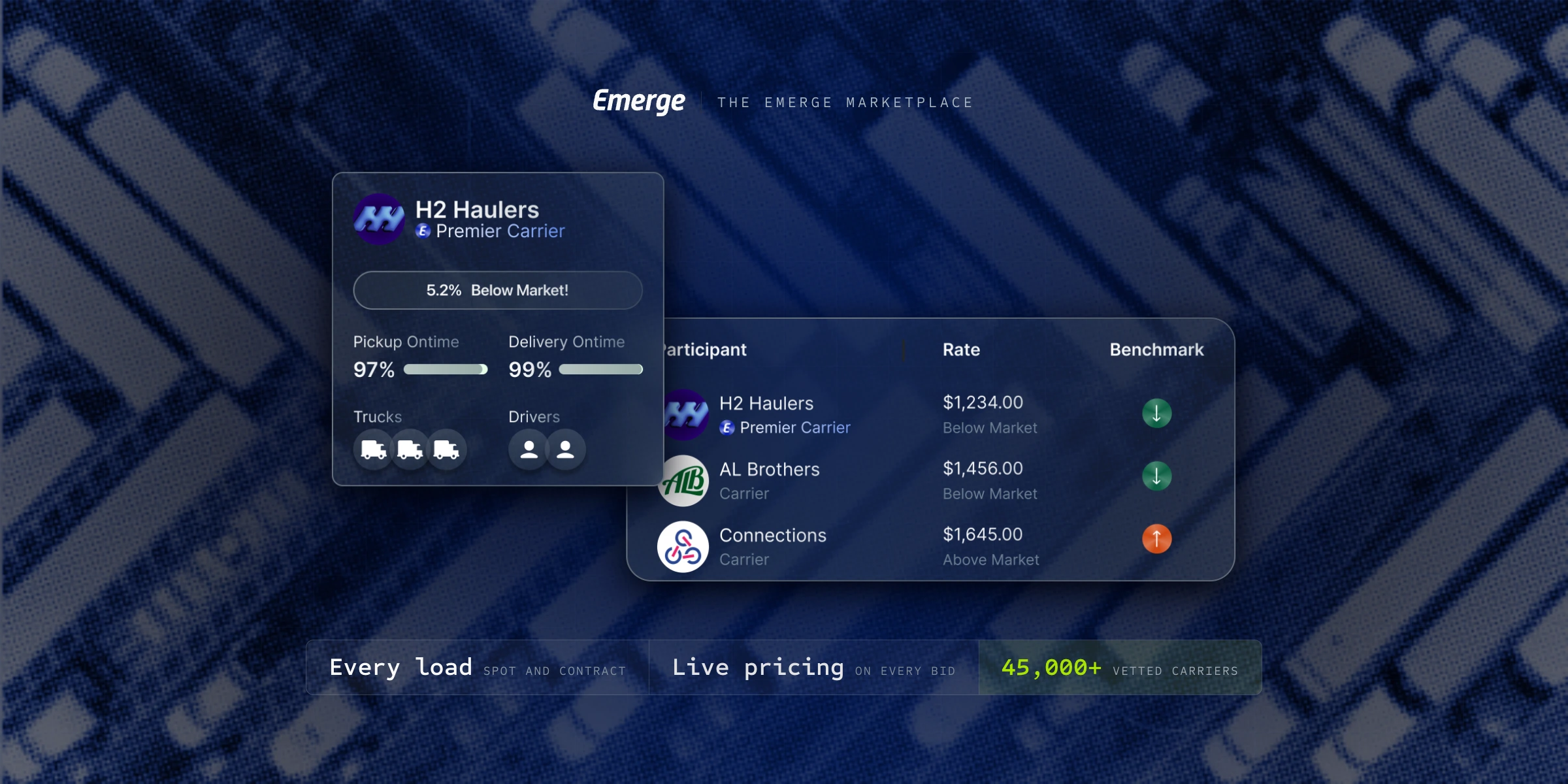
Running your own marketplace means your freight, your vetted carrier network, and carriers competing directly on every load, spot and contract, against live market pricing. Most shippers instead rent access to capacity through intermediaries and static routing guides, which works until the market moves. Owning the competition, the data, and the carrier relationships is what holds up when it does.
Our founder Andrew Leto said it plainly on Freight Caviar's Freight Gong Friday: every shipper should run their own marketplace. It's worth spelling out what that means and why we believe it, because it's the idea Emerge is built on.
Here's the short version. When you buy freight the traditional way, you're renting access to capacity that someone else controls. When you run your own marketplace, the competition for your freight belongs to you. In a market like this one, that difference is the whole game.
Four things, and they're simpler than the phrase sounds.
That's a marketplace. Not a bigger carrier list, and not a fancier load board, a standing competition for your freight that you own.
The traditional setup, an annual RFP, a static routing guide, and an intermediary for whatever falls through, works fine in a soft market. Everyone's rates look good when capacity is loose.
Then the market turns, the way it did at midyear. Spot crosses above contract, carriers get selective, and tender rejections climb. The routing guide you built last year starts failing, and every failed tender rolls downhill to whoever controls capacity in the moment, at whatever the moment charges. When you rent access to a network, the spread between what carriers charge and what you pay belongs to the owner of that network. In a tight market, that spread gets expensive, and you have no way to see it, let alone compete it away.
That's the quiet cost of the old model. It's not that it can't move freight. It's that when conditions swing, you're a price taker in someone else's market.
Competition doesn't disappear when the market tightens. It just needs somewhere to happen, and it works for whoever owns the venue.
In a study of shippers using Dynamic Book It Now, which puts spot loads in front of a large carrier network against a live benchmark, 85% secured rates below market, averaging 8.5% below. That's what owned competition looks like: not beating carriers down, but letting qualified carriers compete openly, with a live benchmark keeping everyone honest, up markets and down.
Depth works the same way. The Emerge Marketplace connects a shipper's own network to tens of thousands of vetted carriers, so backup capacity is standing by before a lane fails rather than sourced from scratch after. And because the data stays yours, every load makes your marketplace smarter: performance feeds scorecards, scorecards feed awards, and your network improves with use instead of going stale between RFPs.
That's the point worth being direct about: Emerge isn't a network you rent access to. It's the venue where you run your own, your carriers at the core, our vetted depth behind them, live pricing refereeing every bid.
Fair question, and usually no.
A TMS executes: it tenders, tracks, and reports. It doesn't create competition; it routes freight to decisions you already made. A long carrier list isn't a marketplace either, contacts aren't competition until they're bidding against each other on live loads with a benchmark in view. And capacity accessed through an intermediary is real capacity, but it's rented: the network, the pricing, and the data belong to them.
This is exactly why Emerge is built the way it is: a light TMS with the marketplace inside it. Execution and competition live in one system, your system, so every bid happens in the open, against a live benchmark, on freight you control. If you're coming off spreadsheets, it's both your execution layer and your marketplace from day one. If you already run an enterprise TMS, it connects to it. Either way, your best carriers still win, they just win by being the best bid, which is exactly why they're your best carriers.
What is a shipper-run freight marketplace?
It's a standing competition for a shipper's freight: their loads in front of a vetted carrier network, with multiple carriers bidding on every shipment, spot and contract, against live market pricing, on a platform where the data and relationships belong to the shipper rather than an intermediary.
How is a freight marketplace different from a load board?
A load board is public and transactional: anyone can see and grab postings, vetting is on you, and there's no lasting network. A shipper-run marketplace is private and cumulative: a vetted network competes for your freight repeatedly, performance data compounds, and the relationships persist.
Do I need to replace my TMS to run my own marketplace?
Not necessarily. The marketplace is the competition layer, deciding who hauls each load and at what rate, and it can connect to an enterprise TMS you already run. Shippers coming off spreadsheets often get both in one step: a light TMS with the marketplace built in handles execution and competition in the same system.
How does a shipper start building their own marketplace?
Start with the network: vet the carriers you have, add qualified depth where you're thin, and put real loads in front of them competitively with a live benchmark. That's what Emerge is built to provide, vetting at scale, structured bidding, and live pricing in one platform, so a shipper's marketplace runs continuously instead of once a year.
Every shipper already has the raw material of a marketplace: freight carriers want. The only question is who owns the competition for it, you, or whoever you're renting access from.
Markets like this one answer the question for you. When capacity tightens and routing guides crack, the shippers who own their marketplace keep competition on every load. Everyone else pays whatever the moment charges. Giving shippers that ownership is the entire reason Emerge exists, and getting yours running takes a lot less than you'd think.


 SOC 2 Type II