
Follow us


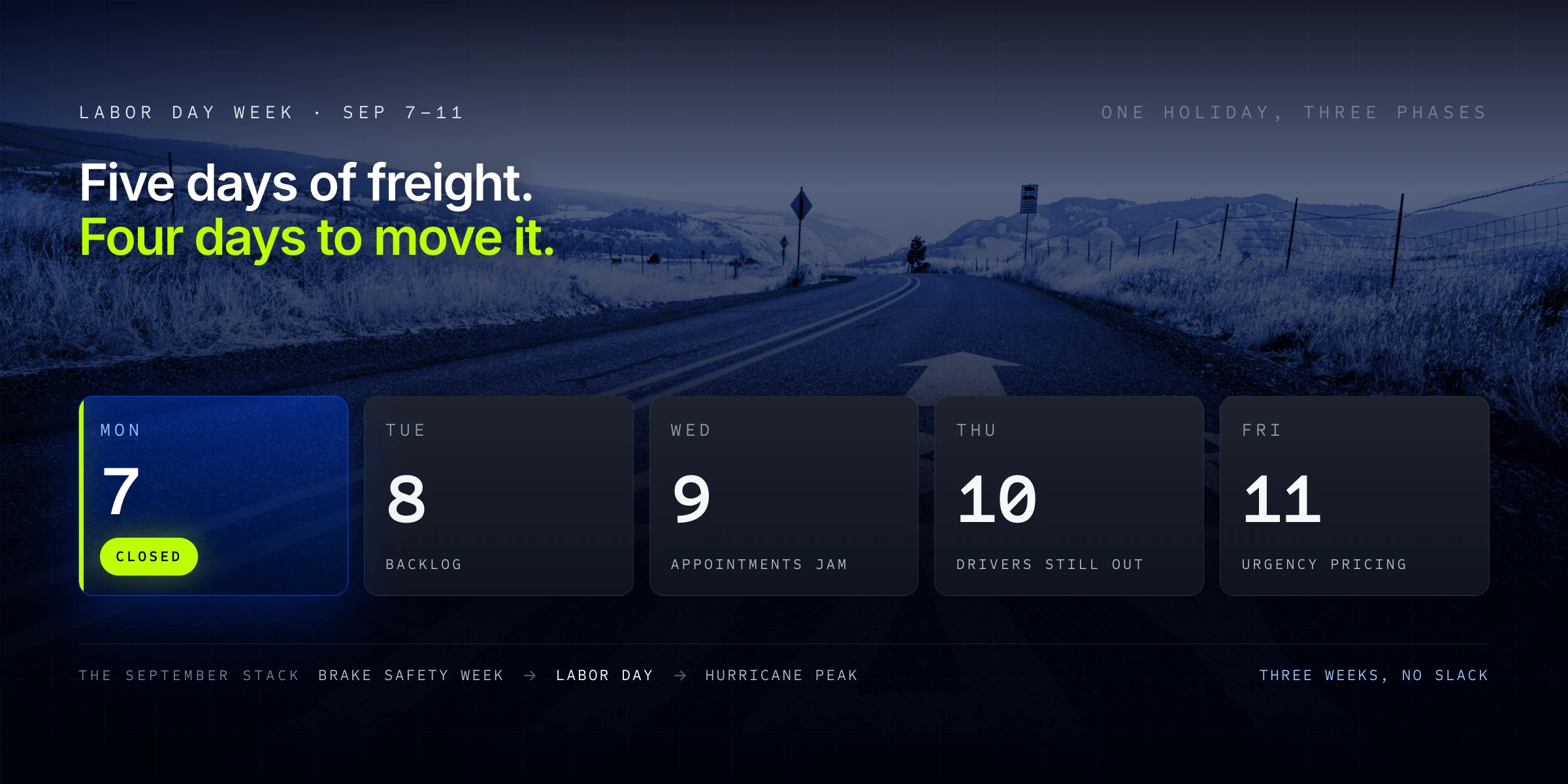
Labor Day moves freight in three phases: a surge the week before as shippers push loads ahead of the closure and retailers replenish for the holiday weekend, a compressed four-day week where drivers take home time and receivers close, and a catch-up week absorbing the backlog. This year the whipsaw lands between Brake Safety Week and the hurricane season peak, on a market with little slack, so freight moving that window should be covered early.
Labor Day looks like one lost shipping day on the calendar. To your freight, it's a three-week event.
This year it's also the middle act of a stacked September: Brake Safety Week runs August 23 through 29, Labor Day compresses the week of September 7, and the statistical peak of hurricane season arrives September 10, three capacity events in three consecutive weeks, hitting a market that's still running well above last year's rates with rejections elevated. None of them is a crisis on its own. Together, on a thin cushion, they're a stretch worth planning deliberately.
Here's how the holiday actually moves freight, and how to come through the whipsaw covered.
In three phases, and the closure day is the least of them.
The honest calibration: analysts expect Labor Day to be an inflection point, not a sustained disruption. It's a short, sharp, entirely predictable whipsaw. Which is exactly why the shippers who plan for it barely feel it.
Because the cushion that used to absorb holiday whipsaws is gone.
Rates remain more than 40% above last year even after the summer cooldown, tender rejections are running far above last year's baseline, and the carrier pool is flat while operating costs sit at records. On top of that, this Labor Day doesn't arrive in isolation: it follows Brake Safety Week's capacity dip by a week, which means some of the catch-up from one event flows straight into the surge phase of the next. Stacked events on a thin market compound, each one starts from the tightness the last one left behind.
That's not a reason for alarm. It's a reason to treat a routine holiday like the known, dated capacity event it is.
Four moves, all doable in the next two weeks.
How does Labor Day affect trucking and freight?
In three phases: a surge the week before as shippers pull freight forward and retailers replenish for the holiday weekend, a compressed week where Monday's closure removes a shipping day while drivers extend home time and receivers reduce schedules, and a catch-up week absorbing the backlog. Capacity dips and rates firm through the window, then normalize.
Should I ship before or after Labor Day?
Flexible freight moves best the week before the pre-holiday crunch fully builds, or from mid-September once the catch-up clears. Freight that must move during the compressed week of September 8 should be booked before the holiday with a day of schedule buffer, since appointments and capacity both tighten.
Which freight feels Labor Day most?
Refrigerated and retail freight, because holiday-weekend demand for beverages, grocery, and cookout goods peaks exactly as capacity thins, and this year that wave overlaps late-summer produce season. Time-sensitive loads of any kind also feel it, since the compressed week leaves little room to recover a missed appointment.
Is Labor Day week a bad time to ship freight?
It's a manageable time that punishes improvisation. The whipsaw is short, sharp, and entirely predictable, analysts expect an inflection, not sustained disruption, so shippers who cover holiday-week freight early, buffer schedules, and price against live market data typically come through with little drama. The expensive version is discovering the compressed week from inside it.
Labor Day is the most predictable kind of capacity event: the date is fixed, the mechanism repeats every year, and this year's only twist is that it lands mid-stack, after an enforcement week, before hurricane peak, on a market with no slack.
Cover the window early, buffer what's time-sensitive, and let the live market referee your rates through the noise. The week is four days either way. Whether your freight notices is up to you.
 SOC 2 Type II