
Follow us


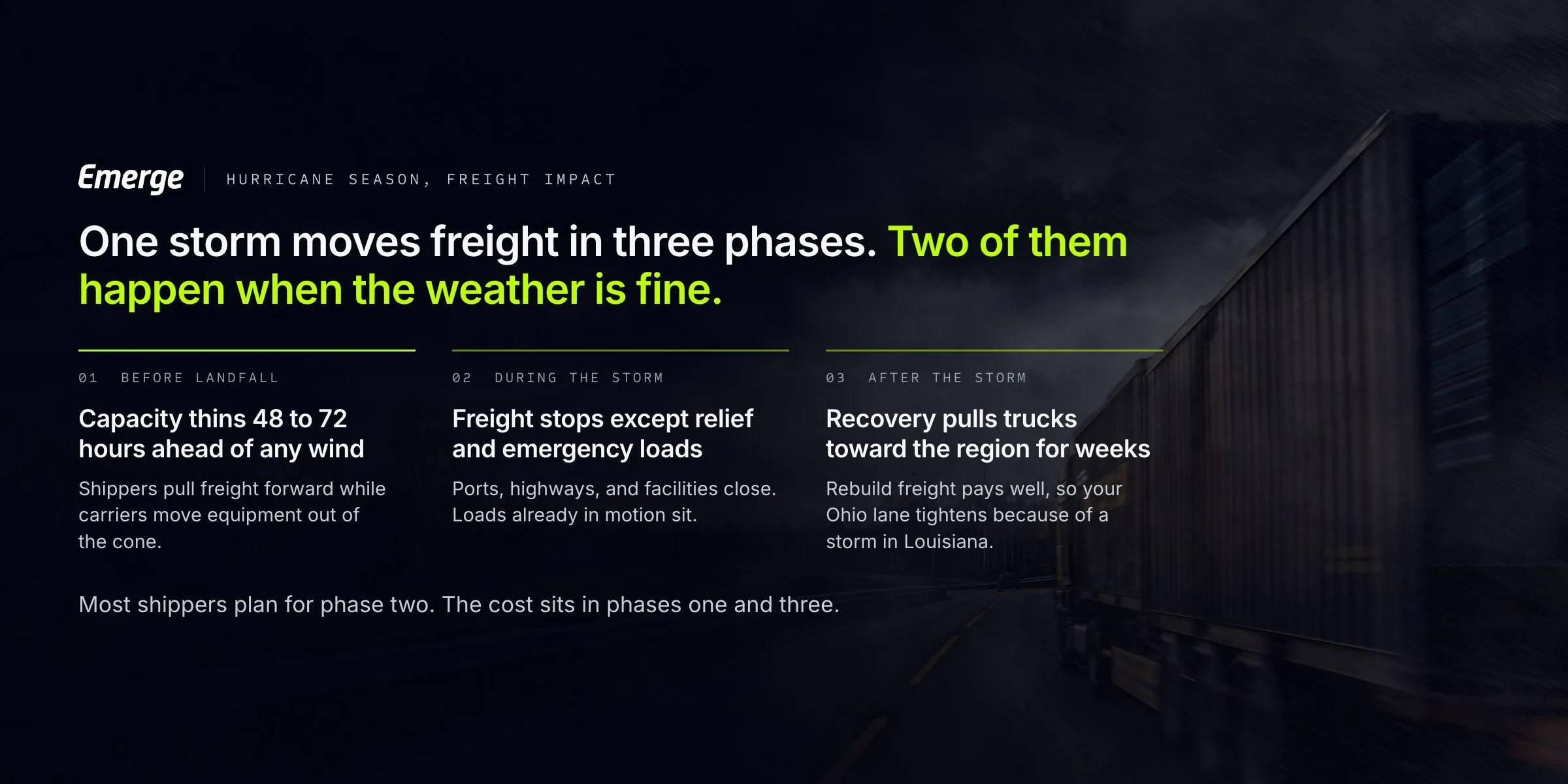
Hurricane season affects freight in three phases: carriers reposition equipment and shippers pull shipments forward before landfall, freight stops moving during the storm, then recovery demand pulls trucks toward the region for weeks. The 2026 forecast is below normal, but truckload capacity has less slack than in recent seasons, so a single storm moves rates further.
NOAA updated its Atlantic outlook on August 6 and cut the numbers again. Seven to 13 named storms, two to six hurricanes, and zero to two majors, with the odds of a below-normal season now at 75%. No hurricane has formed yet. Forecasters point to a strengthening El Niño, which drives up wind shear across the Atlantic and tears storms apart before they organize.
That reads like good news. Plan around it and you will get caught.
Storm counts do not decide your exposure. Market slack does. And there is less slack in truckload right now than in any recent hurricane season.
In three phases, and the first one starts before the weather does.
Because the market underneath it has changed.
The truckload market absorbed storms easily during the downcycle. There were spare trucks nearly everywhere, and a regional shock got soaked up by carriers with nothing better to do. That bench is gone. FMCSA's count of property carriers with operating authority fell 11.4% between December 2022 and December 2025, and FTR's read is that truckload attrition has run about as far as it can go without larger carriers failing.
Rates reflect it. ACT Research put aggregate spot rates 43% above last year in June, with contract rates 13% higher at $2.41 per mile excluding fuel. ACT also warns against reading the third-quarter lull as a return to the leverage shippers had two years ago. Softer seasonal demand is not the same as spare capacity.
So the math has flipped. A busy season into a loose market is an inconvenience. A quiet season into this market is a real risk, because there is nothing standing by to absorb the one storm that does land.
The obvious ones are Gulf and Southeast. Houston, New Orleans, Mobile, Tampa, Jacksonville, and the Carolinas. Both of this season's US-relevant storms formed in the Gulf rather than tracking in off the Atlantic, and one came ashore in St. Bernard Parish, Louisiana.
That detail matters more than it sounds. A storm that spins up off the Texas coast does not give you the week of watching a Cabo Verde system does. It gives you days. The pre-landfall window where shippers still have options is narrower this season than the classic hurricane playbook assumes, and it closes fastest for exactly the shippers with Gulf freight.
The less obvious exposure is everywhere else. When recovery freight pays a premium in the Southeast, trucks leave the Midwest and the Northeast to chase it. Your Ohio lane gets tighter because of a storm in Louisiana. That second-order pull is what turns a regional weather event into a national rate move, and it is the reason shippers with no Gulf freight still feel it.
Ports add a third layer. When a Gulf or Southeast terminal closes for a few days, the containers behind it do not disappear. They stack up and then release all at once, and every one of them needs a truck. That backlog arrives days or weeks after the storm has cleared the news, which is exactly when most shippers have stopped watching.
Timing compounds all of it. The statistical peak of the season falls in mid-September, which lands on top of produce volume still moving out of growing regions and an import surge that already pulled peak season forward this year. Three demands on the same trucks, in the same weeks, in a market with no bench.
The work is the same whether you do it now or in the middle of a named storm. Only the price changes.
A below-normal forecast is not a low-risk season. It is a low-frequency season in a market with no cushion, which is a different thing entirely.
Shippers who come through storms well are not the ones who guessed the track. They are the ones who already had depth in their network, a spot path that works, and visibility into loads in motion before anything formed in the Gulf.
That is what the Emerge Marketplace is for, and it is easier to build in August than in September. Book a demo and we will look at your exposure against your own lanes.
How does hurricane season affect freight rates?
Rates move in three stages. Before landfall, shippers pull freight forward while carriers move equipment out of the path, which thins regional capacity and lifts spot rates. During the storm, most freight stops. After it passes, recovery demand pulls trucks toward the region and keeps rates elevated for weeks, often well beyond the affected lanes.
When is the peak of hurricane season?
The Atlantic season runs June 1 through November 30, with activity concentrated from mid-August through October and a statistical peak in mid-September. That window overlaps produce volume and the start of retail peak season, so trucks are already in demand when storm risk is highest.
Does a below-normal hurricane forecast mean less freight disruption?
Not necessarily. A seasonal outlook predicts overall storm activity, not landfall, and it says nothing about how much spare capacity exists to absorb one. With for-hire carrier counts down sharply since 2022 and spot rates well above last year, a single landfall in a major freight market has more effect now than a busier season did during the downcycle.
What should shippers do to prepare for hurricane season?
Identify which lanes and facilities sit in the Gulf and Southeast exposure zone, add carrier depth to those lanes before a storm forms, confirm you have a spot procurement path when the routing guide fails, pull flexible shipments forward, and make sure you can track loads in motion. All of it is cheaper and easier to do before a storm is named.
 SOC 2 Type II