
Follow us


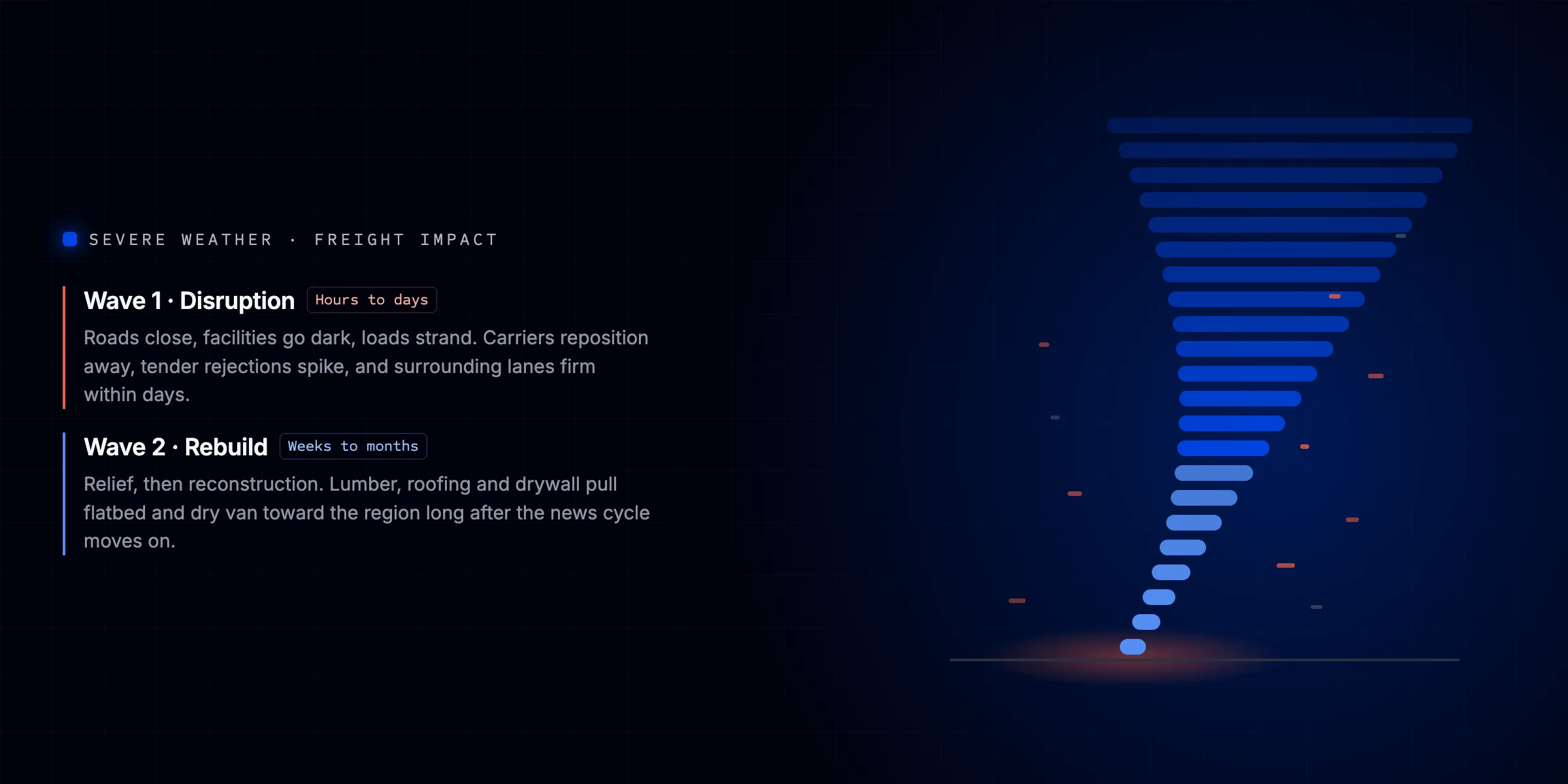
A tornado disrupts freight in two waves. First comes the immediate hit: closed roads, damaged facilities, stranded loads, and carriers repositioning away from the region, which tightens local capacity within hours. Then comes the longer wave: relief supplies and months of rebuilding materials flowing in, pulling flatbed and dry van capacity toward the recovery. Unlike seasonal spikes, none of it is on a calendar, which is why prepared networks beat predictions.
Most of the capacity crunches we write about come with a schedule. Produce season peaks on a calendar. Retail waves follow the school year and the holidays. Big events publish their dates a year out. You can see them coming, and the whole playbook is to prepare before the window opens.
A tornado is the other kind of disruption. No date, no warning beyond minutes, and no way to map your lanes against it in advance. The spring of 2026 was a reminder of how real that is: the season got off to an unusually active start, with repeated outbreaks across the Plains and Midwest, strong tornadoes in Nebraska in May, and severe weather stretching into June across states like Michigan, Indiana, and Illinois. Beyond the human toll, which always comes first, each of those events rippled through regional freight markets in a pattern worth understanding.
Because while you can't predict a tornado, the freight effects that follow one are surprisingly consistent. Here's the pattern, and what it means for how you prepare.
Roads close from debris and downed power lines. Warehouses, distribution centers, and truck terminals in the path take damage, and the freight inside them stops moving. Loads in transit get rerouted or stranded. Power outages take fuel stations and facilities offline across a much wider area than the tornado's actual track. And carriers do what any rational operator does: they reposition away from the affected region until conditions clear, taking capacity with them.
The market signal shows up almost immediately. Tender rejections spike in the affected region as carriers decline loads into and out of the disruption zone, and spot rates on the surrounding lanes firm as the remaining capacity gets scarce. A shipper with freight anywhere near the region feels it within days, whether or not their facilities took a single hit. It's the same shared-capacity math as every other regional squeeze: when trucks leave an area or get absorbed by a disruption, everyone competing for the ones that remain pays more.
Here's the part most shippers don't plan for: the disruption ends in days, but the freight effects run for months, in the opposite direction.
After the emergency phase comes relief freight: water, food, generators, tarps, and supplies moving into the region, often on tight timelines. Then comes the much bigger and longer wave, reconstruction. Lumber, roofing, drywall, windows, appliances, and equipment flow toward the damaged area for months as homes and businesses rebuild. Much of it moves on flatbed, which is why flatbed capacity in a recovery region tightens long after the news cycle moves on, with dry van pulled along for everything else.
That rebuild demand competes with whatever freight normally runs those lanes. If your network touches a recovery region, you're now bidding against construction and relief freight for the same trucks, sometimes for a quarter or more. A tornado that never came within a hundred miles of your facilities can still sit on your rates for months through that channel.
Every other capacity event in the playbook rewards mapping your lanes against a calendar. This one doesn't, and that changes what preparation means.
You can't pre-book capacity for a disruption you can't locate or schedule. What you can do is build the kind of freight operation that absorbs a regional shock without scrambling, which comes down to three things: depth, visibility, and flexibility. The shippers who ride out a severe-weather disruption are the ones who had backup carriers on their lanes before the storm, saw the regional market move in real time, and could shift timing or routing when a lane went dark. The ones who get hurt are running thin networks at full stretch, discovering the disruption through a failed tender.
In other words, tornado preparedness for a shipper isn't a weather plan. It's the same resilience that protects you in every other tight market, held to a higher standard because there's no calendar to lean on.
Four moves, all of them before the storm, because during it is too late.
None of this predicts the weather. It makes the weather survivable, which is the only version of prepared that exists for a disruption without a date.
When a regional shock hits, the difference shows up in how fast you can re-cover a lane.
In a study of shippers using Dynamic Book It Now, which books spot loads against a live market benchmark across a large carrier network, 85% secured rates below market, averaging 8.5% below. That combination, a deep network plus a live read on the market, is precisely what a disruption tests: whether you can find quality capacity fast and know what fair looks like when the local market is moving by the hour.
The shippers who come through a severe-weather event cleanly aren't the ones who saw it coming. Nobody does. They're the ones whose network and visibility were built before the sirens.
How do tornadoes affect freight and trucking?
In two waves. Immediately: closed roads, damaged facilities, stranded loads, and carriers repositioning away from the region, which spikes tender rejections and firms spot rates on surrounding lanes within days. Then over the following months: relief and reconstruction freight flows into the region, pulling flatbed and dry van capacity toward the rebuild and tightening those lanes long after the storm.
Why do freight rates rise after a tornado even far from the damage?
Because truckload capacity is a shared pool. Carriers reposition away from disrupted areas, displaced freight moves to surrounding lanes, and rebuild demand later pulls trucks toward the region. Shippers with no connection to the storm still compete for the same capacity, so rates can firm across a wide area around the actual damage path.
How long does a tornado affect the freight market?
The acute disruption typically clears in days as roads reopen. The rebuild wave lasts far longer: reconstruction freight can tighten flatbed and dry van capacity in a recovery region for months, and a major event can influence regional rates for a quarter or more.
How can shippers prepare for severe weather disruptions?
You can't schedule the storm, so preparation means resilience: vetted backup carriers on every lane before you need them, real-time visibility into regional rates and rejections so you see disruption as it develops, spot-market readiness for fast re-coverage, and timing buffers through affected geographies during storm season.
Tornadoes are the disruption you can't put on a freight calendar. The damage is local, but the freight effects are regional and long: an immediate capacity shock, then months of rebuild demand pulling trucks toward the recovery.
The playbook is honest about what you can't do. You can't predict the storm, pre-book around it, or map it like peak season. What you can do is build the network depth, market visibility, and spot readiness that make a regional shock a manageable week instead of a lost quarter. Prepared beats predicted, especially when prediction isn't on the table.
Ready to reinvent your procurement strategy?
 SOC 2 Type II