
Follow us


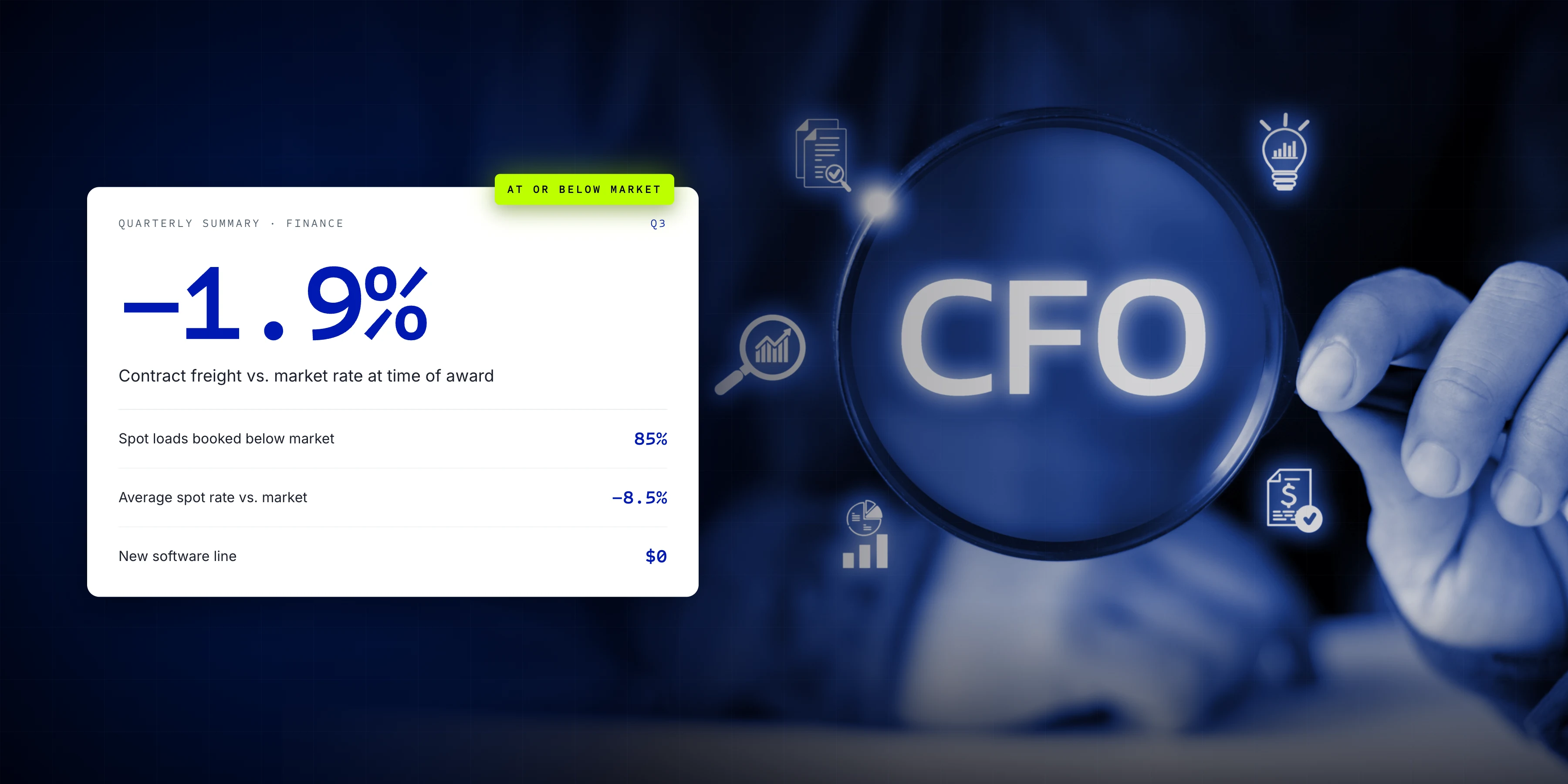
A business case for freight procurement software has to answer finance's question, not transportation's: what measurable outcome does this produce, and what does it cost to get it? The strongest cases show visibility into rates before freight is committed, performance measured against the market rather than last year's budget, a cost that doesn't add a new software line, and a plan to keep reporting results after approval.
Most transportation leaders don't report to someone who thinks about freight. They report to someone who thinks about a budget, and freight is one line in it. So when the question comes up, "why do we need software to buy transportation?", the answer that works inside the transportation team almost never works in that room.
True freight ROI isn't only measured by beating the market. It's also measured by what stays off the balance sheet. Cutting costs drives immediate value, and performance against market rates is the visible line finance can see every quarter. Freight fraud and reputational exposure are the invisible ones: the stolen load, the carrier who wasn't who they claimed, the incident that runs under your company's name because it was your product on the trailer. A business case that covers both is the one finance takes seriously.
Three things, and none of them is a feature list.
Visibility before the money moves. Finance's quiet worry about freight is that it's spent before anyone can question it. A platform that shows the market rate on a lane before a load is tendered or a bid is awarded changes that, because the decision becomes reviewable at the moment it's made, not in an audit three months later.
Performance against the market. Not against last year. Freight rates move with the market, so a budget that beat last year in a soft market says little, and one that rose in a tight one may still be the best anyone could have done. The number finance can trust is where you landed relative to what the market was charging at the time.
Results that keep coming. A one-time ROI slide gets approval once. What finance values is a number that shows up every quarter without being asked for, which is also what protects the program later, more on that below.
Because it's the only one that holds up when conditions change.
A transportation leader who promises to cut freight spend is making a promise the market can break. A leader who commits to keeping freight at or below market rates, and can show it, is making one they can keep in any cycle. That framing also happens to be the one finance understands best, because it's how they already think about every other variable cost.
It helps that it's provable. Dollar Tree, which runs its procurement through Emerge, averages 1.9% below market by bidding against current data rather than last year's numbers. In a study of shippers using Dynamic Book It Now, which books spot loads against a live benchmark, 85% secured rates below market, averaging 8.5% below. Those are the kinds of figures a business case can carry into the room, and they're measured the way finance would measure them.
By making sure it isn't one.
The objection is fair. Legacy procurement suites earned it: large upfront license fees, implementations measured in months, training nobody had time for, and a dependency on engineers to keep it running. Finance has seen that movie.
The answer is a platform whose cost sits with the freight rather than beside it. No capital expenditure to approve, no separate software line to defend each year, and an implementation that takes days to weeks because the product was built by people who ran freight, not for them. When the cost shows up as part of operating transportation, and the results show up as freight at or below market, finance is comparing an operating expense to a measurable outcome, which is a comparison it knows how to make.
This is the part most business cases skip, and it's often the part finance cares about most.
There's an old line in enterprise purchasing: nobody ever got fired for buying IBM. The freight version is less about brand and more about exposure. Transportation leaders don't lose their standing because rates went up in a tight market. They lose it when something preventable goes wrong: a routing guide that quietly slips from high compliance to something lower, with every missed tender rolling into spot costs nobody budgeted, or a load handed to a carrier that turned out not to be who they said they were. Freight fraud has become a mainstream concern, and the liability lands on the shipper.
So the business case should say, plainly, what the platform prevents: freight moving with vetted carriers rather than whoever answered the phone, backup coverage in the routing guide before a lane fails, and a record of every decision against the market rate. Finance may not ask for this. It will remember you offered it.
By reporting on it before anyone asks.
Leadership changes. A CFO who approved the platform leaves, and the new one has never seen the case. The programs that survive are the ones where the transportation team never stopped reporting: freight versus market every quarter, routing guide compliance, coverage during the tight stretches. When the question comes up again, and it will, the answer is already in the last three reports, and nobody has to restart the narrative from zero.
That's also the honest reason to pick a platform that produces those numbers natively. A business case you have to rebuild by hand every year is one that eventually doesn't get rebuilt.
The report finance wants, in the form finance wants it, without a week of spreadsheet work first.
This is where the choice of platform shows up in the business case directly. If every quarterly update means pulling rate data from one system, carrier performance from another, and market benchmarks from a third, the reporting cadence that protects the program is the first thing to slip. The platform should do the compiling.
In Emerge, the pieces of that report already exist as working data. Lane-level benchmarking shows where your contracted and spot rates sit against the market, at, above, or below, so the performance-versus-market number is read off the platform rather than calculated by hand. Carrier scorecards track acceptance and on-time performance by carrier, which is where routing guide compliance becomes a number you can show. And Emerge AI answers questions about your own freight data in plain language, so "how did our top lanes perform against market last quarter" is a question you ask, not a project you assign. Put those together and the quarterly summary for finance is something you compile from the platform in an afternoon, in the same format every time, which is exactly what keeps it credible.
Five things, in roughly this order:
How do you justify freight procurement software to finance?
Frame it around outcomes finance can measure: visibility into market rates before freight is committed, performance measured against the market rather than last year's budget, a cost that sits with operating expense instead of a new software line, and a quarterly reporting plan. Pair that with the risk the platform reduces, such as routing guide failures and carrier fraud exposure.
What is the ROI of freight procurement software?
The clearest measure is freight performance against the market: whether contracted and spot rates land at or below what the market was charging at the time. Shippers using benchmark-driven bidding have documented results below market, such as Dollar Tree averaging 1.9% below market and 85% of shippers in a Dynamic Book It Now study securing below-market spot rates. Reduced spot exposure from stronger routing guide compliance is the second measure.
Why shouldn't a freight business case focus on year-over-year savings?
Because freight rates follow the market, so year-over-year comparisons mostly measure the market, not the program. In a soft year any approach looks good; in a tight year a well-run program may still show higher spend. Performance against the market rate at the time of each decision is the measure that holds up across cycles and the one finance can audit.
How do you keep leadership support for procurement software after approval?
Report continuously rather than once. A quarterly summary of freight versus market, routing guide compliance, and coverage during tight periods keeps the case current, so a leadership change or budget review doesn't require rebuilding it from scratch. Choosing a platform that produces those metrics natively, with lane-level benchmarking, carrier scorecards, and data you can query directly, makes the cadence sustainable.
Finance doesn't buy software. It buys an outcome it can measure, at a cost it can classify, with a risk it can understand. Build the case in that order, commit to freight at or below market, and keep reporting after the yes. The leaders who do that rarely have to make the case twice.
 SOC 2 Type II