
Follow us


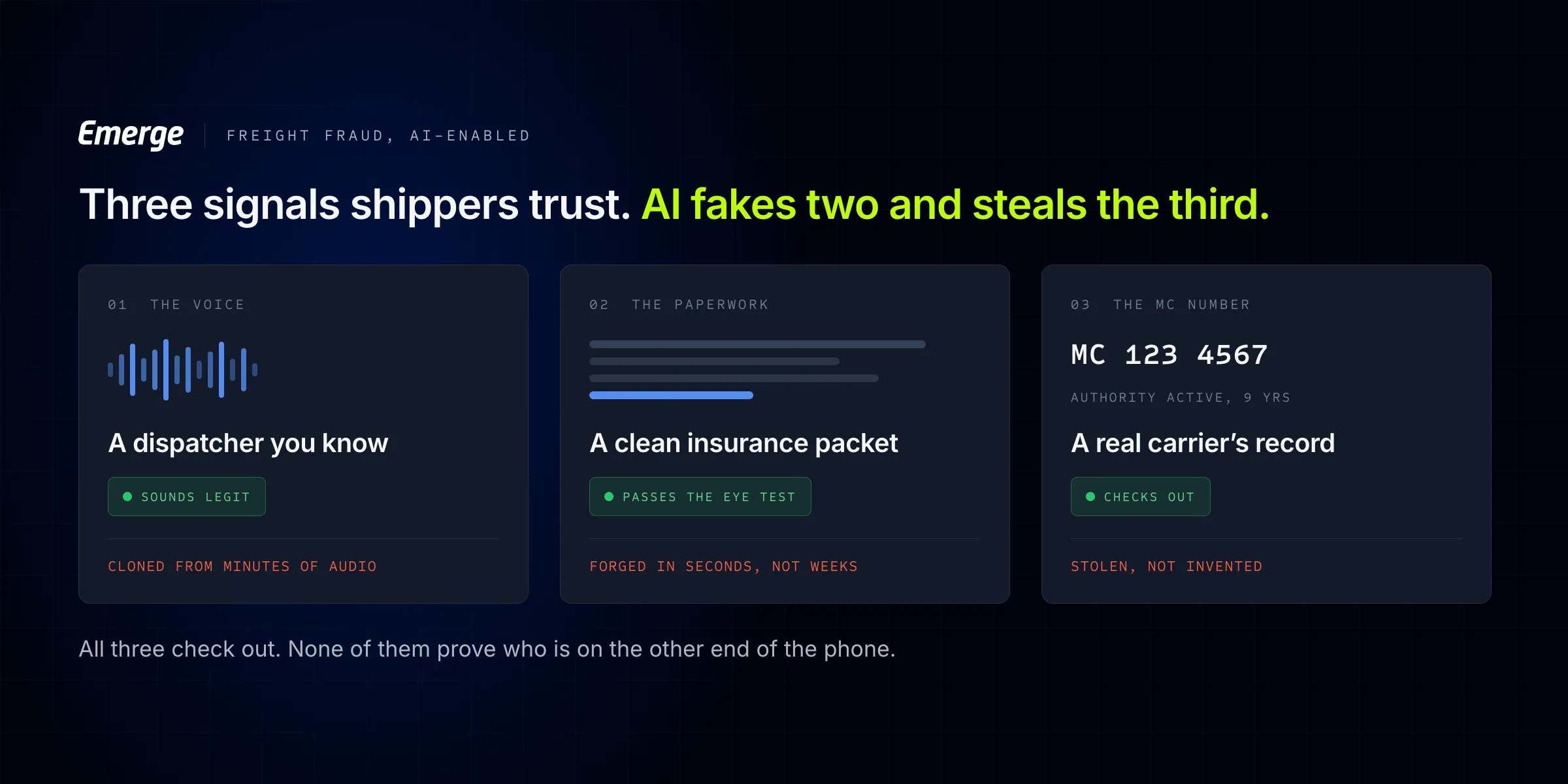
Freight fraud is getting an AI upgrade: cloned voices impersonating dispatchers, convincing phishing at scale, forged documents, and criminals operating under real carriers' stolen credentials. It shows up in the data as fewer theft incidents but far bigger losses. The signals shippers traditionally trust, a familiar voice, clean paperwork, a real MC number, are exactly what the new playbook fakes or hijacks. Trust what accumulates and what's source-verified instead.
The strangest stat in freight right now: cargo theft incidents are falling, and losses are exploding.
In the second quarter of 2026, documented theft incidents dropped 26% year over year while estimated losses more than doubled to $304.6 million, per Verisk CargoNet. That's not a contradiction. It's a strategy. Organized fraud has shifted from grabbing trailers to stealing identities, and the category built on deception, identity theft, and fraudulent documentation, what CargoNet calls strategic theft, has surged roughly 1,500% since 2021. Fewer jobs, bigger scores, much harder to spot.
AI is the upgrade making it work, and it's aimed at the exact signals shippers have always trusted.
The patterns are worth recognizing, at the pattern level, because that's how you spot them.
None of this requires the criminal to be sophisticated anymore. The tools are.
Every one of those tactics targets a shortcut shippers use to establish trust.
A familiar voice used to mean a familiar person. Clean paperwork used to mean a legitimate operation. A real MC number with a real safety record used to mean the entity on the phone was the entity in the database. AI broke the link between the signal and the thing it signaled. The credential still checks out; it's just being worn by someone else.
That's why this wave is so effective against experienced teams. Nobody's falling for an obvious scam. They're extending normal trust to signals that used to deserve it, and the fraud lives precisely in that gap, especially in the window between when a carrier was last checked and whenever anyone looks again.
The defense isn't paranoia. It's shifting weight onto the things AI can't cheaply counterfeit.
Is AI increasing freight fraud?
It's changing its shape more than its count. Theft incidents have actually declined, but losses have surged, more than doubling year over year in mid-2026, because AI-enabled tactics like voice cloning, convincing phishing, and forged documents let organized groups run fewer, larger, identity-based thefts. Strategic theft built on deception and identity fraud is up roughly 1,500% since 2021.
What do AI-enabled freight scams look like?
At the pattern level: cloned voices impersonating known dispatchers, fluent phishing that harvests carrier and broker credentials, forged insurance and authority documents, and criminals operating under real carriers' stolen identities to accept tenders and redirect freight. The common thread is that things which used to signal legitimacy can now be faked or hijacked.
How can shippers detect a fake or impersonated carrier?
Verify credentials against source systems rather than documents, treat sudden changes in banking, contacts, or communication style as triggers for confirmation through channels already on file, and weight behavioral history heavily. Months of executed loads and consistent performance are far harder to fake than paperwork.
If theft incidents are falling, is the risk actually lower?
No. Fewer incidents with much larger losses means fraud has become more targeted and more successful per attempt. Organized groups are choosing higher-value freight and using identity-based methods that are harder to detect, so the average event is more damaging even as the count declines.
Freight fraud didn't get smaller. It got smarter, and AI is doing the sharpening. The voice, the paperwork, the MC number: the new playbook fakes the first two and steals the third.
So move your trust to what can't be counterfeited on demand. Source-verified credentials. Accumulated performance. Confirmation through channels you already own. Fraud industrialized; the signals that still mean something are the ones that take months to build and seconds to check.
 SOC 2 Type II