
Follow us


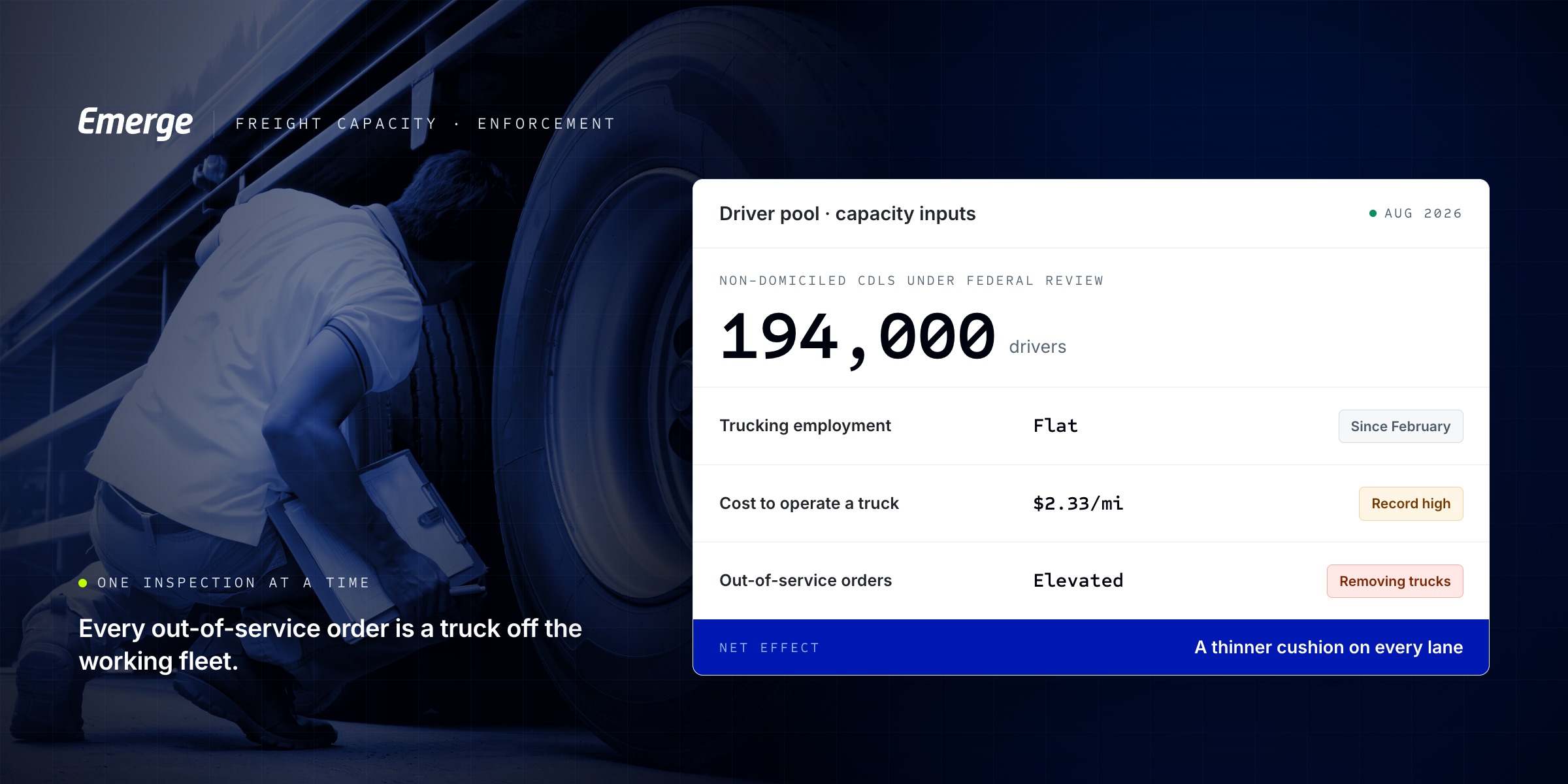
Enforcement has become a measurable capacity input in 2026. Inspection operations are producing thousands of violations and hundreds of out-of-service orders, licensing oversight has tightened for a meaningful slice of the driver population, and it's all landing on a driver pool that is flat while carrier operating costs sit at record highs. For shippers, that means a thinner cushion, and a premium on carrier quality and backup depth.
Most of what tightens truckload capacity gets a headline: a storm, a strike, a rate spike. One of this year's steadiest tightening forces gets less attention, because it arrives one inspection at a time.
Enforcement activity across the industry has stepped up in 2026, and its capacity effect is real, measurable, and worth understanding, no politics required. Here's what's happening, why it reaches your lanes, and how to keep your freight covered through it.
Three verifiable things, all pressing on the same labor pool.
Inspection activity is elevated. Beyond scheduled events like Brake Safety Week, agencies have reported repeated enforcement waves this year: single state operations producing thousands of violations with hundreds of drivers and vehicles placed out of service, and multi-day federal operations reporting out-of-service orders in the hundreds. Every out-of-service order is a truck or driver removed from the working fleet until the issue is resolved.
Licensing oversight has tightened. Federal scrutiny of commercial licensing, including English-language proficiency requirements and non-domiciled commercial driver's licenses, has increased, with industry coverage putting the non-domiciled CDL group alone at roughly 194,000 drivers. Requirements and enforcement intensity have shifted through the year, which adds compliance work for carriers and uncertainty about the pool's effective size.
There's also a legal fight over the verification system itself. In mid-August, attorneys general from 22 states, including Arizona, sued to block a federal demand for the Commercial Driver's License Information System, the state-owned database used to verify roughly 17 million CDL holders across state lines. The states, which are responsible for verifying drivers' identities, qualifications, and driving histories across jurisdictions, argue the demand violates driver-privacy and spending laws; the federal government says it is entitled to the data for road-safety enforcement. Courts will decide who's right. The freight-relevant fact is narrower: officials in at least one state have warned that disruption to the system could complicate driver verification at scale, which would be a capacity issue if it materialized. For now, it's uncertainty rather than impact.
And the pool has no slack to give. Trucking employment has been roughly flat since February. Carrier exits that began in 2022 have continued, with more small-carrier bankruptcies filing this summer. Industry research now puts the average cost of operating a truck at a record high, above $2.33 per mile, meaning the carriers still running have thin margins for any added friction.
None of those facts requires an opinion. Together they describe a supply side being trimmed at the edges while nothing replenishes it.
Because the math compounds in three ways.
Direct subtraction. Out-of-service orders remove capacity immediately, mid-route in many cases, and the truck stays out until repairs or compliance issues are resolved. Multiply across a year of elevated activity and the working fleet is persistently a little smaller than the registered one.
Behavior around the waves. Announced enforcement changes carrier behavior, the same pattern we documented with Brake Safety Week: some operators schedule maintenance or downtime around known enforcement windows, thinning posted capacity during those stretches even among fully compliant fleets.
Pressure on the margin. Compliance costs and enforcement risk land hardest on carriers already operating at the edge, and with costs at record levels, added friction accelerates the exits that have been running for three years. That's a slow leak in the capacity pool, and it doesn't reverse quickly, because the structural squeeze was already the defining feature of this market.
The honest takeaway: enforcement that improves safety is good for freight, unsafe trucks off the road protect everyone, and it still tightens capacity while it works. Both things are true, and shippers should plan for the second while supporting the first.
Four moves, none of which depend on predicting any rule or operation.
Budget and bid for a thin cushion. A flat driver pool plus active enforcement plus record carrier costs is not a recipe for slack returning. Set rate expectations and capacity plans against that reality rather than a hoped-for loosening.
Watch the operational signals. Enforcement effects show up where everything shows up: tender rejections by region and live lane rates. Those will register any real squeeze faster than any announcement will.
Make carrier quality your shield. Enforcement pressure concentrates on carriers with marginal compliance and shaky safety records, and largely passes over well-run fleets with stable, qualified drivers. That makes vetting for safety and performance a capacity strategy, not just risk management: a network of continuously screened, compliant carriers, the standard the Emerge Marketplace is built on, is a network that enforcement waves mostly pass through without touching your freight.
Keep backup depth on every lane. To your freight, a truck sidelined by an inspection looks identical to one sidelined by weather. The answer is the same: backups already in place, so a disruption becomes a re-tender instead of a scramble.
How does CDL enforcement affect freight capacity?
Three ways: out-of-service orders remove trucks and drivers from service immediately, carriers adjust schedules around announced enforcement windows, and compliance costs pressure marginal operators toward exiting, a meaningful effect when the driver pool is flat and operating costs are at record highs. The result is a persistently thinner capacity cushion, felt most during enforcement waves and in tight regional markets.
Are there enough truck drivers in 2026?
The pool is best described as flat and under pressure rather than simply short. Employment has hovered near February levels, carrier exits remain elevated, and licensing and enforcement changes have added friction. Whether that amounts to a shortage is a long-running industry debate; what matters for shippers is that supply isn't growing while demands on it shift.
What signals should shippers watch for enforcement-driven tightening?
Regional tender rejection rates, which register capacity friction within days; live lane-level rates, which show where a squeeze is priced in; and the calendar of announced enforcement events, which reliably produce localized dips. Operational data will always show the effect before any report explains it.
How can shippers protect coverage during enforcement waves?
Favor carriers with strong safety and compliance records, they're the least likely to be sidelined, keep vetted backup carriers on every key lane, add schedule buffer on time-sensitive freight during announced enforcement windows, and price against live market data so quotes during a squeeze reflect the moment rather than exploit it.
Enforcement is doing what it's supposed to do, taking unsafe trucks and unqualified drivers off the road, and doing it against a driver pool with no slack, which makes it a capacity force shippers can't ignore. The cushion is thinner, the waves are on the calendar or in the data, and the carriers who sail through are exactly the ones worth building a network on.
You don't control the inspections. You control whether your network is the kind they pass over, and whether your backups are ready when a truck isn't. Do both, and enforcement season is a line in your market read instead of a hole in your coverage.
 SOC 2 Type II