
Follow us


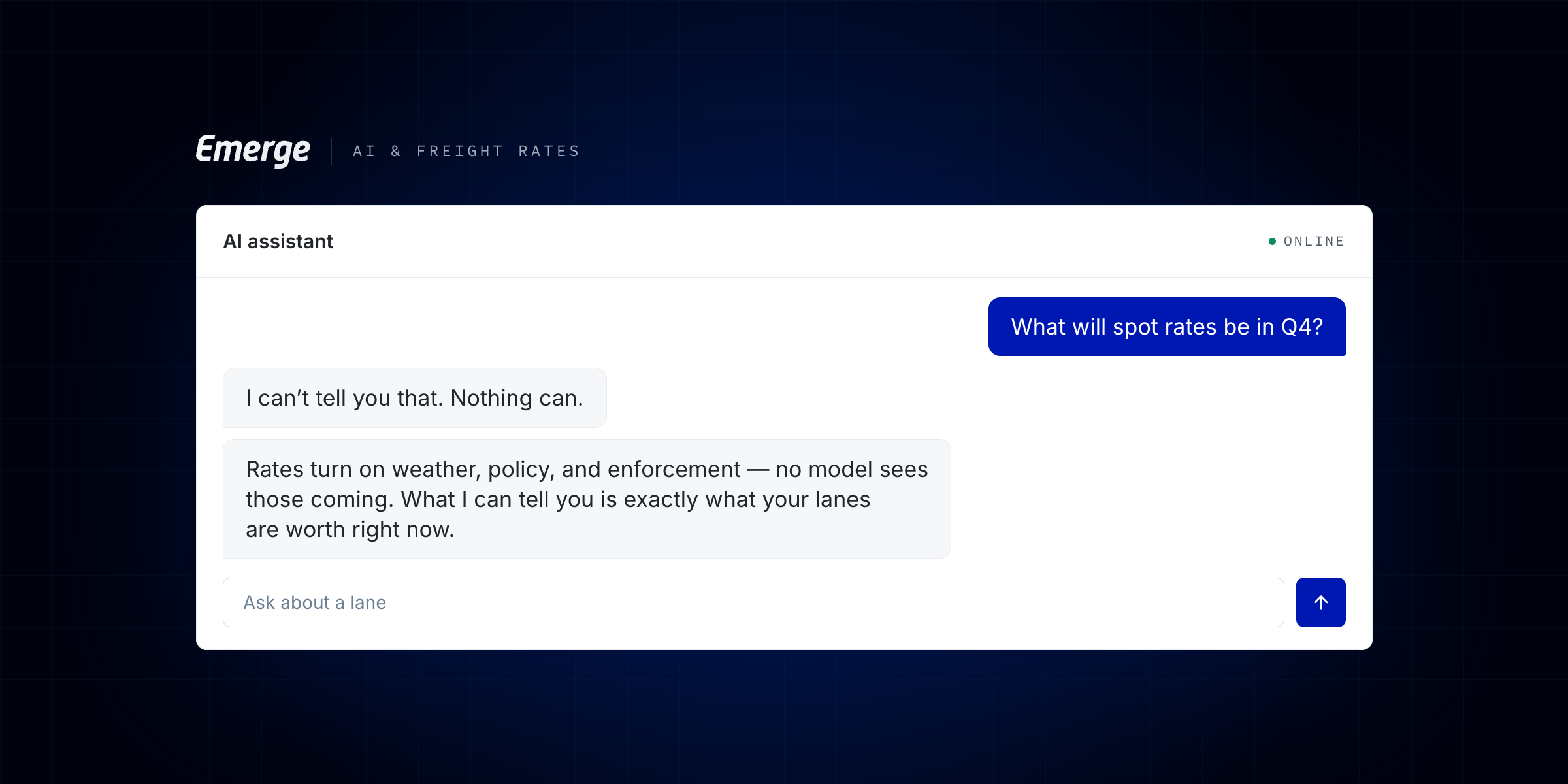
Partially. AI is genuinely good at reading freight rates in real time, benchmarking what's fair on a lane today, flagging when a market starts drifting, and spotting anomalies. It is far less reliable at predicting turns, because rates are moved by shocks like weather, policy, and enforcement that no model foresees. The dependable edge isn't forecasting the market. It's seeing it live and reacting faster.
Here's the answer nobody selling a rate forecast will give you: sort of, and mostly not in the way you're hoping.
Ask whether AI can predict freight rates and what you usually get back is an accuracy number. Ninety-five percent. Ninety-eight. The fine print matters: accuracy measured on stable lanes during stable stretches is a very different claim from calling the moments that actually cost you money, the turns. And 2026 has been a live demonstration of the difference. The market flipped at midyear faster than nearly every projection, and major forecasts were revised upward more than once as reality outran them. We covered that in our H2 outlook, and the pattern is the point: the people whose full-time job is predicting this market keep getting surprised by it.
That doesn't make AI useless on rates. It makes the question wrong. Here's what it can actually do, where prediction breaks, and what to use instead.
Four things, and they're worth having.
Notice what all four have in common: they're about seeing clearly, not seeing ahead.
Because the freight market's biggest moves come from shocks, and shocks are precisely what models trained on history can't foresee.
Look at what actually moved rates in the past year: a chokepoint crisis pulling imports forward, tariff deadlines whipsawing demand, enforcement waves thinning capacity, hurricanes and harvests tightening regions on their own schedules. A model can extrapolate seasonality and trend beautifully, and none of that helps when the driver of the next move is a policy announcement or a storm track. Industry analysis makes the same point from the data side: rate-prediction models struggle with market volatility and sparse lane-level data. The practical result is that a forecast is at its shakiest exactly when the market is moving, which is the only time you'd lean on it.
There's also a subtler problem: forecasts fail worst at inflection points, and inflection points are the only moments a forecast would earn its keep. A model that's 95% accurate in a flat market and wrong at the turn is a model that's accurate when it doesn't matter. This year's midyear flip, spot crossing above contract for the first time in years while projections chased the move from behind, is the case study.
None of this is an argument that forecasting is worthless. Directional outlooks help with budgeting and planning. It's an argument for knowing what you're holding: a scenario, not a schedule.
Trade the crystal ball for the ticker.
The shippers who navigated this year's whipsaw best weren't the ones with better predictions. They were the ones who saw each move as it happened and reacted faster: reading the spot cooldown correctly instead of extrapolating it, bidding against live benchmarks instead of last quarter's assumptions, and treating general-purpose AI's blind spots as a reason to keep their AI connected to real freight data. Speed of sight beats depth of forecast, because sight stays reliable at exactly the moments forecasts aren't.
Practically, that means AI pointed at three jobs: a live benchmark on every quote and every bid, drift alerts on the lanes that matter, and your own network's data organized so the next disruption is a scenario you've already costed. All three compound; none of them require the model to know the future. Our shipper comparison of quoting platforms with live rate benchmarking shows which tools put that ticker directly in the booking workflow.
The benchmark-not-forecast approach has a track record.
In a study of shippers using Dynamic Book It Now, which books spot loads against a live market benchmark across a large carrier network, 85% secured rates below market, averaging 8.5% below. No one predicted anything. Every load was simply priced against what the market actually was at that moment, with enough carriers competing to make the benchmark real. That's the whole thesis operationalized: you don't beat the market by forecasting it, you beat it by seeing it clearly and moving first.
Can AI predict freight rates?
Partially. AI models forecast seasonality and trend reasonably well in stable stretches, but they consistently miss turns, because the freight market's biggest moves come from shocks like weather, policy changes, and enforcement waves that models trained on history can't foresee. AI is far more reliable at real-time work: benchmarking current rates, detecting drift, and flagging anomalies.
How accurate are AI freight rate forecasts?
Advertised accuracy figures deserve a careful read. High accuracy measured across stable lanes and calm periods says little about performance at inflection points, which is where forecasts would actually earn their value. In 2026, major industry forecasts were revised upward repeatedly as the market tightened faster than projected, a reminder that even sophisticated models chase turns rather than call them.
What's the difference between a rate forecast and a rate benchmark?
A forecast estimates where rates will be at some future point. A benchmark measures what's fair on a specific lane right now, based on live market data. Forecasts help with budgeting scenarios; benchmarks drive decisions, whether a quote is competitive, whether a bid is priced to the market, whether a lane is drifting. For day-to-day procurement, the benchmark is the number that pays.
How should shippers use AI for freight rates day to day?
Put a live benchmark behind every quote and bid so pricing decisions reference the current market rather than assumptions, set drift alerts on core lanes to catch tightening early, and use AI to organize your own freight data so disruptions become pre-costed scenarios. Those uses are reliable because they read the present instead of guessing the future.
Can AI predict freight rates? At the horizons and moments that matter most, not dependably, and this year proved it in public. What AI can do is make you the fastest-informed shipper in the market: a true benchmark on every decision, early warning when a lane turns, and your exposure mapped before the shock arrives.
Predicting the market is optional. Seeing it isn't.
 SOC 2 Type II