
Follow us


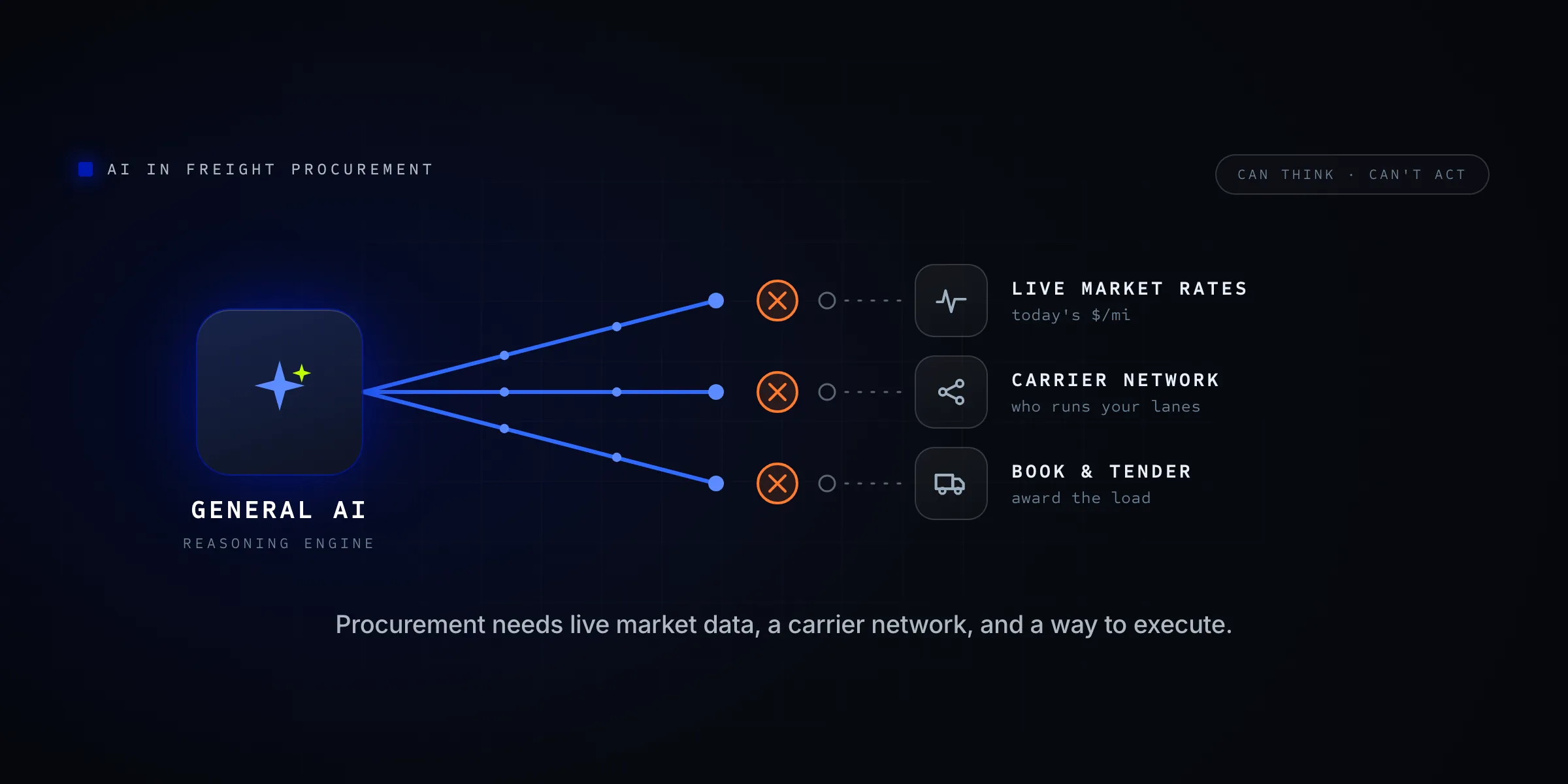
A general AI assistant can analyze freight data you give it, draft an RFP email, or explain a market trend. What it cannot do is see live carrier capacity, know today's market rate for your lane, or actually run a bid and book a load, because it has no connection to any of that. General AI is a reasoning engine. Freight procurement also needs live data, a carrier network, and a way to execute.
It's a fair question, and more shippers are asking it: if AI is this capable, why pay for a freight procurement platform when you could just put your own data into a general AI tool and ask it what to do?
We hear it on sales calls. A sharp logistics manager will say some version of "we could get a cheap AI subscription, load our own data, and get the same analytics. What do you actually do that we can't do ourselves?" It's exactly the right question to ask, and it deserves an honest answer rather than a sales pitch.
So here's the honest answer. General AI assistants are genuinely useful, and you should use them. But there's a specific, structural reason a general chatbot can't run your freight procurement on its own, and understanding it tells you where AI actually helps and where it falls short.
Start with what these tools do well, because it's a lot. And shippers are already leaning in: research from AI at Wharton and The Hackett Group found that 94% of procurement executives now use generative AI tools at least weekly, a 44 percentage point jump in a single year.
A general AI assistant is excellent at reasoning over information you give it. Paste in a spreadsheet of last quarter's lane rates and it will summarize trends, flag outliers, and answer questions in seconds. Ask it to draft an RFP invitation, explain the difference between spot and contract, or outline a carrier scorecard, and it will produce a solid first pass. For research, drafting, and making sense of data you already have, it's a real time-saver, and shippers who aren't using it that way are leaving efficiency on the table. If you want to put that to work, we put together 12 AI prompts freight shippers can copy and paste for exactly these tasks.
That capability is real. The mistake is assuming it extends to running procurement. It doesn't, and the reason is structural, which may explain a striking finding: MIT's Project NANDA reported that 95% of generative-AI deployments produced no measurable bottom-line impact, most often because of data and integration gaps rather than the models themselves. Capable AI, disconnected from the data and systems the work runs on, tends not to move the numbers. Procurement is a clear example of why.
A freight procurement decision needs three things a general chatbot simply doesn't have access to.
It doesn't have live market data. Ask a general AI what the going rate is on Dallas to Atlanta today and it can't tell you, because it isn't connected to the freight market. It can describe how rates behave in general, but it has no live feed of what carriers are actually charging on your lane this week. Rates move constantly, and advice built on stale or generic numbers is how shippers overpay without realizing it.
It doesn't have a carrier network. A chatbot can tell you what makes a good carrier. It can't show you which carriers run your lane, what they're bidding, or invite them to compete for your freight, because it isn't connected to any carriers at all. Procurement is ultimately about getting real trucks from real carriers, and a reasoning engine has no trucks behind it.
It can't execute. Even if a general AI gave you perfect advice, it can't run the bid, award the lane, tender the load, or book the truck. It produces text. Someone still has to take that text into a separate system and do the actual work. The analysis and the execution live in two different places, which means the "just use AI" approach still leaves you doing procurement by hand.
Put simply: a general AI is a brain with no hands and no live senses. It can think about freight. It can't see the market, reach the carriers, or move the load.
Not as a separate chatbot you consult, but as intelligence built into the system that already has the data, the network, and the execution layer.
That's the difference between general AI and purpose-built AI. A general assistant reasons over whatever you paste into it, in isolation. Purpose-built freight AI reasons over live market rates, a connected carrier network, and your own procurement workflow, and it can act on that reasoning in the same place. The intelligence is the same underlying kind. What changes is what it's wired into.
This is why the useful question isn't "general AI or a platform." It's "is my AI connected to the things procurement actually requires." A recommendation is only as good as the data behind it and only as useful as your ability to act on it.
To make it concrete, this is the gap Emerge AI is built to close, and it helps to see it as two connected parts: an assistant that answers questions about your freight, and a platform that acts on the answers.
Start with the assistant. Picture staring at your freight spend and thinking, "where are we actually leaking money?" or "how does this compare to the market?" Instead of pulling reports or waiting on an analyst, you just ask. Where am I overpaying? Which carriers are driving the most spend? What changed quarter over quarter? Emerge AI answers in plain language, because it's already connected to your freight data and to live market rates. This is the sharpest contrast with a general chatbot: both let you "just ask," but a general tool can only answer about the data you manually paste in, while Emerge AI is answering about your actual spend, your carriers, and your rates against the current market, with nothing to export or upload.
Then the platform acts on what the assistant surfaces. A few examples of what that connection makes possible:
The point isn't that Emerge AI is smarter than a general model. It's that the assistant and the tools around it sit on top of the three things a general model can't reach: live data, a carrier network, and a way to act.
The value shows up in performance, not in the novelty of the AI.
In a study of shippers using Dynamic Book It Now, which books spot loads against a live market benchmark across a large carrier network, 85% secured rates below market, averaging 8.5% below. That result comes from tools connected to real rates and real carriers acting in real time, which is precisely what a general chatbot, however capable, has no way to do.
So use general AI for what it's great at: research, drafting, and making sense of data you already have. When it comes to actually sourcing capacity and pricing freight, what helps is a system that can see the market and reach the trucks, with an assistant that lets you ask it anything along the way.
Can I use ChatGPT or another general AI for freight procurement?
You can use a general AI assistant for research, drafting RFP language, and analyzing freight data you provide, and it's genuinely useful for that. It can't run procurement on its own, because it has no live market rates, no carrier network, and no way to execute a bid or book a load. General AI advises; it can't source or move freight.
What's the difference between a general AI and purpose-built freight AI?
A general AI reasons over information you paste into it, in isolation. Purpose-built freight AI comes as an assistant already connected to your live freight data and market rates, backed by a platform that runs bids and books loads. So you can ask it about your real, current freight and then act on the answer in the same place. The underlying intelligence is similar; the difference is what it's connected to.
Why pay for an AI freight platform if I already have an AI subscription?
Because the subscription gives you a reasoning engine, not the data or the network procurement requires. A platform connects that intelligence to current market rates, real carriers competing for your freight, and an execution layer, so a recommendation becomes a booked load rather than a paragraph you have to act on manually.
Does AI replace freight brokers or procurement teams?
AI changes the work more than it removes it. It automates analysis, benchmarking, and load matching so teams spend less time on manual data work and more on strategy and relationships. The judgment about which trade-offs to make and which carriers to build with still belongs to people.
General AI is a powerful tool, and shippers should use it for research, drafting, and analysis. But running procurement takes more than reasoning. It takes live market data, a network of carriers, and the ability to act, none of which a general chatbot has.
That's the real distinction. Not smarter AI versus simpler AI, but AI that's connected to the market versus AI that's talking about it from the outside.
Ready to reinvent your procurement strategy?
 SOC 2 Type II