
Follow us


The best AI prompts for freight procurement give the AI a clear role, your specific context, and a defined output. Use them for the thinking work, drafting RFP scopes, building carrier scorecards, prepping negotiations, structuring spend analysis, and writing QBR agendas, where a general AI is genuinely strong. Just remember a general tool can't see live market rates or your carrier network, so treat its output as a fast first draft, not a booking decision.
General AI tools can help with freight work, if you know exactly what to ask and where they stop. Used well, they take some of the drafting, structuring, and first-pass analysis off your plate. Used blindly, they hand you confident-sounding answers built on nothing, which is worse than no answer at all.
The difference is the prompt, and knowing what to do with what comes back. A good prompt gives the AI three things: a role to play, the specific context of your situation, and a clear format for the answer. That turns a general chatbot into a fast junior analyst for the prep work around procurement.
Below are twelve prompts you can copy, paste, and adapt. Each includes when to use it and what to do with the output. But read the whole thing, because the most important part isn't the prompts. It's the pattern you'll notice underneath them: every one of these helps you prepare to procure, and not one of them can actually procure. That line is the point, and we come back to it at the end.
1. Draft an RFP scope
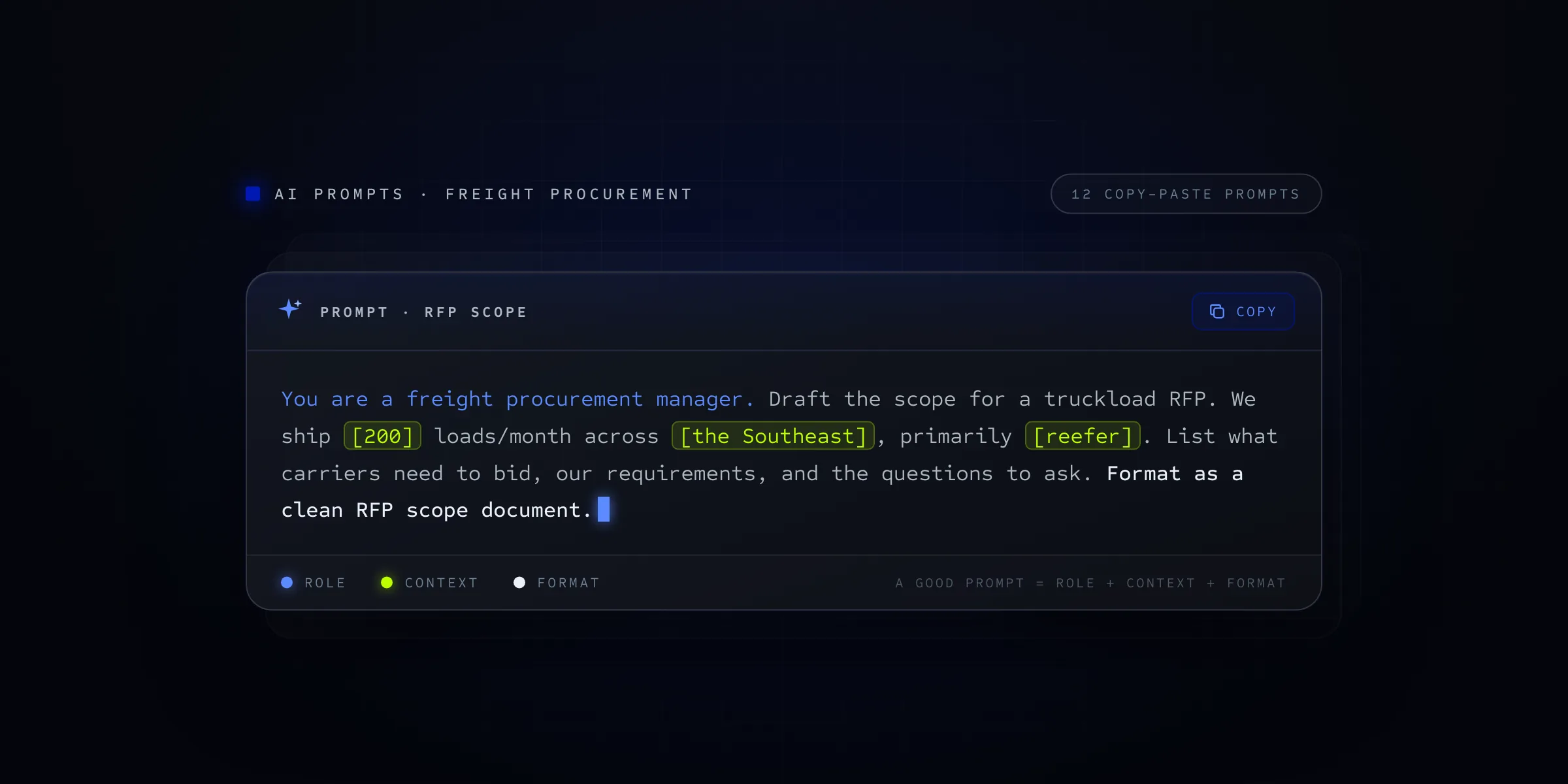
You are a freight procurement manager. Help me draft the scope section of a truckload RFP for [company/industry]. We ship [volume] loads per [week/month] across [regions/lane types], primarily [dry van/reefer/flatbed]. List the information carriers will need to bid accurately, the requirements we should set (insurance, tracking, appointment compliance), and the questions we should ask bidders. Format as a clean, organized RFP scope document.
When to use it: At the start of a bid, before you build the event. What to do with the output: Use it as a structured first draft, then add your real lane list, volumes, and rate data inside your procurement system.
2. Turn messy lane notes into a clean bid list
I'm going to paste a rough list of lanes. Reformat it into a clean table with columns for origin city/state, destination city/state, estimated monthly volume, and equipment type. Flag any rows that look incomplete or ambiguous so I can fix them. Here is the list: [paste].
When to use it: When your lane data lives in scattered notes or emails. What to do with the output: Clean it up, then load it into your bid. This is prep work, not pricing, the AI is organizing your data, not valuing it.
3. Write clear carrier bid instructions
You are helping a shipper communicate with carriers. Write a short, professional set of bidding instructions for carriers invited to our RFP, covering the bid deadline, how rates should be submitted (all-in, fuel included), the award timeline, and who to contact with questions. Keep it under 200 words and easy to skim.
When to use it: When you invite carriers to a bid. What to do with the output: Drop it into your invitation, adjusting the specifics to match how your bid actually runs.
4. Build a carrier scorecard framework
You are a logistics analyst. Design a carrier scorecard for evaluating truckload carriers on a [dry van/reefer/flatbed] network. Recommend the metrics that matter most (on-time pickup and delivery, tender acceptance, claims, communication), suggest how to weight them, and explain what "good" looks like for each. Present it as a scorecard template I can populate.
When to use it: When you're setting up or overhauling carrier performance tracking. What to do with the output: Use the framework, then populate it with your own performance data (a platform with reporting can pull the actual numbers).
5. Draft a carrier performance conversation
You are coaching a shipper through a tough but fair conversation. Help me write talking points for a call with a carrier whose on-time delivery has slipped to [X]% over the last [timeframe]. I want to keep the relationship strong while being clear about the standard we need. Give me an opening, the key points, and a constructive close.
When to use it: Before a difficult carrier check-in. What to do with the output: Adapt the talking points to the specific relationship. You know the history the AI doesn't.
6. Summarize a carrier contract
Summarize the key commercial terms in this carrier agreement in plain language: rate structure, fuel surcharge, accessorials, volume commitments, term, and any termination or rate-adjustment clauses. Flag anything unusual or worth negotiating. Here is the agreement: [paste].
When to use it: When reviewing or comparing carrier agreements. What to do with the output: Use it to orient quickly, then have the real terms reviewed by whoever owns contracts. AI summaries are a starting point, not legal advice.
7. Prepare for a rate negotiation
You are a freight procurement strategist. I'm negotiating rates with a carrier on [lane or set of lanes]. Help me prepare: list the factors that influence truckload pricing on these lanes, the questions I should ask the carrier, the levers I can offer besides rate (volume, flexibility, faster payment), and how to respond if they push back on a lower number. Format as a negotiation prep sheet.
When to use it: Before any rate conversation. What to do with the output: Use the framework to prepare. Bring your own live market benchmark to the table, because the AI can't tell you the current rate, only how to think about the negotiation.
8. Draft a rate-increase response
A carrier has requested a [X]% rate increase on [lane]. Help me draft a professional response that takes the request seriously, asks for their justification, and keeps the door open to a middle ground without immediately accepting. Keep it brief and relationship-preserving.
When to use it: When a carrier asks for more and you need to buy time and information. What to do with the output: Send it after checking the ask against current market data, so your response is grounded in where rates actually are.
9. Structure a freight spend analysis
You are a freight data analyst. I want to understand where my truckload spend is going. Given data with columns for [lane, carrier, mode, load count, total cost], tell me exactly which analyses to run to find where I'm overspending, which cuts and comparisons will be most revealing, and what questions the results should answer. Then I'll run them.
When to use it: When you have spend data but aren't sure how to interrogate it. What to do with the output: Follow the analytical roadmap. Note the limit clearly here: the AI is telling you how to analyze, but it can only work on data you paste in, and it has no live market to benchmark against. This is exactly the gap a purpose-built freight data assistant closes, since it can answer these questions against your live data directly.
10. Explain a freight trend to leadership
You are helping a logistics manager brief a CFO. Turn this summary of our freight costs into a short, clear explanation a finance leader would appreciate: what changed, the likely drivers, and what we're doing about it. Avoid jargon and lead with the number that matters most. Here's the summary: [paste].
When to use it: Before reporting freight performance upward. What to do with the output: Refine and deliver. Pair it with the real numbers from your reporting so the story holds up to questions.
11. Build a QBR agenda
You are preparing a quarterly business review between a shipper and a key carrier (or 3PL). Draft an agenda that covers performance against KPIs, market conditions, upcoming volume changes, problem lanes, and joint goals for next quarter. Make it a focused 45-minute agenda with time allocations.
When to use it: Ahead of any quarterly review. What to do with the output: Populate it with your actual performance data and the specific issues you want to raise.
12. Pressure-test your procurement strategy
You are a freight procurement advisor. Here's our current approach: [describe how you buy, spot vs. contract mix, bid cadence, carrier count]. Play devil's advocate. Where are we exposed if the market tightens? What are we likely overlooking? What would a best-in-class shipper do differently? Be direct.
When to use it: Once or twice a year, or when the market shifts. What to do with the output: Treat it as a thinking partner that surfaces blind spots. The moves it suggests, tightening your cadence, widening your carrier network, watching the market more closely, are the ones that need a real platform to actually execute.
Three habits make every one of these better.
What are the best AI prompts for freight procurement?
The best prompts give the AI a clear role, your specific context, and a defined output format. Effective ones cover drafting RFP scopes, building carrier scorecards, preparing rate negotiations, structuring spend analysis, and planning QBRs. These are the tasks where a general AI is strong. It can't provide live rates or carrier capacity, so use it for the thinking work and a platform for the buying.
Can I use ChatGPT or another general AI for freight tasks?
Yes, for the right tasks. General AI tools are strong at drafting, summarizing, structuring, and first-pass analysis of data you provide. They can't see live market rates, access a carrier network, or execute a bid, so treat their output as a fast first draft rather than a procurement decision.
How do I write a good freight AI prompt?
Give the AI a role ("you are a freight procurement manager"), the specifics of your situation (volumes, lanes, equipment, timeframe), and the format you want back (a table, an agenda, a prep sheet). Then iterate: if the first answer is too generic, tell the AI what's missing and refine.
Will AI replace freight procurement work?
AI changes the work more than it replaces it. It speeds up analysis, drafting, and planning so teams spend less time on manual prep and more on strategy, relationships, and decisions. Judgment about trade-offs and which carriers to build with still belongs to people.
Used well, a general AI tool helps a shipper draft faster, analyze smarter, and prep harder. That's real, and these prompts are how you get it.
But prepping to procure and procuring are two different things. A prompt can help you plan a bid, structure your spend analysis, or rehearse a negotiation. It can't tell you today's market rate, put real carriers on your freight, or run the bid, and no prompt ever will, because a general tool isn't built for it. That's not the tool to fix with a better prompt; it's the job a purpose-built platform exists to do.
When you're ready to turn the prep into booked loads, that's where we come in.
Ready to reinvent your procurement strategy?
 SOC 2 Type II