
Follow us


Most carrier vetting happens once, at award. You check authority, insurance and safety scores, you decide who gets the lane, and you move on. Then the load tenders, and a truck arrives at your warehouse days or weeks later.
Almost nobody checks whether the truck that shows up belongs to the carrier that was assigned.
That space between award and pickup is where a lot of freight risk actually lives, and after a Supreme Court decision this year it is getting a much closer look.
In Montgomery v. Caribe Transport II, LLC, the Court held unanimously that state-law negligent hiring claims against freight brokers are not preempted by the Federal Aviation Administration Authorization Act. States, the Court concluded, keep their authority to regulate motor vehicle safety under the statute's express safety exception. Justice Barrett wrote the opinion, and Justice Kavanaugh filed a concurrence joined by Justice Alito.
The case came out of a highway collision in Illinois. The injured plaintiff sued the driver and the motor carrier, and also sued the broker that arranged the load, arguing it had negligently selected that carrier. Brokers had often defeated claims like this at the threshold by arguing federal preemption. That defense is now substantially narrower.
The practical effect is straightforward. How a transportation provider was chosen, and whether anyone confirmed the right one actually performed the move, is now a question that gets to a jury rather than being dismissed early.
The obvious reading of Montgomery is that it is a broker problem. A lawsuit now moving through California courts suggests the theory does not stop there.
In that case, plaintiffs allege that a load of refrigerated product left a cold storage warehouse in Bakersfield bound for a retail distribution center. According to the complaint, the shipper had contracted with a broker to arrange the move, and the broker assigned the load to a specific motor carrier. The truck that arrived to collect the freight, plaintiffs allege, displayed a different company's placards and DOT number, and that company's operating authority had been inactive for close to a year.
The plaintiffs have named the shipper and the warehouse operator alongside the broker and the trucking companies. Their claim is that none of them had adequate procedures to confirm that the driver and truck collecting the freight were the ones actually authorized to do so, and that the substitution went undetected as a result.
These are allegations, not findings. The complaint does not establish what duties any defendant owed, whether any duty was breached, or whether any alleged failure caused the collision. The defendants have not been found liable. We are describing the theory of the case because of what it asks, not because it has been proven.
And the question it asks is a fair one for any shipper to sit with: who verified the carrier before the freight was allowed to leave?
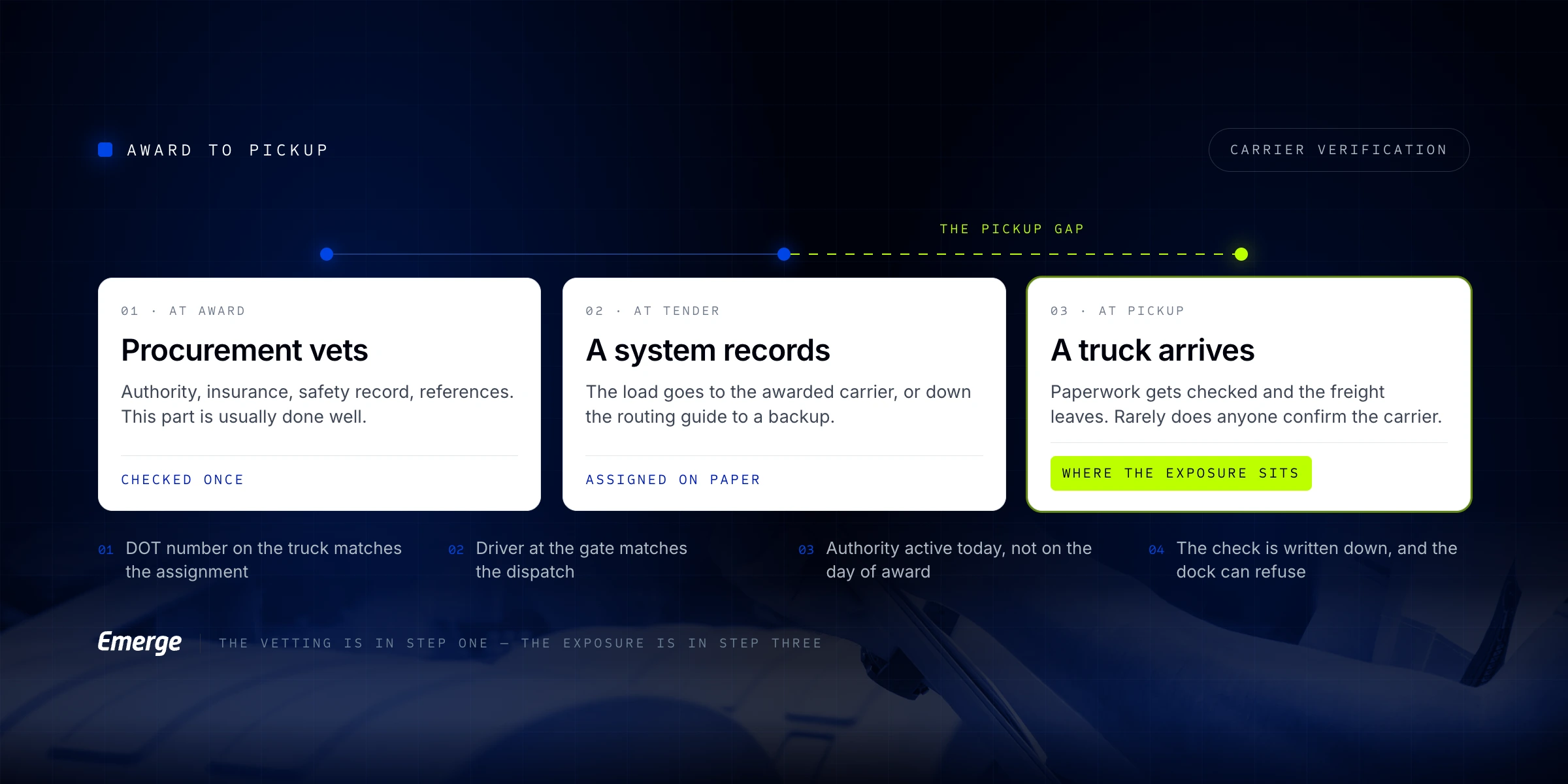
Here is the sequence in most networks.
The vetting happened in step one. The exposure is in step three. Between them the load may have been reassigned, brokered on, or covered by someone nobody in procurement has ever evaluated. Reassignment is not automatically improper, and legitimate co-brokerage exists. The problem is when it happens without the shipper knowing, so the carrier on the dock is not the carrier in the file.
That is also the mechanism behind a lot of cargo theft. Freight fraud has climbed for several years, and identity misuse is one of the most common methods: a bad actor presents as an established carrier, collects the load, and disappears. The same control failure produces both outcomes, which is why closing it pays twice.
None of this requires new technology. It requires someone at the point of pickup knowing what they are checking and having the authority to stop a load.
If your warehousing is outsourced, these checks belong in the contract with the 3PL, because they are the ones standing at the door.
Dock verification catches the substitution. It does not reduce how often one is attempted, and it does not help if your routing guide is thin enough that loads routinely fall to whoever will take them.
That is a procurement problem. The deeper and better understood your carrier base, the less often a load ends up somewhere nobody chose. Vetting a carrier properly before you award is the front half of it, and what belongs on a carrier scorecard is how you keep watching after the award, because performance drift usually shows up before a real failure does.
Capacity matters here too. Carriers in the Emerge Marketplace are vetted before they can quote, and asset-based capacity reduces the number of hands a load passes through in the first place. Fewer intermediaries means fewer opportunities for an assignment to change without anyone noticing. That does not remove the need to check at the dock. It shrinks the surface area you are checking.
Spot freight deserves particular attention, since it is covered fastest and with the least history. We have written on managing spot procurement risk separately.
Verification at pickup is a control, not a guarantee. It will not stop a crash caused by a properly assigned, properly authorized carrier, and most crashes involve exactly that. Nothing here suggests otherwise, and no procedure would have changed the outcome in any particular case.
What it does is close a specific gap: freight leaving with someone nobody selected. That gap is now considerably more expensive to leave open than it was a year ago.
A claim that a party arranging transportation failed to exercise reasonable care in choosing the motor carrier, and that the failure contributed to harm. It is usually brought against brokers, and increasingly against shippers who took an active role in selection.
No. Montgomery v. Caribe Transport II did not decide whether any broker was negligent. It held that FAAAA preemption does not bar state-law negligent hiring claims, which means such claims can proceed to be decided on their merits rather than dismissed at the threshold.
It depends on the shipper's role, its contracts and the applicable state law. The theory being tested in current litigation is that a shipper who retains control over how freight is released may share responsibility for confirming the right carrier collected it. That theory has not been resolved.
When a carrier that accepted a load re-brokers it to another carrier, typically without the shipper's knowledge or consent. It is not always illegal, but undisclosed reassignment breaks the chain between who was vetted and who actually hauls the freight.
Match the carrier name and DOT number on the tractor to the carrier assigned in your system, confirm the driver matches the dispatch, check that operating authority is active that day, and record the check. Give dock staff explicit authority to hold a load that does not match.
Both, and the failure usually sits in the handoff. Procurement decides who is authorized. The warehouse is the only party positioned to confirm that is who arrived. Neither can close the gap alone.
 SOC 2 Type II