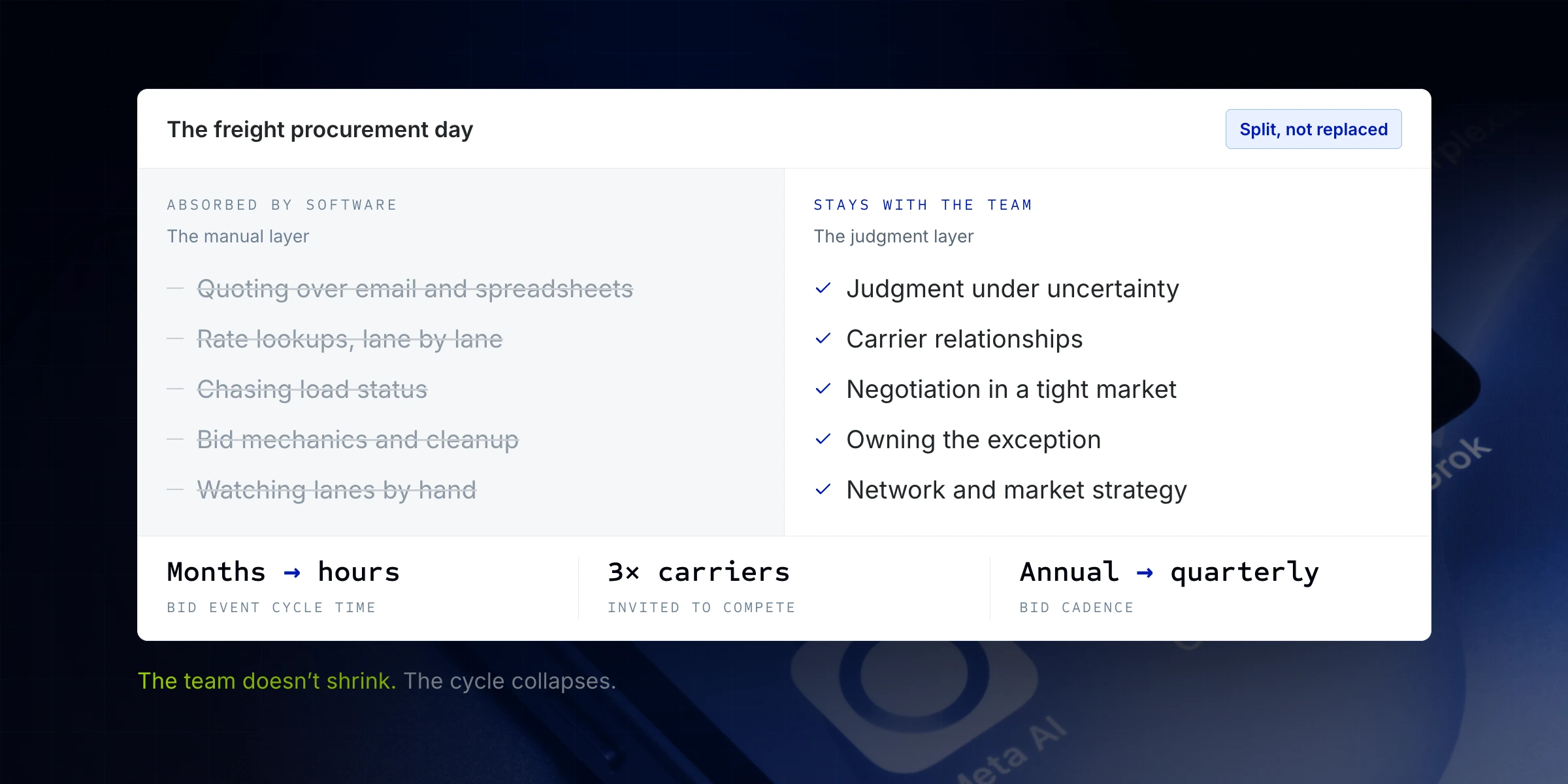
No, but it is replacing a version of the job. AI is absorbing the manual layer of freight procurement: quoting over email and spreadsheets, rate lookups, status chasing, and bid mechanics. Judgment, carrier relationships, and market strategy get more valuable, not less. The real risk to a procurement team isn't being replaced by AI; it's competing against a team that uses AI on live freight data while yours doesn't.
Ask this question honestly and you'll get two useless answers. Vendors say AI will transform everything, buy now. Doomsayers say the robots are coming for the org chart. Neither describes what's actually happening inside freight procurement teams.
Here's what is: the job is splitting. The manual layer, the part of freight procurement that was always data grunt work wearing a strategy title, is being absorbed by software at real speed. The judgment layer is getting bigger, more valuable, and harder to do without better tools. Whether that's a threat or a promotion depends entirely on which layer your day is made of, and which tools your team has.
The grind. Specifically, the parts everyone already resents.
Start with quoting: the average freight quote still involves emails, spreadsheets, and rate lookups stitched together by hand, a process we've written a whole guide about escaping. AI-backed systems compress that to minutes: a live benchmark on the lane, qualified carriers competing, the paper trail automatic. Add rate research (asking a system what the market is on a lane instead of hunting for it), load status chasing, bid mechanics, and lane monitoring, the always-on watching that humans do badly and software does natively.
This is what AI in freight actually looks like today, and it's worth being precise: an assistant that answers questions against your live freight data, plus platform features that optimize and execute the routine motions. Not a robot procurement manager. A very fast analyst who never sleeps and never wanted your job.
The parts that were always the real job.
Leaner on grind, heavier on leverage, and there's a structural reason it's happening now.
Procurement research from The Hackett Group has reported workloads growing around 10% while budgets rise about 1%, an efficiency gap that no amount of hustle closes. That's the honest driver of AI adoption in this function: teams aren't being replaced to cut costs; they're being equipped because the workload math stopped working. The role shifts from data gatherer to market operator: running more bids faster, watching more lanes with real signals, spending the recovered hours on network strategy and carrier relationships, the work that compounds.
One concern in the data deserves a straight look: the routine tasks being automated were the traditional training ground for junior talent, and reported entry-level logistics hiring has fallen sharply. The teams that handle this well won't pretend it isn't happening; they'll rebuild the ladder deliberately, training juniors on market judgment and how to use AI well from day one instead of on spreadsheet maintenance.
The proof isn't headcount charts. It's cycle time.
Pepsi Bottling Ventures compressed bid events that once took months into hours, and tripled the number of carriers invited to compete. ND Paper moved from annual bidding to a quarterly cadence, keeping rates aligned with a moving market. In both cases the team didn't shrink; the cycle collapsed, and the people ran a faster, deeper operation than manual process ever allowed.
That's also the resolution to the strangest stat pair in AI right now: 94% of enterprise decision-makers report weekly AI use, yet most deployments show no measurable business impact. The difference isn't the model. It's the rails: AI connected to live freight data, a real carrier network, and executable workflows produces the Pepsi outcome; AI bolted onto nothing produces a chatbot and a press release. Teams don't lose to AI. They lose to teams whose AI is connected to something.
Will AI replace freight procurement jobs?
No, but it is reshaping them. AI is absorbing the manual layer, quoting mechanics, rate lookups, status tracking, monitoring, while judgment, negotiation, carrier relationships, and market strategy grow in importance. Industry projections generally expect technology to shift roles toward oversight and strategy rather than eliminate the function, and the near-term competitive risk is falling behind AI-equipped teams, not being replaced by software.
What freight procurement tasks can AI handle today?
Live rate benchmarking on any lane, automating quote collection and comparison, monitoring lanes and flagging drift or anomalies, answering questions against a shipper's own freight data, and executing routine spot bookings against a market benchmark. The common thread: high-volume, data-heavy, rules-based work where speed and consistency beat intuition.
What skills matter most for procurement teams in the AI era?
Market literacy (reading signals like tender rejections and spot-contract spreads), network strategy (building and managing a deep, vetted carrier base), negotiation and relationship management, and tool fluency, knowing how to direct AI, question its outputs, and connect it to real freight data. Execution skills are depreciating; judgment skills are appreciating.
How should a procurement team start with AI?
Start where the grind is: put a live benchmark behind quoting and bidding, automate lane monitoring, and use an AI assistant against your own freight data for the questions your team currently answers by spreadsheet archaeology. Choose tools connected to live market data and a real network, since disconnected AI produces answers without outcomes.
AI isn't coming for the freight procurement team. It's coming for the spreadsheet, the inbox quote chase, and the 2 a.m. rate lookup, the parts of the job that were never the job.
What's left is the work that always mattered: reading the market, building the network, making the call. The teams that thrive will be smaller in grind and bigger in leverage, and the gap that should worry anyone isn't human versus machine. It's equipped versus unequipped.


 SOC 2 Type II