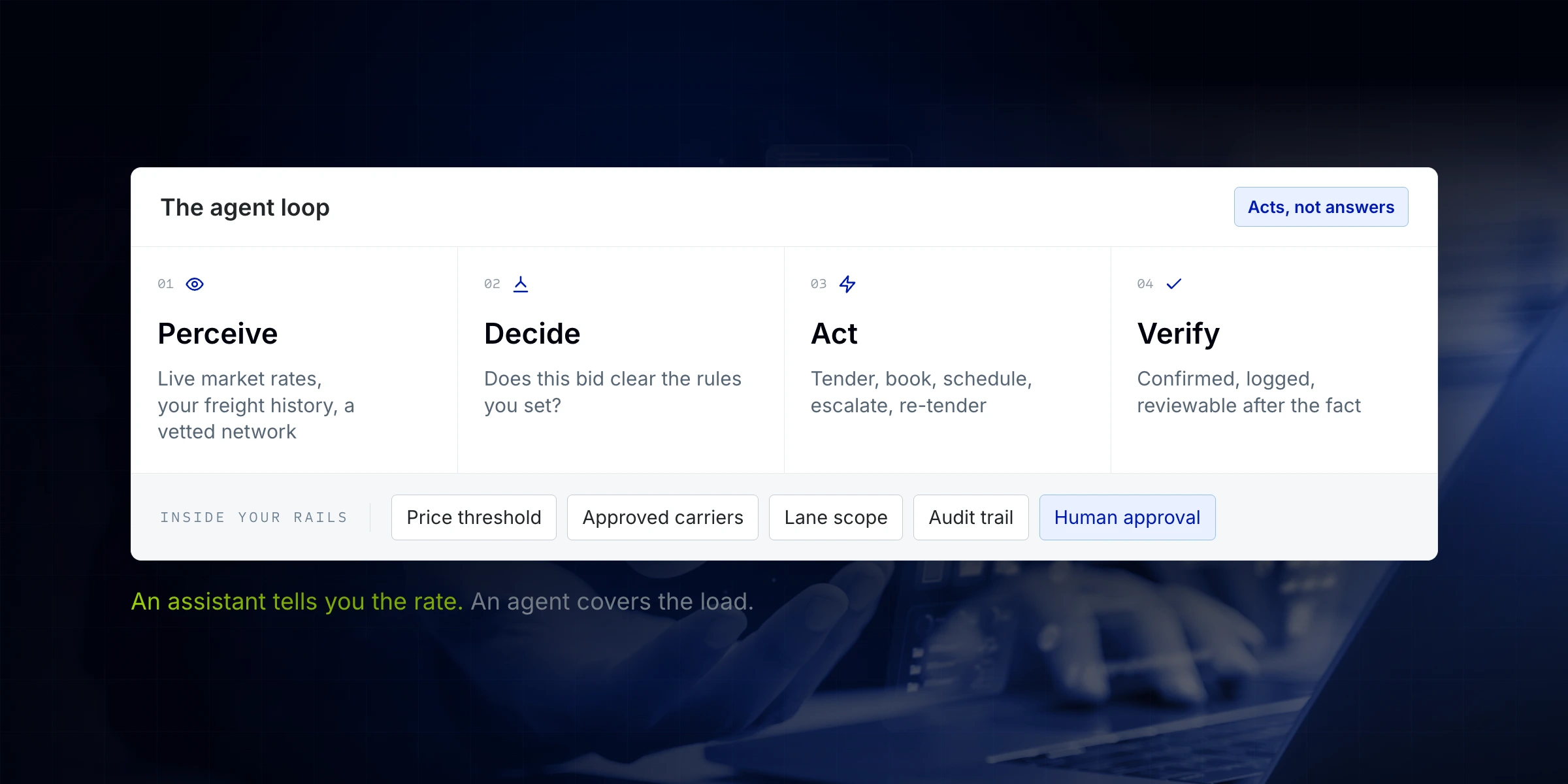
Agentic AI is AI that takes actions toward a goal instead of just answering questions: it perceives conditions, decides, acts, and verifies, within limits a human sets. In freight, that means software that doesn't just tell you the market rate but books the load against it under your rules. The bounded, auditable versions are already delivering for shippers today; fully autonomous procurement isn't here yet, and doesn't need to be.
Every AI conversation in freight has picked up a new word this year: agentic. Vendors are pitching it, analysts are tracking it, and procurement leaders are deploying it faster than most people realize. It's worth pinning down what it actually means, because this is the most useful shift in freight software in years, and the shippers who understand it early get the most out of it.
The short version: generative AI answers. Agentic AI acts. That one-word difference changes what to expect, what to ask for, and how much of your team's grind can quietly disappear.
An agent is software that runs a loop: perceive the situation, decide on an action, take it, and check the result, repeatedly, toward a goal you gave it, inside limits you set.
The contrast makes it concrete. An AI assistant answers a question: "What's the market rate on Dallas to Atlanta today?" An AI agent completes a task: "Cover this load if a qualified carrier accepts within 4% of the live benchmark," and then actually tenders, books, and confirms. The assistant hands you information; the agent hands you an outcome. That's the whole distinction, and it's why the best agentic tools come with something else built in: clear rules, live data, and a record of everything they do.
Adoption is moving faster than the hype cycle suggests: in The Hackett Group's 2026 procurement research, 56% of procurement organizations report having deployed agentic AI in some form, nearly double the year before. The question for freight teams isn't whether agents are coming. It's which versions are real.
The honest list is bounded, specific, and genuinely useful.
Notice the pattern: every real example is a high-volume, rules-friendly task with clear success criteria. That's where agents earn their keep today.
Fully autonomous procurement, and that's fine, because it's not what delivers the value.
An agent that strategizes your network, negotiates open-endedly with carriers, and manages your budget unsupervised isn't something any vendor can genuinely offer today. Negotiation, exception judgment, and accountability remain human work, and honestly, that's the part of the job worth keeping. The same goes for general-purpose chatbots rebranded as agents: without live freight data, a real network, and execution, there's nothing for them to act on.
None of this is a knock on where agents are headed. It's a maturity map: the bounded, high-volume tasks are solved and paying off now; the open-ended judgment work stays with your team, better equipped than ever. The principle that makes it all work: clear rails aren't a brake on agents, they're what make it easy to say yes to them.
One honest aside worth knowing: agents have arrived on the attack side too. The same voice technology handling legitimate check calls also powers carrier impersonation fraud, which makes "whose agent is this, and whose rails is it on?" a fair question to ask of anything calling your team.
Five questions get you to the good version fast.
Start where the pattern is proven, rules-based spot coverage and monitoring, watch the results stack up, and widen the rails from there. That's how agents become leverage quickly and stay leverage.
What is agentic AI in freight?
AI that takes actions toward goals rather than only answering questions: it perceives conditions, decides, acts, and verifies within human-set limits. In freight, real examples include booking spot loads against a live benchmark under configured rules, monitoring lanes and triggering re-tenders, and automating quote collection, status checks, and scheduling.
What's the difference between agentic AI and generative AI?
Generative AI produces content and answers, drafts, summaries, responses to questions. Agentic AI completes tasks: it strings together perception, decisions, and actions toward an outcome. In practice they're combined, an agent may use a generative model to reason, but the defining feature of agentic AI is that it acts, which makes limits, data quality, and audit trails matter far more.
Is agentic AI safe for freight procurement?
Yes, in the form it's actually delivered today: clear action scope, configurable limits, live data underneath, full audit logs, and human approval on anything novel. Bounded agentic tools are already widely used in procurement, and the built-in rails are what make adopting them low-drama, you set the rules, watch the results, and expand authority as fast as trust builds.
What are examples of agentic AI in logistics?
Automated spot booking against live market benchmarks under shipper-defined rules, continuous lane monitoring that triggers alerts or re-tenders, automated quote gathering and comparison, appointment scheduling, document chasing, and AI voice agents handling routine carrier check calls. Common thread: high-volume, rules-friendly tasks with clear success criteria.
Agentic AI is the most practical thing to happen to freight software in years: bounded agents that perceive live data, act inside rules you set, and log everything, quietly clearing the grind while your team runs the strategy. The playbook is simple: start with the proven patterns, set the rails, and let the results argue for wider ones.
And if you'd rather see it than read about it, watching rules-based booking cover a live load on your own lanes takes about fifteen minutes. That's what demos are for.


 SOC 2 Type II