
Follow us


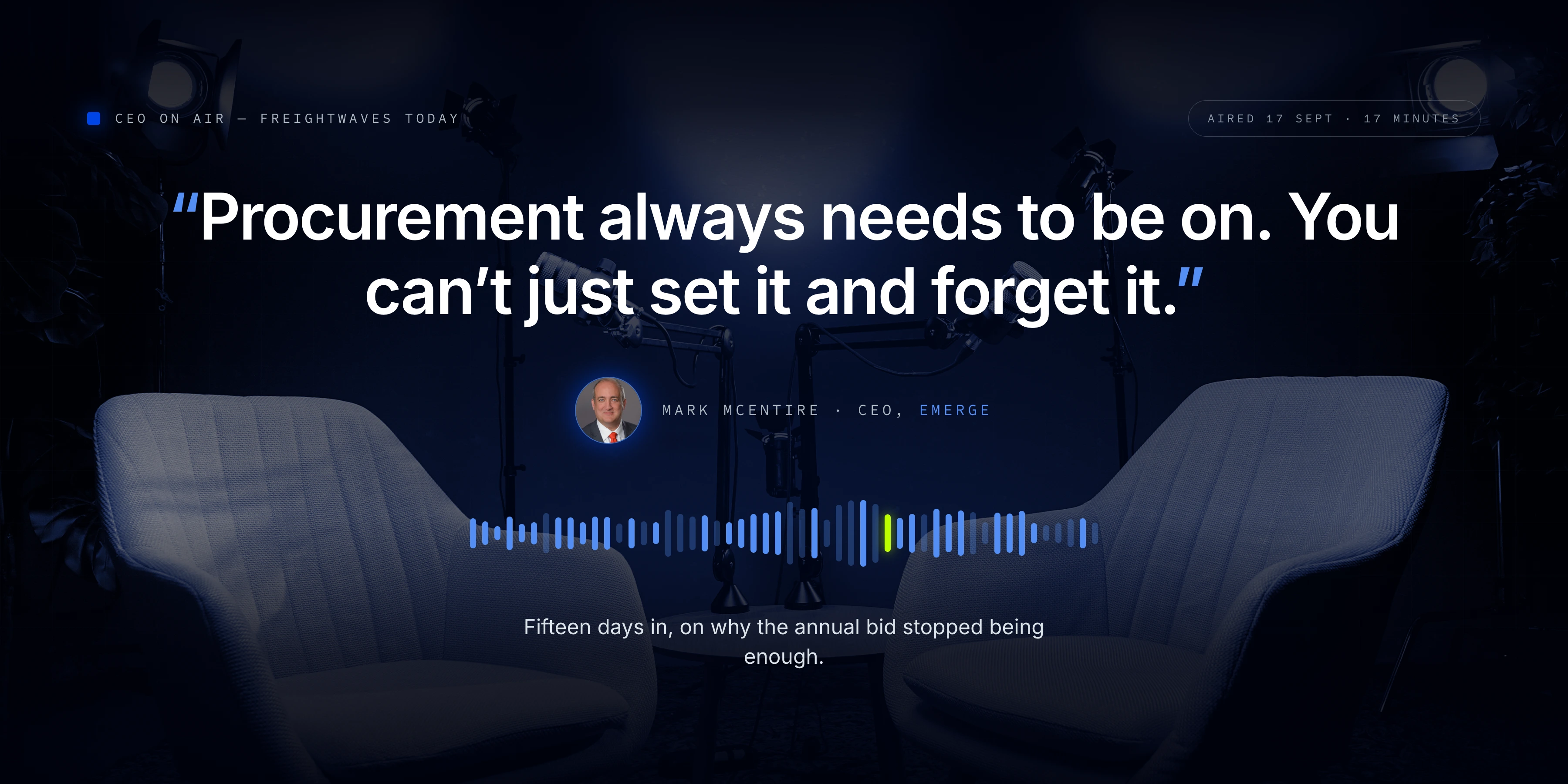
Most shippers still run procurement on a calendar. One bid a year, a routing guide built out of it, and a commitment to look again in 12 months. That schedule made sense in a market that moved slowly. It does not describe the market anyone is operating in now.
Emerge CEO Mark McEntire made that case on FreightWaves Today with hosts Craig Fuller and Julie Van De Kamp. Fifteen days into the job, he spent most of the 17 minutes on a single argument: procurement has stopped being an event and become a process, and AI is what makes the faster rhythm practical instead of exhausting.
Mark spent more than three decades in freight. Seventeen years at Transplace, ending as SVP of Managed Transportation. Earlier roles at J.B. Hunt Transport and Penske Logistics. CEO of Princeton TMX. A stint at Emerge as SVP of Strategic Operations in 2022 and 2023, which is when he built the strategic account management team and the customer advisory board that are both still running.
That history is the reason his opening answer was not about software.
"I've sat at the table with them and helped them build their carrier strategies, their routing guides, their procurement strategies."
"When I sit down with the team at Emerge, I don't really start by asking about technology. I really start by asking, what are we trying to solve for shippers?"
Asked for the biggest shift coming in how shippers manage procurement, he did not hedge.
"We are moving from episodic to more of a continuous improvement cycle. And I believe there's even more you can do than just continuous. I think AI is going to bring another element to that that'll be more predictive."
The pattern he described will be familiar to anyone who has run a bid. A shipper holds an annual procurement event, sets the routing guide, makes the commitments, and then, in his words, "set it, forget it, and we'll revisit it in a year from now."
"That simply doesn't work in the world we live in today. It's too volatile. It's too dynamic."
"Procurement always needs to be on. You can't just set it and forget it."
This is the same conclusion we reached from the data side and named the Evergreen Freight Model. The annual bid is the trunk, providing stability, structure, and your core carrier relationships. Mini bids are the branches, re-pricing specific lanes and regions as the market moves. The annual event is not the problem. Treating it as the only event is.
Mark got to the same place from a different direction, by watching it happen to the shippers he worked with.
Pressed on what a tighter market with less capacity changes, he reframed what a bid result actually is.
"I don't think price alone is enough anymore. If you get a rate in a bid, but it doesn't come with reliable capacity, it isn't really a rate."
That is the paper rate problem in a single sentence. A number a carrier wins and then will not honor at tender is not a savings. It is spot exposure you have not budgeted for yet.
His list of what belongs in the award decision alongside price: capacity, carrier fit, lane fit, performance, and risk. Cost and service stay paramount, he said, but risk and fraud have moved inside the process rather than sitting beside it. It is the argument for carrier scorecards, and he made it from experience rather than theory, having spent a career living with the consequences of awarding on price alone.
"Routing guides can fail very fast."
"I don't think shippers should think of it as an event. They should think about it as a process."
On AI, he skipped the debate and offered a filter.
"If AI is helping you make a better decision or eliminating waste or eliminating work, then it's AI and it's valuable. If it's not, it's probably noise."
Then he applied it to procurement, and this is the number worth taking away from the interview. Some shippers, he said, run a bid only every two or three years, for one reason: the work is brutal.
"You can take a bid event and turn that into maybe a two, three week deal versus, in some cases, two months just to gather all that data."
Two months of data gathering compressed into a two to three week event is what changes the math on running procurement more often. A shipper who cannot face the workload twice a year is not going to become continuous through willpower.
The second half of his AI answer is the part shippers ask about most.
"Shippers sit on a mountain of data. It's impossible for a human to see all the patterns in that data, the anomalies with the rates, the routing guide deterioration, all the things you need to be paying attention to."
"I don't know that I think AI will replace the procurement professional, but I do believe it will bring greater tools to bear, which will drive a demonstrable outcome for the shipper."
Asked about mode coverage, he made a point about how buyers actually think.
"Shippers don't view their networks in silos. They don't view it in truckload, rail, LTL, intermodal. They view it as a full network."
He did not get into specifics on the roadmap, and said what drives it instead: a strategic account management team, a 16 member customer advisory board, and a weekly executive call where the team sorts a one-off request from something that would create value for everyone.
"It all starts with that voice of the customer."
Three things, in his order. Get closer to the customer, with leaders talking to customers every single day. Growth, and not only new logos, but existing customers handing over more work because they treat Emerge as a trusted advisor. And pace.
"I firmly believe that the pace of the leader sets the pace of the pack."
Asked for the single trend a shipper should watch, he asked for "one and one A." Pay close attention to what the market is doing, because you cannot do this job without it. Then:
"Really need to pay attention to AI and where it can impact decision making, eliminate waste and do things faster."
The full 17 minute episode is on FreightWaves TV.
Thanks to the FreightWaves team for having Mark on. Seventeen minutes, and worth it if you are still deciding how often your network should be re-priced.
 SOC 2 Type II