
Follow us


C.H. Robinson announced this morning that it will acquire RXO in a cash-and-stock transaction valued at about $5.8 billion, creating a company with an enterprise value of more than $25 billion. RXO shareholders receive $30.25 per share, $17.25 of it in cash and the rest in C.H. Robinson stock. The deal is expected to close in the first half of 2027, subject to regulatory clearance and RXO shareholder approval.
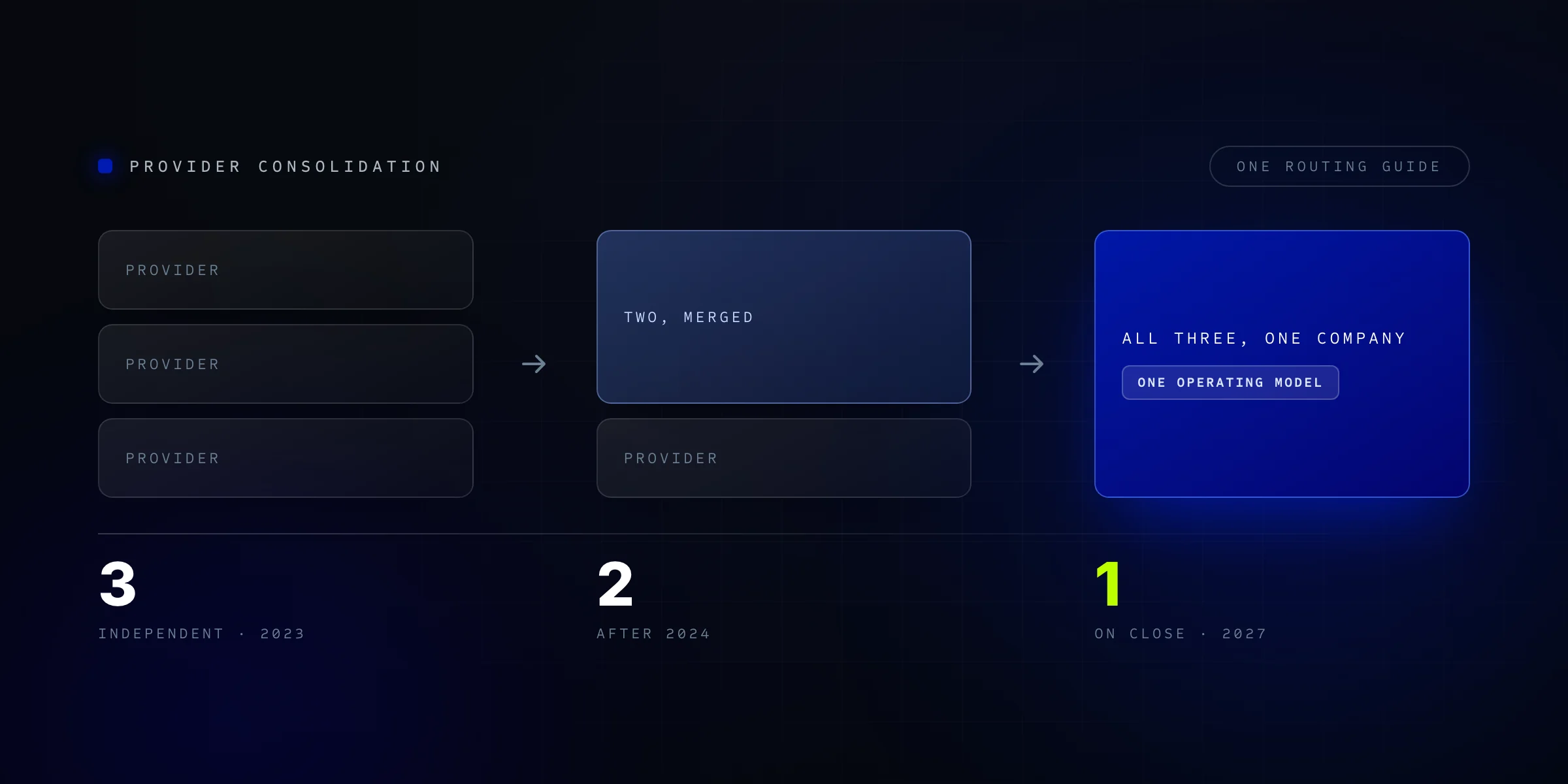
The number worth your attention is not $5.8 billion. It is three.
Run the lineage. In 2023, a shipper building a truckload routing guide could have awarded freight to C.H. Robinson, to RXO, and to Coyote Logistics, and reasonably called that three providers. They were three separate companies with three separate balance sheets, three pricing desks, and three independent views of the market.
In September 2024, RXO bought Coyote from UPS and spent the following year folding Coyote's coverage operations onto its own platform. That took the count from three to two.
This morning took it from two to one.
If your current routing guide carries awards to C.H. Robinson and to RXO, and especially if some of those RXO awards arrived through Coyote, then a diversification decision you made three years ago has quietly become a concentration. Nothing in your routing guide changed. The market underneath it did.
The combined scale is worth stating plainly, because it frames how much of your option set this touches. C.H. Robinson works with 75,000 customers and 450,000 contract carriers, and moves 37 million shipments a year representing $23 billion in freight. RXO serves roughly 18,000 shippers across a network of about 150,000 carriers. Those pools overlap, so you cannot simply add them, but the direction is not ambiguous.
C.H. Robinson has told investors it expects $300 million in net run-rate cost synergies within two years of closing, achieved by applying what it calls its "Lean AI operating model" to RXO's business. RXO will be integrated primarily into C.H. Robinson's North American Surface Transportation division.
That is a stated cost-reduction plan, and it is worth reading literally rather than cynically. Cost synergies in a brokerage come substantially from removing duplicated operations: overlapping coverage desks, redundant systems, two teams doing one job on the same lane. This is not a prediction that service degrades. Integrations are run well and run badly, and the Coyote migration into RXO Connect is recent enough that both companies have fresh experience in doing one.
It does tell you what to watch, though, and the two indicators are ones you already collect.
Rep continuity. The person covering your freight today is the most common casualty of an operations consolidation. You will usually feel this before it shows up in a scorecard.
Tender acceptance. If award performance on your C.H. Robinson or RXO lanes starts drifting during integration, that is a leading indicator and not a rounding error. We have written before about why tender rejections rise and what to do about them, and an integration is exactly the kind of event that produces them.
The most useful line to come out of today is not about this transaction at all. C.H. Robinson's chief executive said industry consolidation is likely to accelerate.
Take that seriously, because the acquirer has the best available view of the pipeline. This deal also lands in a year that already saw FedEx agree to sell its FedEx Supply Chain unit to CMA CGM at an enterprise value of $1.4 billion. The pattern is not one surprise. It is a direction.
That changes what a sensible response looks like. A one-off reaction to a single deal is wasted motion. What holds up is a procurement posture that assumes your provider list will keep getting shorter, and that measures your exposure on a schedule rather than when a press release lands.
We should be straight about our own position, because it affects how you should read everything above.
Emerge is a technology company, and we sell into this market. We have a commercial interest in how shippers buy freight, and that is worth knowing before you weigh the argument. It is also why this is not a piece arguing that brokers are the problem or that you should route around them. Brokers solve real problems, C.H. Robinson and RXO are both good at what they do, and a consolidated one may well deliver the service gains it is promising.
The argument is narrower and it survives our own conflict of interest, which is why it is worth making. Every provider's tool shows you that provider's capacity. That is not a criticism, it is what those tools are for. But it means the number of independent views you have into the market is a function of how many independent providers you work with. Consolidation reduces that number. It reduces it whether or not service quality changes at all, and it reduces it quietly, because no single award in your routing guide has to move for your visibility to narrow.
The response is not to pick a different provider. It is to make sure that neither your rate benchmark nor your view of available capacity depends on any single company. Including ours.
Map your awards to their ultimate parent, twice. Once as the corporate structure stands today, and once as it will stand after close. Put the two columns side by side. For most shippers with meaningful C.H. Robinson and RXO volume, the second column is the first real look at their actual concentration.
Set a concentration ceiling before your next bid, not after. It is a far easier conversation to have while you are designing the event than while you are defending an award.
Instrument the integration. Track acceptance and on-time performance on affected lanes from now through close and for the year after. You will have roughly eighteen months of baseline before anything merges, which is a better dataset than most shippers ever get going into a disruption.
Keep your benchmark independent of your providers. If the companies quoting your freight are also the source of your sense of what freight should cost, consolidation compounds. Benchmarking against independent market data is the cheapest insurance against that, and it is why we partnered with DAT for rate benchmarking in the platform.
The thing that makes this manageable is the timeline. This deal does not close until the first half of 2027, and integration runs well past that. Nobody needs to rebid a network this quarter.
What that window rewards is measurement. A shipper who spends the next two bid cycles quietly checking concentration, watching acceptance on the affected lanes, and building a few alternatives into the routing guide will meet the close with options. A shipper who waits for the integration to produce a service problem will be solving it in the spot market.
This is the same argument we have made about bid cadence for a while, arriving from a different direction. An annual event cannot respond to a market that restructures between events. Mini bids can.
Your routing guide is a snapshot of a market that no longer exists the moment you publish it. Today it is three providers less accurate than it was yesterday.
Emerge is a freight technology company. Its ProcureOS platform gives shippers one place to run annual RFPs and mini bids, quote and book spot freight, benchmark rates against market data, and add capacity from Emerge Marketplace. Contract bids run across truckload, LTL, drayage, intermodal, ocean, and air.
 SOC 2 Type II