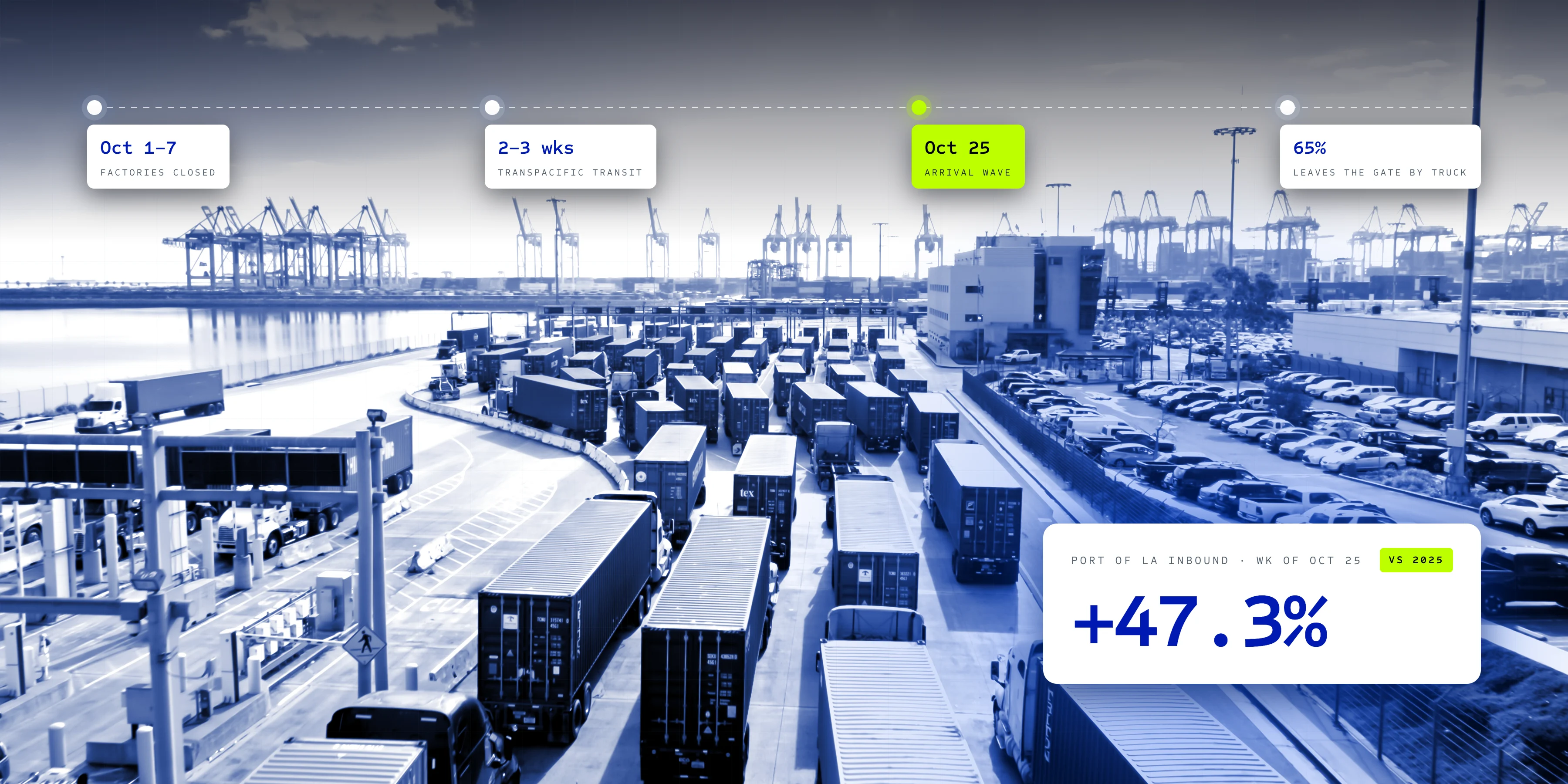
China's Golden Week closed factories from October 1 to 7, and the usual expectation is a lull in U.S. imports a few weeks later. This year the picture is more mixed. Carriers blanked fewer sailings than normal, the Port of Los Angeles just posted its busiest month on record, and inbound volume is holding into late October. Domestic truck capacity, meanwhile, is contracting steeply. Roughly two thirds of those containers leave the port on a truck.
Every October, freight coverage fills with the same story: Chinese factories close for the National Day holiday, carriers cancel sailings, and a few weeks later the volume drops off at U.S. ports. It is a real pattern, and it is almost entirely an ocean story.
The half that reaches domestic truckload happens after the box is on the ground, and this year it looks different from the headline.
Here is what the data shows.
Not directly. The effect is indirect and it runs on a lag.
Golden Week is a manufacturing and sailing event. It does not touch a domestic lane on its own. What it changes is the timing of when containers arrive at U.S. ports, first by pulling export bookings forward ahead of the shutdown, then by thinning sailings during it. Those two waves land at U.S. ports roughly two to four weeks later, and everything that arrives moves inland.
Unlike a port strike or a weather event, the timing sits on a published calendar.
The path runs through four steps, and each one is measurable.
This is the same transmission chain described in our earlier piece on how ocean disruption reaches domestic trucking. The difference with Golden Week is that nothing about it is a surprise.
Figures below were read on October 12, 2026. Port and rate data move weekly.
On the ocean, rates softened and the blanked sailings eased. Drewry's World Container Index assessed its composite at $4,351 per 40ft on October 8, down 2%, with Shanghai to Los Angeles at $7,624, down 3%. Drewry attributed the softness to weak demand during the Golden Week factory closures. It counted four blanked transpacific sailings announced for the following week, down from eleven the week before.
At the port, volume did not fall. The Port of Los Angeles handled 1,042,652 TEUs in September, up 18.07% year over year and its busiest month on record. Loaded imports came to 545,696 TEUs, up 18.62%. Its own three week forward outlook, published daily through the Port Optimizer Signal, showed 134,266 TEUs inbound for the week of October 11, 118,045 for the week of October 18, and 135,149 for the week of October 25. That last week sits 47.3% above the same week a year ago.
On the ground, capacity is contracting. The September Logistics Managers' Index, released October 6, put Transportation Capacity at 34.4, a drop of 5.6 points that the report calls a steep rate of contraction. Transportation Prices came in at 92.7, the fifth reading above 90 in six months. Anything below 50 on that scale indicates contraction.
The same report notes that inventories are largely still at the wholesale level rather than at retailers, and that the transfer between the two typically happens around mid October. Wholesale to retail movement is domestic truckload freight.
The step between an import number and a truckload number is the terminal gate, and the gate has its own math.
Across the Port of Los Angeles terminals, the average appointment success rate currently sits at 54%, ranging from 44% at the lowest terminal to 77% at the highest. Nearly half of attempts to book a drayage appointment do not land on the first try. Average truck dwell runs 3.3 days on a 30 day rolling basis.
A high arrival week therefore does not produce a smooth flow of trucks inland. It produces a queue, and the queue compresses freight into a narrower window. That compression is the condition under which routing guides fail and loads fall to the spot market, the same dynamic that sits underneath rising tender rejections on port adjacent lanes.
The effect is not limited to importers. Truckload capacity is a shared pool. When import freight pulls carriers toward port markets, fewer trucks are available elsewhere, and rates firm on lanes with no connection to a container.
Four parts of a procurement cycle come under pressure when arrival volume compresses. Emerge builds software in this category, so the capabilities named below are ours.
In a study of shippers using Dynamic Book It Now, which books spot loads against a live market benchmark across a large carrier network, 85% secured rates below market, averaging 8.5% below.
Emerge's marketplace carries 45,000+ pre-vetted carriers, which is the pool those loads are priced against when a routing guide drops a load during a tight window.
When is China's Golden Week, and when does it affect U.S. freight?
Golden Week ran October 1 to 7 in 2026, with work resuming October 8. The freight effect reaches U.S. ports on a lag. Cargo pushed out before the shutdown arrives roughly two to three weeks later on the West Coast, and any gap from cancelled sailings lands behind it. For domestic truckload, that means mid October through November.
Does Golden Week reduce U.S. truckload demand?
Not reliably, and not in 2026. The expected pattern is a volume dip a few weeks after the holiday. This year carriers cancelled fewer sailings than usual and the Port of Los Angeles projected inbound volume for the week of October 25 at 47.3% above the same week last year. The lull is not showing up in the forward data so far.
How much imported freight moves by truck rather than rail?
At the Port of Los Angeles in the week of October 11, 2026, 48,217 inbound containers were set to leave by local truck against 19,287 by on dock rail and 6,676 by off dock rail. That is about 65% moving by truck, which is why import arrival volume is a truckload capacity question and not only an ocean one.
Why do domestic rates move if a shipper imports nothing?
Because truckload capacity is shared. When import volume pulls carriers into port markets, fewer trucks are available elsewhere, and rates firm on lanes that never touch a container. A domestic shipper competes with import freight for the same capacity.
What is a mini bid?
A short, targeted contracting event covering a subset of lanes re-priced to the current market, run between annual RFPs. Rates from a mini bid are contracted and awarded to qualified carriers in a planned event, which is what separates it from spot coverage.
Golden Week is one of the few disruptions in freight that arrives on a published schedule. The ocean effect is covered every year. The domestic effect gets less attention, and it is the one that reaches shippers who never touch a container.
This year the data departs from the usual script. Fewer blanked sailings, a record month at the largest U.S. container port, inbound volume holding into late October, and a transportation capacity reading of 34.4. That combination does not describe a lull. It describes freight arriving on schedule into a market with little room.
Ready to reinvent your procurement strategy?


 SOC 2 Type II