
Follow us


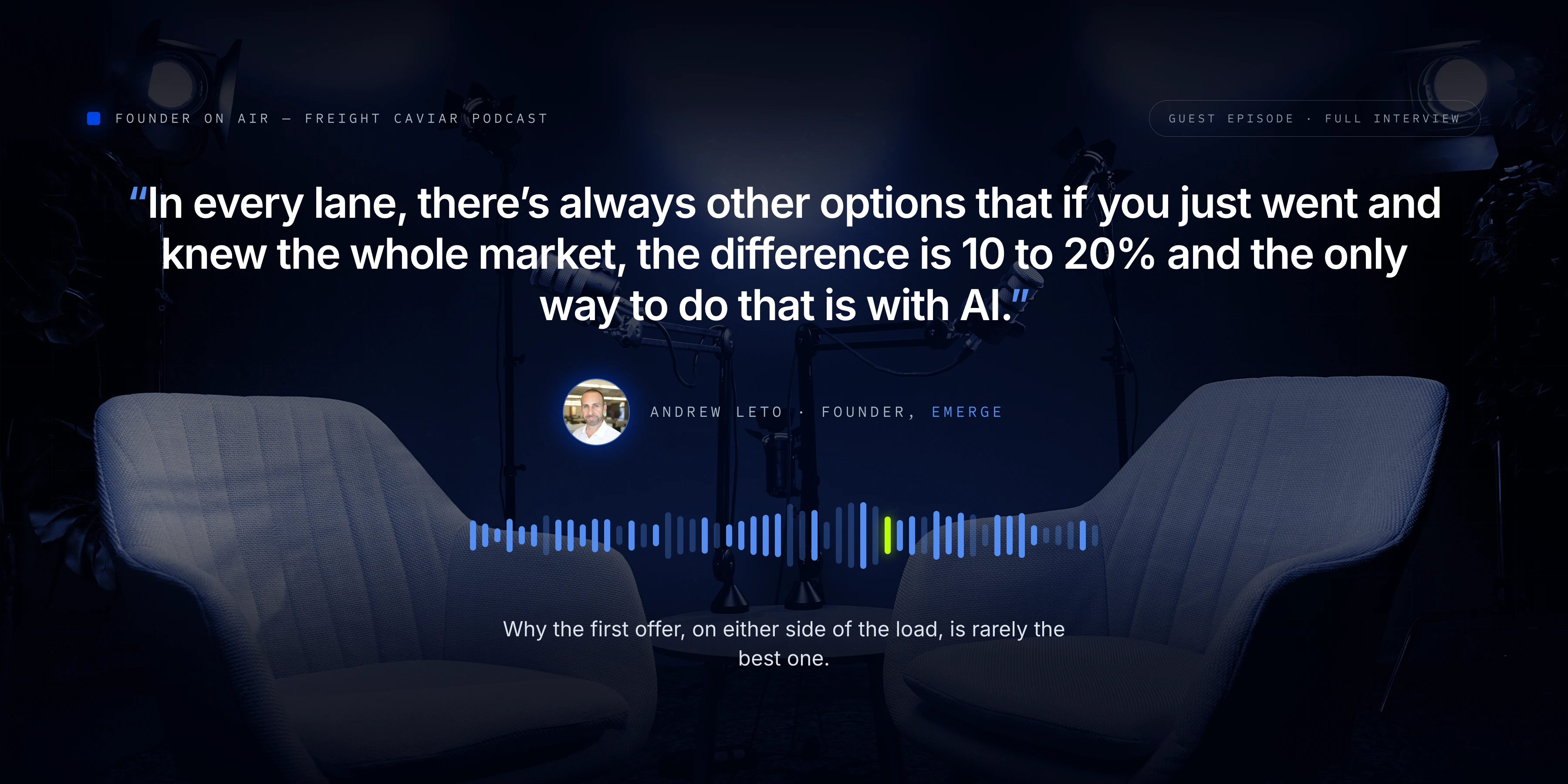
Emerge founder Andrew Leto joined The Freight Caviar Podcast to make one argument from both sides of the load: taking the first offer, the first broker who calls a carrier, or the first quote a shipper accepts, leaves 10 to 20% on the table, because on every lane the full market holds better options. Seeing that whole market at once, he argues, is only possible with AI.
Our founder Andrew Leto sat down with The Freight Caviar Podcast this week, and the conversation centered on a number worth stopping for: 10 to 20%. That, Andrew argues, is what gets left on the table when anyone in freight, carrier or shipper, transacts with the first option in front of them instead of the whole market.
Here's the moment Freight Caviar shared from the episode, in Andrew's words:
"The difference is massive. It's not $50 a load. It's the difference between 10 to 20% yield. Taking the first broker that calls you in the morning, which mostly– it's always been like that, he's gonna fill up half my trucks. The second broker is gonna fill up another 10% of my trucks, and then I'll post whatever I have left over on the load boards if I have to at the end of the day.
If you don't use AI you're constrained. I see it all day long with Emerge, because we're a shipper platform, and shippers use us and bring all their carriers and brokers and so we know rates and how it works. Sometimes even it's a 10 to 20% difference between the brokers.
In every lane, there's always other options that if you just went and knew the whole market, the difference is 10 to 20% and the only way to do that is with AI." — Andrew Leto, Founder, Emerge
What Andrew is describing on the carrier side is a habit as old as the industry: trucks get filled in the order the phone rings. The first broker of the morning takes half the fleet, the second takes another slice, and the leftovers go to the load boards. Every one of those decisions is made against the options visible in that moment, not against the market, and the gap between "first available" and "best available," in his telling, runs 10 to 20% of yield.
Nobody works that way because they're careless. They work that way because seeing the whole market in real time, every option on every lane, repriced constantly, was never humanly possible. That's the part that changed. As Andrew put it, knowing the whole market is now an AI problem, and it's a solved one.
Because the same blindness prices your freight, from the other direction.
Buried in the quote is the shipper-side version of the stat: across the carriers and brokers shippers bring onto the platform, pricing on the same freight can differ 10 to 20% between providers. A shipper taking the first workable quote is making the mirror-image mistake of the carrier taking the first morning call, transacting against the visible option instead of the market. The fix is the same on both sides: put every load in front of the whole market at once, with a live benchmark refereeing so everyone knows what fair looks like on that lane, that day.
That's been the argument behind Emerge from the start, and it's why the marketplace model serves both sides of the load: carriers see more freight than the morning's phone calls, shippers see more options than the incumbent's quote, and the 10-20% stops hiding.
The anecdote that explains the whole problem. Andrew recalls walking a major brokerage's floor around 2009 and asking its founder what the armies of people on the phones were doing. The answer: calling carriers to find out where they are. Fifteen years and billions in freight tech later, that's still a fair description of how much of the spot market runs, which is exactly the siloed-information problem the whole conversation circles.
The best pushback, and where it lands. The host raises the sharpest counterargument: some carriers want opacity. His example is a small reefer operator who deliberately withholds capacity until late in the day during produce season, timing the market on instinct, because the fog is his edge. It's a real objection, and the exchange lands somewhere shippers should note: as market visibility spreads, both expect rate bands to tighten and pricing to get more predictable rather than spiky. For anyone who has budgeted through this year's whipsaw, more predictable is not a small promise.
The full conversation is on the Freight Caviar Podcast, also available on Spotify and Apple Podcasts. It's Andrew's second visit with the Freight Caviar crew this year, following his Freight Gong Friday appearance, where he made the case that every shipper should run their own marketplace. This episode is the other half of that thesis.
What did Andrew Leto discuss on The Freight Caviar Podcast?
The Emerge founder argued that carriers taking the first loads offered, and shippers taking the first workable quotes, leave 10 to 20% on the table, because every lane holds better options that only become visible when you can see the whole market at once, which he describes as an AI problem.
What is the "first-call problem" in freight?
The industry habit of transacting in the order options appear: carriers fill trucks for the first brokers who call each morning, shippers accept the first workable quote. Each decision is made against the options visible in the moment rather than the full market, and the gap between first available and best available is the yield left behind.
Where can I listen to the full interview?
The Freight Caviar Podcast is available on YouTube, Spotify, and Apple Podcasts; search "Freight Caviar Podcast" on any of them for the full episode.
 SOC 2 Type II