
Follow us


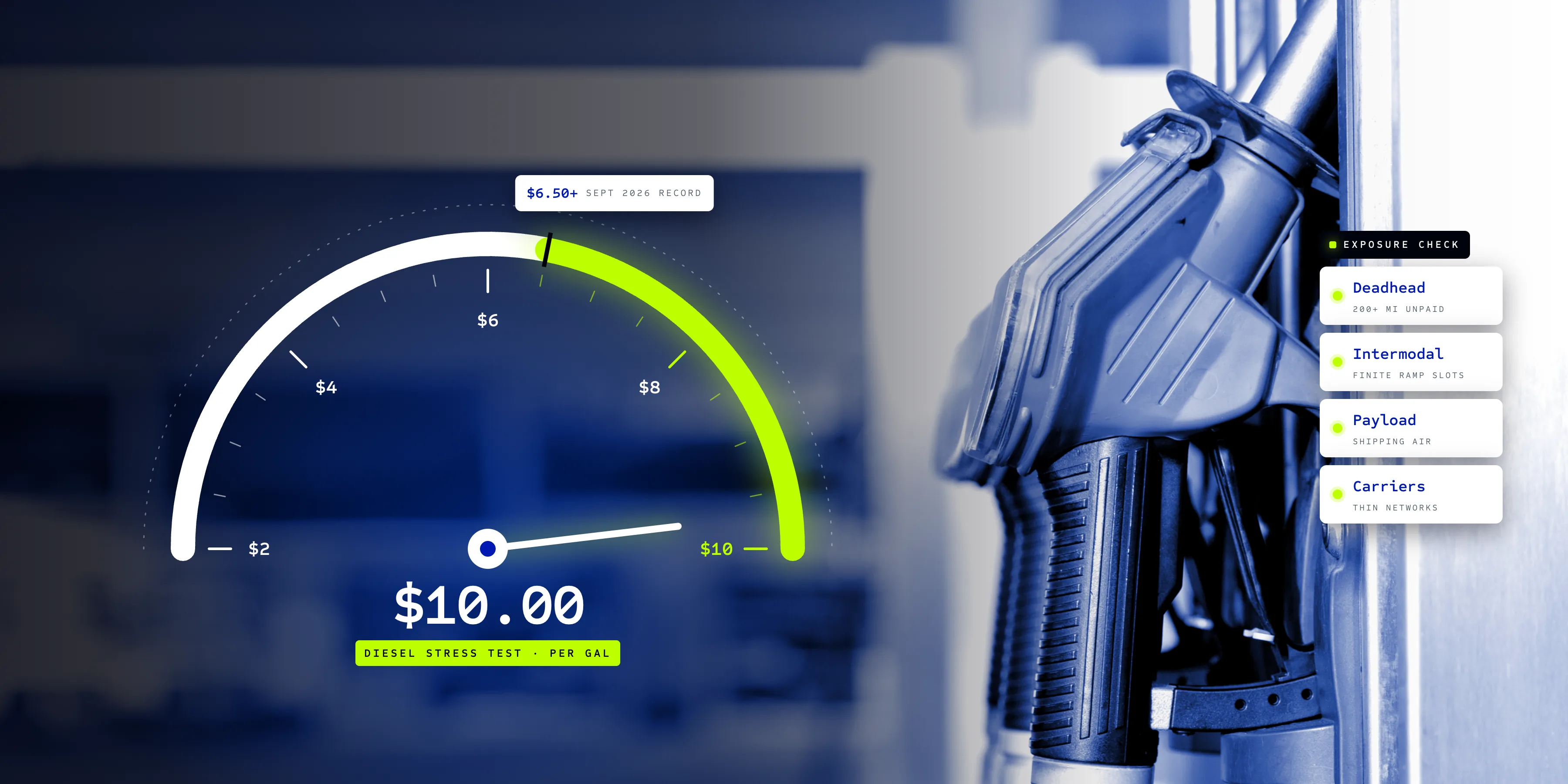
Diesel set an all-time record in 2026, and still, nobody is forecasting $10 per gallon. The scenario is worth running anyway, because it exposes weaknesses that exist at any price: fuel surcharges that cover loaded miles while deadhead goes unpaid, intermodal capacity that can't absorb a stampede, trailers running half full, and carrier networks too thin to hold pricing honest when leverage flips. The fixes are all cheaper now than they would be then.
Diesel spent September doing something it had never done. The national average broke the all-time record set back in June 2022, then kept climbing, topping $6.50 per gallon before easing. Even off the peak, it's still running above the old record, which means every fuel matrix in the industry is working harder than it was built to.
Nobody is predicting $10 per gallon, but let's get into the hypothetical. After a year that keeps breaking fuel records is exactly when a stress test could be warranted. Banks run them on balance sheets, engineers run them on bridges, and freight networks deserve the same treatment. Because here’s the thing about the weak points a stress test finds: they aren’t created by the extreme. They’re already in your network at whatever diesel costs this morning, and the extreme just makes them too expensive to keep ignoring.
So, ten dollars per gallon. What would actually happen?
If you asked most shippers, the first answer would probably be some version of "that's what the fuel surcharge is for." The matrix adjusts weekly, the surcharge floats with the national average, so the exposure is handled, right?
On paper, yes. In a truck, not quite.
A fuel surcharge pays for the loaded move, but it doesn't pay for everything the truck did to get there. Chris Kozak, our Director of Carrier Strategy, has a real-world version of this that he sees from the carrier side. Take a carrier servicing a location like Holcomb, Kansas, or Lexington, Nebraska, where, in his words,
"their average deadhead to service that location is over 200 miles."
The shipper on that freight can have a well-built fuel surcharge and still miss the exposure, because if the carrier priced the lane six months ago, those 200-plus empty miles were priced on six-month-old fuel assumptions, and the surcharge on the loaded move never reimburses them. Push fuel far enough past the old assumptions and that carrier is upside down on the rate, surcharge and all.
When that happens, you usually find out one of two ways: the carrier comes back asking for rate relief, or they quietly stop showing up for the freight that loses them money. Milder versions of this happen in ordinary fuel markets. At ten dollars, it would be the defining feature of the market. Your surcharge line would keep adjusting right on schedule, and it would keep measuring the wrong thing: the miles you can see on the invoice, not the miles the carrier actually ran.
Honestly, a lot of freight would try, and the instinct isn't wrong. Rail moves a ton of freight on a fraction of the fuel, and economics that look merely attractive today would start to look mandatory at ten dollars.
The problem is what happens when everyone has the same idea at the same time. Intermodal capacity is finite: so many containers, so many railcars, so many slots out of the ramps near your freight. When a lot of volume rushes toward a fixed resource, the resource gets expensive, fast. The shippers who'd come out ahead in that scramble are the ones who converted suitable lanes early, not the ones showing up in week three asking what's still available. And some freight was never going to convert anyway, whether because of lane length, service requirements that can't flex, or drayage on both ends eating whatever the linehaul gained.
There's a quieter constraint underneath that one, too. A meaningful share of truckload capacity runs on thin margins and floating fuel exposure, and it's fair to ask how much of it could ride out that kind of volatility at all; some of that capacity wouldn't reprice so much as leave.
So yes, intermodal would help, and it's worth scoping now rather than in the middle of a squeeze, as long as you treat it as a lever rather than an exit. The scoping part is also more practical than it used to be, since intermodal contract bids run in Emerge alongside your truckload events, so finding out which lanes actually convert doesn't mean standing up a second process.
This is where the conversation gets practical, because the freight that can't switch modes has one big dial left to turn: how efficiently it uses the trucks it's on.
At ten dollars, trailers running half full stop being a scheduling quirk and become a cost nobody wants to own in a budget meeting. The focus turns to filling trailers and not shipping air, and payload per gallon becomes a number people actually track. Some long-standing habits would get hard questions too. Delivery frequency is a good example: five light deliveries a week is a service choice, but it's also a fuel choice, and under enough pressure, three fuller deliveries start to look like the smarter trade rather than a downgrade.
The same math reaches the network itself. How far does your freight originate from your distribution centers? How many empty miles does the design create? Do the providers you work with see enough freight around yours to fill the gaps? These are questions worth having answers to at any fuel price, which is the slightly uncomfortable part of the exercise: the hypothetical doesn't create the waste, it just raises the cost of leaving it alone.
This is also where the scenario stops being about fuel, really, and becomes about leverage.
A spike like that wouldn't arrive by itself. It would come with capacity thinning as marginal operators exit, with tender acceptance getting shakier, and with pricing power swinging toward whoever still has trucks on the road. In that kind of market, the gap between shippers gets wide. Everyone pays more, but the shippers with deep carrier networks pay a competitive price. The ones leaning on a short list, or a single provider, pay whatever they're quoted, because the alternative is freight that doesn't move.
Which gets to the real question hiding inside this whole exercise, and it has nothing to do with diesel: is your carrier count right for a market that turns on you, and how fast could you expand the network if you needed to? Networks don't get built mid-emergency. The shippers who'd come through ten-dollar diesel in decent shape are the ones building depth and competition into their routing guides now, while diesel costs whatever it costs today.
That depth gets built faster than most shippers assume. Over one 60-day span, shippers awarded 355 primary and 172 backup lanes to vetted carriers from the Premier Carrier Program, capacity added from beyond their own incumbent networks, and roughly a third of those awards were backup coverage put in place before any lane had failed.
Keep its to-do list. Four questions worth asking this quarter, useful at any pump price:
None of these require believing in $10 diesel. They just require noticing that the answers are worth having at every price between here and there.
Is $10 diesel actually likely?
No one credible is forecasting it, and this scenario isn't a prediction. It's a stress test: an extreme input that makes existing network weaknesses, surcharge gaps, deadhead exposure, thin carrier competition, visible enough to act on. The value is the exposure map it produces, which is accurate at today's prices too.
Why doesn't a fuel surcharge fully protect against fuel spikes?
Because a surcharge reimburses fuel on loaded miles, while a carrier's real fuel cost includes deadhead, repositioning, and idle time that never appear on the invoice. Rates priced months earlier under lower fuel assumptions can go upside down even with a surcharge attached, which shows up as rate-relief requests and declined freight rather than a clean line item.
Would intermodal absorb freight if diesel spiked severely?
Some of it, for the shippers who moved early. Intermodal's fuel efficiency makes it the natural first response, but container, railcar, and ramp capacity are finite, so a sudden surge would tighten availability and raise intermodal pricing quickly. Lanes with the right length, service tolerance, and drayage economics convert well; much freight doesn't fit at all.
How can shippers reduce fuel-driven freight costs now?
Map and price deadhead exposure in network design, scope which lanes could convert to intermodal before it's urgent, improve trailer utilization and revisit delivery frequency where it forces light loads, and build enough carrier competition into every lane that pricing stays competed rather than quoted. Each of these lowers cost at current prices and compounds in any spike.
Ten-dollar diesel is a thought experiment, and ideally it stays one. The weaknesses it points at are real right now, though: surcharges measuring the wrong miles, conversions nobody has scoped, trailers shipping air, networks one market turn away from becoming price takers.
Run the stress test on your own network, keep the list, and start on it at today's prices. The scenario is hypothetical, but the exposures it points to are not.
 SOC 2 Type II