
Follow us


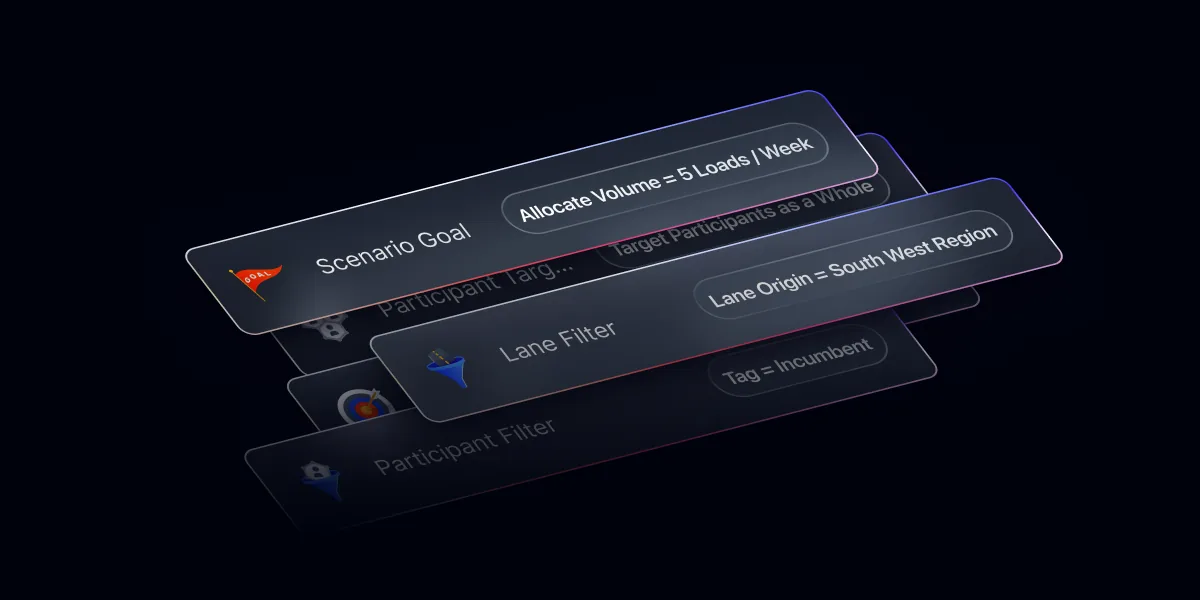
Freight procurement is a complex puzzle, and understanding how to optimize costs is just the starting point. In this educational discussion, we dive deeper into the strategies top shippers are using to balance cost with other critical objectives. Amy Elgart, our Group Product Manager, explains how shippers leverage business rules—known as constraints—to fine-tune their freight strategies and achieve their unique business goals.

About Amy Elgart
Amy Elgart is our Group Product Manager, responsible for meeting with our top shippers to get a pulse on the problems they face every day
There are two main ways to approach it:

It’s actually rare for our shippers to only focus on Lowest Cost. Most use a hybrid approach: run a Lowest Cost Scenario first, then layer in rule-based constraints to fine-tune the results because each shipper has unique needs for their business that they need to account for like maintaining relationships or achieving high levels or service.
Constraints let you tailor your freight decisions to fit your business needs. They help you go beyond just cost savings and focus on priorities like working with specific carriers, meeting certain service standards, or spreading your volume across multiple providers. Think of it like setting the rules to make sure you're getting exactly what you need out of your freight procurement, whether that’s keeping a certain carrier involved or balancing capacity more effectively. Constraints help you keep everything in line with what you're trying to achieve.
Yes, you might create a rule to “favor incumbents” or “only award lanes to carriers offering special services.” Which might mean paying above the lowest rate on some lanes, but worth it for the strategic benefits.
Here’s the thing: Analyzing these constraints would be really complex if you were doing it with spreadsheets and emailed responses. This isn’t a problem with ProcureOS because all the responses are in one central location and EmergeAI guides you through building the constraints, helping you quickly identify and fix any issues, so everything works smoothly.
Constraints built with EmergeAI pass validation, meaning they have to work with your data and other rules. If something doesn’t add up—like asking for two carriers on a lane that only got one bid. Emerge guides you through this process, helping you quickly identify and fix any issues, so you can trust that your proposed goals will actually work.
Definitely. The key is planning ahead:
Also, filters are your best friend. Let’s say you want to only award lanes to incumbents with a grade above 90%. You can layer those filters to make sure the rule applies exactly where it should.
Over the past six months, we’ve seen three big ones:
Some shippers get more specific, like awarding more participants on high-volume lanes or setting rules for special services like white-glove delivery.
It’s all about balance. You’re trying to get the best cost while meeting service goals and keeping relationships strong. Start with a baseline, know your rules, and validate your setup to make sure everything runs smoothly.
 SOC 2 Type II